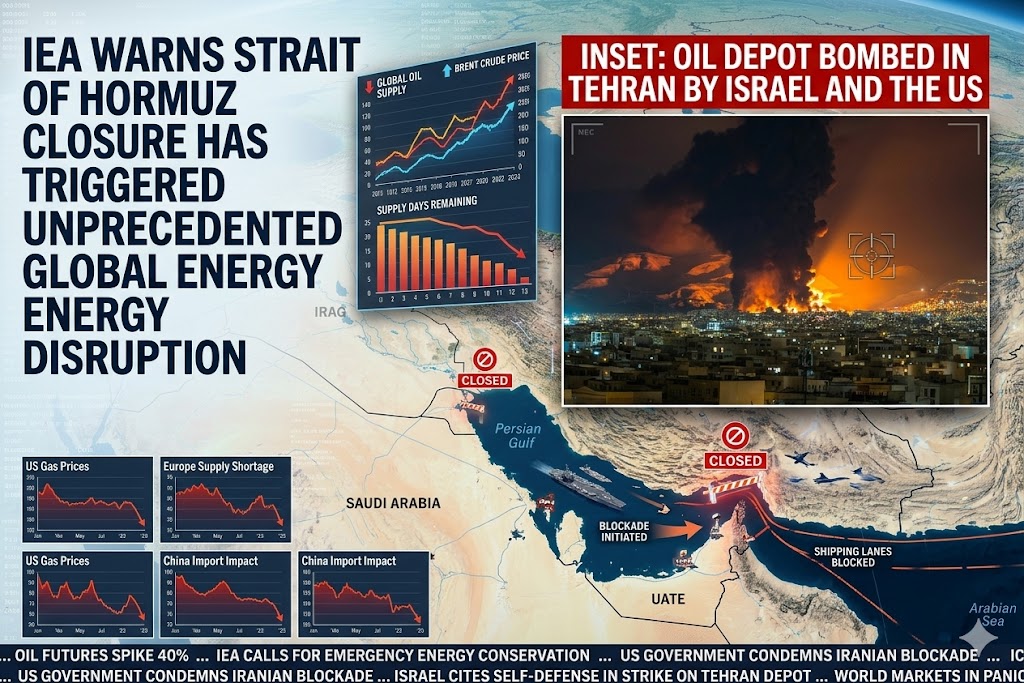
Dubai, April 7 — The closure of the Strait of Hormuz has caused what the International Energy Agency (IEA) describes as the most severe disruption to global energy supplies on record, as tensions in the Middle East continue to escalate.
Fatih Birol said the scale of the crisis surpasses previous energy shocks, including those in 1973, 1979, and 2022. The strait, a critical maritime corridor linking the Persian Gulf and the Gulf of Oman, typically carries around 20% of the world’s oil and gas shipments, but has been effectively closed following Iran’s response to joint U.S.-Israeli military operations launched in late February.
“The world has not experienced a disruption of this magnitude before,” Birol said in an interview with French media, warning that the consequences would be felt globally.
Prices Surge, Global Economy Under Pressure
Energy markets have reacted sharply, with oil and gas prices rising significantly amid fears of prolonged supply shortages. Analysts warn that the disruption could intensify inflationary pressures worldwide, particularly in developing economies that are more vulnerable to rising fuel and food costs.
IEA member states have begun releasing strategic reserves in an effort to stabilize markets, though officials caution that such measures may only offer temporary relief if the disruption continues.
Nuclear Safety Concerns After Strikes Near Bushehr
Separately, concerns have grown over nuclear safety following reported strikes near Iran’s Bushehr Nuclear Power Plant, the country’s only operational nuclear reactor.
Rafael Grossi warned that military activity near nuclear facilities poses serious risks, including the potential for a radiological incident with cross-border consequences. Satellite analysis confirmed impacts near the site, although no direct damage to the reactor has been reported.
Russia, which has technical involvement at the facility, warned that continued strikes could lead to a disaster with far-reaching implications, urging an immediate halt to hostilities.
Escalating Rhetoric Ahead of Deadline
The developments come as U.S. President Donald Trump has set a deadline for Iran to reopen the strait, warning of potential military action targeting energy and transport infrastructure if the blockade continues.
Iran has rejected proposals tied to the reopening of the waterway, with officials stating that any agreement must include broader conditions such as an end to hostilities, sanctions relief, and guarantees for safe passage through the strait.
Market Volatility and Uncertain Outlook
Global financial markets have shown increased volatility in response to the crisis. Benchmark crude prices have climbed sharply, with Brent and West Texas Intermediate both trading at elevated levels as investors assess the risk of prolonged disruption.
Despite ongoing diplomatic efforts, progress toward a ceasefire remains limited, leaving the outlook uncertain as geopolitical tensions continue to shape energy markets and global economic stability.