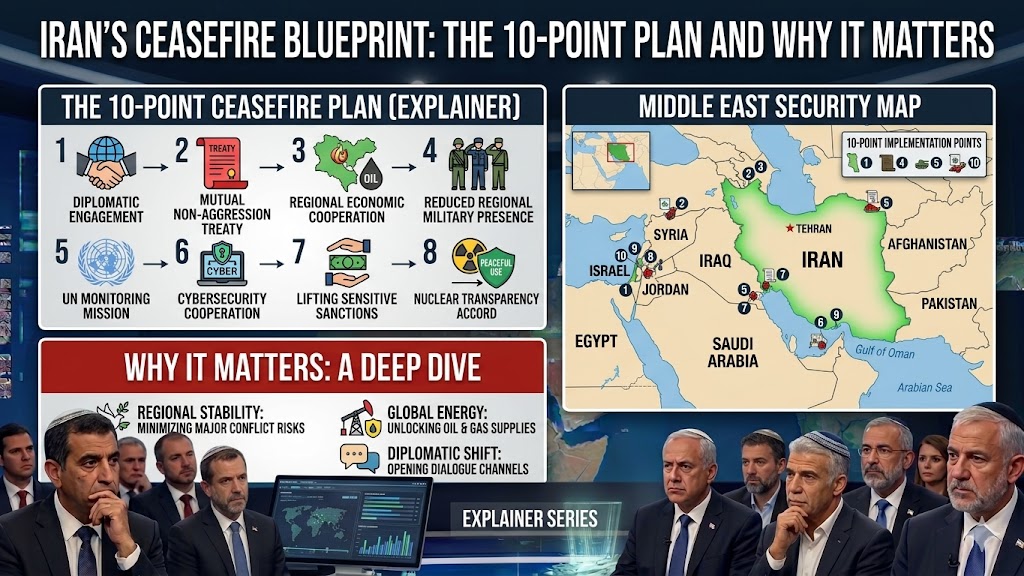
Washington/Tehran, 8 April — The United States and Iran have agreed to a temporary two-week ceasefire, opening a window for negotiations based on a proposal put forward by Tehran. The plan, described by U.S. President Donald Trump as a “workable basis” for talks, outlines a series of conditions that could shape the next phase of diplomacy.
What Is in Iran’s Proposal?
According to Iranian state-linked reporting, the plan includes several key demands:
- Removal of U.S. sanctions on Iran
- Continued Iranian oversight of the Strait of Hormuz
- Withdrawal of U.S. forces from the Middle East
- A halt to attacks on Iran and its regional allies
- Release of Iranian financial assets held abroad
- A binding resolution through the United Nations
Some versions of the proposal also reference Iran’s nuclear program, including continued uranium enrichment, though details have varied across different language releases.
Implications for the Strait of Hormuz
Iranian officials have indicated that shipping through the strait would resume under managed conditions, though the extent of control remains unclear. The waterway is a critical route for global energy supplies, carrying roughly one-fifth of the world’s oil.
Reports suggest that Iran may seek to regulate transit and potentially introduce fees, with proceeds directed toward reconstruction. Analysts note that any continued control over the strait could remain a point of contention in negotiations.
Will the U.S. Accept the Terms?
Despite the ceasefire, significant differences remain between Washington and Tehran. Analysts say several of Iran’s demands—particularly regarding control of the strait and U.S. military withdrawal—are likely to face resistance.
Chris Murphy said in a televised interview that any arrangement granting Iran authority over the strait would have major global implications, highlighting concerns among U.S. policymakers.
Trump has not publicly endorsed specific elements of the proposal but indicated that the United States would play a role in ensuring stability and navigation in the region.
Israel’s Position
Israel has expressed conditional support for the ceasefire. Prime Minister Benjamin Netanyahu said backing depends on Iran reopening the strait and halting attacks on Israel and its allies. Israeli officials also emphasized that operations related to Lebanon are not covered under the current arrangement.
What Happens Next?
Diplomatic efforts are expected to continue, with Pakistan playing a mediating role. Prime Minister Shehbaz Sharif has invited representatives from both countries to participate in talks in Islamabad.
China is also believed to be encouraging de-escalation, reflecting its economic interests in regional stability.
Outlook
While the ceasefire has reduced immediate tensions, analysts caution that the path to a lasting agreement remains uncertain. The proposal is likely to serve as a starting point for negotiations rather than a final settlement, with key issues—including energy security, sanctions, and military presence—still unresolved.