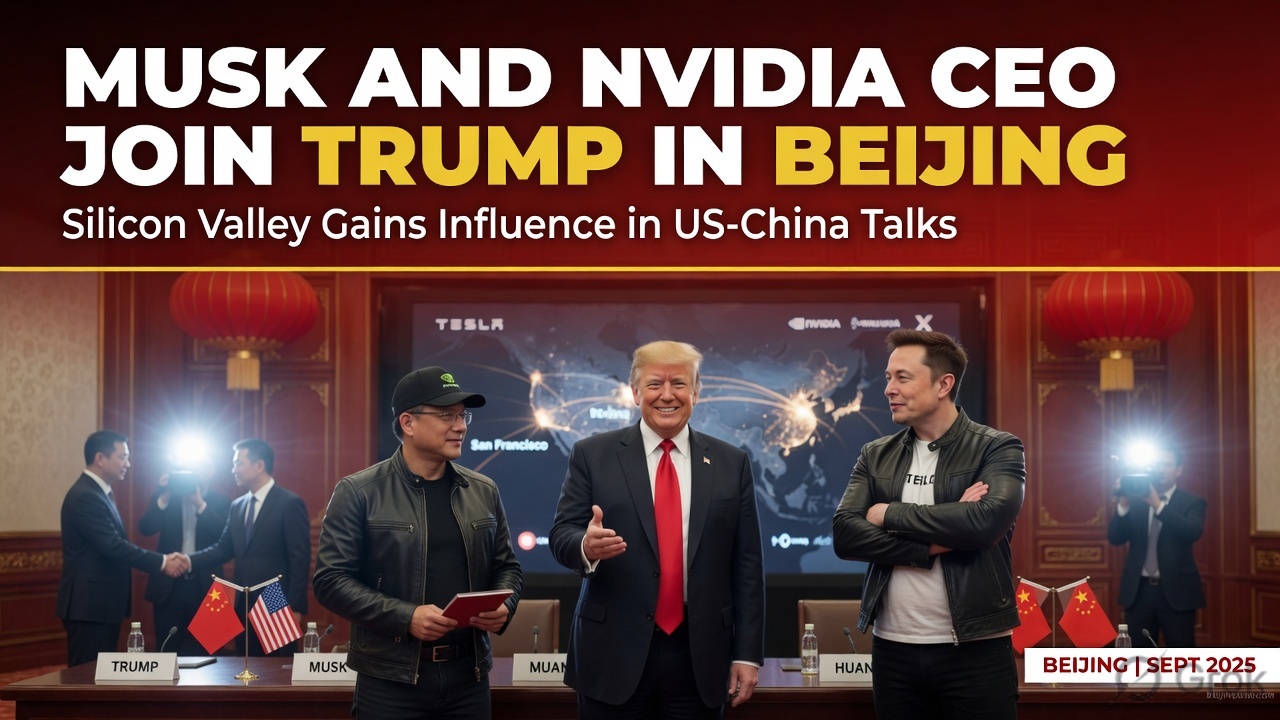
San Francisco – 15 May 2026
Elon Musk, Nvidia CEO Jensen Huang and several leading American technology executives joined President Donald Trump in Beijing this week for high-level talks with Chinese President Xi Jinping, signalling a growing role for Silicon Valley in shaping US-China relations.
The executives participated in discussions involving semiconductor export controls, tariffs and the future of technology trade between the world’s two largest economies.
While the White House publicly described their presence as part of the broader economic delegation, analysts say the arrangement reflects a major shift in how American foreign policy is increasingly intersecting with corporate technology interests.
Tech Leaders Move Closer to the Negotiating Table
The involvement of senior technology executives comes as tensions between Washington and Beijing remain heavily focused on advanced semiconductors, artificial intelligence and supply chain control.
Nvidia has spent months navigating US export restrictions that limit the sale of advanced AI chips to Chinese companies. Those restrictions have become a central part of Washington’s national security strategy toward China.
At the same time, Musk’s Tesla maintains significant manufacturing operations in Shanghai, giving the billionaire entrepreneur direct exposure to tariff policies and trade negotiations between both governments.
Analysts note that the executives attending the summit were not merely symbolic participants. Many represented companies with billions of dollars tied directly to the outcome of trade and technology agreements being discussed behind closed doors.
AI and Chips at the Centre of US-China Tensions
Since returning to office, the Trump administration has expanded restrictions on advanced semiconductor exports to China while also pushing aggressively to strengthen domestic AI infrastructure.
That strategy has created competing pressures inside the technology sector. American firms are attempting to maintain access to one of the world’s largest markets even as Washington tightens national security controls on critical technologies.
Industry observers say those tensions are becoming increasingly difficult to manage through traditional diplomatic channels alone.
Reports this week suggesting that Nvidia may receive approval for limited chip-related clearances involving certain Chinese firms added to speculation that corporate lobbying and high-level diplomacy are becoming more closely connected.
Silicon Valley’s Growing Political Power
The Beijing summit has also intensified debate in Washington over the growing influence of technology executives in foreign policy decisions.
Traditionally, summit-level negotiations involving national security and trade policy have been led primarily by diplomats, intelligence officials and cabinet members.
The direct participation of major corporate leaders marks a noticeable shift toward a model where technology companies play a more active role in geopolitical negotiations.
Supporters argue that closer coordination between government and industry is necessary in an era where AI, semiconductors and global supply chains have become central to economic and national security.
Critics, however, warn that allowing companies with major financial interests to participate directly in sensitive negotiations could blur the line between public policy and corporate influence.
For now, the summit highlights a broader reality taking shape across global politics: technology companies are no longer just economic actors. Increasingly, they are becoming diplomatic players in their own right.