What every SEO professional needs to do in the next 90 days – and what you absolutely must not
Published June 2, 2026; Mountain View, California – The Day the Rollout Completed
At 8:40 AM PDT on May 21, Google flipped a switch.
Twelve days later, that switch finished reshaping the search results across millions of websites.
It completes itself on June 2, 2026. It follows the March 2026 core update, the March 2026 spam update, and the February 2026 Discover update, as per IMARC.
Some publishers woke up to find 30% of their organic traffic gone.
Others watched pages that had sat quietly on page two for years suddenly climb into the top three positions.
Both groups experienced the same update.
Only one group was prepared for it.
The May 2026 Core Update may eventually be remembered as the update that accelerated a trend Google has been signaling for years:
Originality beats optimization.
Experience beats aggregation.
Brand strength beats SEO shortcuts.
And content that merely exists is increasingly losing ground to content that deserves to exist.
What Actually Happened?
Google officially launched the May 2026 Core Update on May 21 and completed the rollout on June 2. Like all core updates, Google described it in familiar language:
“A regular update designed to better surface relevant, satisfying content for searchers.”
That statement sounds routine.
The reality was anything but.
SEO monitoring platforms reported significant volatility across industries, with some of the largest ranking shifts seen since the Helpful Content era began.
This wasn’t a penalty.
And that distinction matters.
Google didn’t punish websites.
It reassessed them.
Pages that declined weren’t necessarily “bad.”
Pages that improved weren’t necessarily “better optimized.”
Google simply recalculated which pages deserved visibility based on a changing understanding of relevance, expertise, trust, and usefulness.
Pages that gain were not rewarded for a trick – they matched what Google now considers higher-quality relevance signals more closely than before. (Source: Nexdigm)
That difference changes how publishers should respond.
You don’t fight a penalty.
You learn from a recalibration.
The Scale of the Shake-Up
If you felt like rankings moved everywhere, you weren’t imagining it.
Recent industry studies suggest that nearly 90% of top-10 search results experienced some degree of movement during major 2026 updates.
Think about that for a moment.
Nine out of ten results.
According to SE Ranking data, 79.5% of URLs in top-three positions shifted during the March 2026 rollout, up from 66.8% in the December 2025 update. In the top 10, 90.7% of URLs shifted, compared to 83.1% in December. Only 20.5% of top-three URLs held their exact positions during March.
(Source: Mordor Intelligence)
May 2026 is showing similar or slightly higher volatility based on the early days of the rollout. To put that in plain language: if you are looking at any competitive keyword today, there is roughly a 90% chance the top 10 results have moved at least one position since May 21, and an 80% chance the top three have completely reshuffled.
This is not a small update.
When volatility reaches that level, the conversation can no longer be about isolated ranking factors.
We’re looking at a broader shift in how Google evaluates content quality.
And once the dust settled, a clear pattern began to emerge.
The Winners and Losers Were Surprisingly Predictable
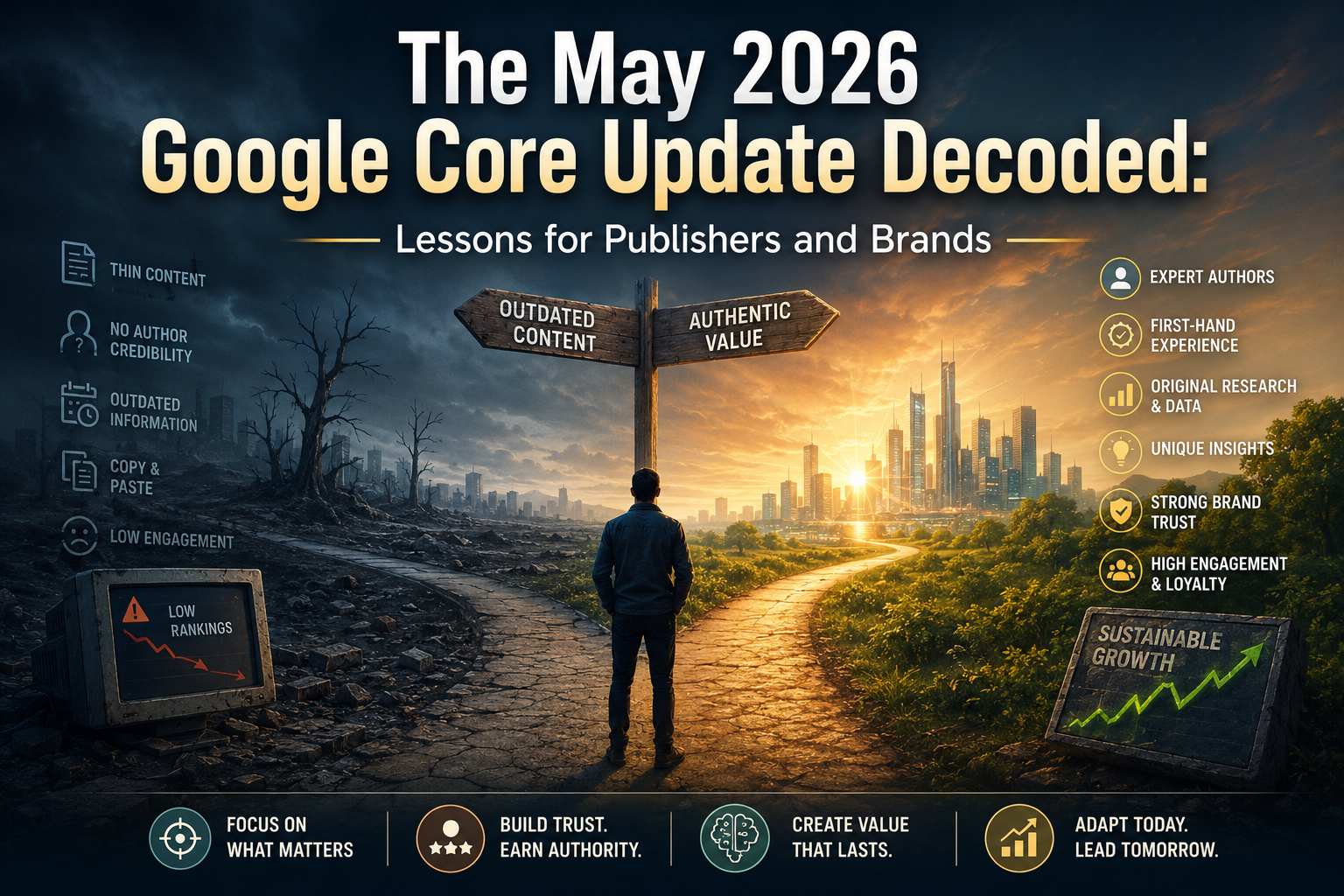
The winners looked remarkably similar.
They had identifiable authors.
They demonstrated first-hand experience.
They included original research, unique data, expert interviews, product testing, or proprietary insights.
Most importantly, they gave readers something they couldn’t find elsewhere.
The losers shared their own set of common traits.
Many relied heavily on templated content.
Many published articles that looked almost identical to competing pages.
Many had weak authorship signals, thin updates, and little evidence of real-world expertise.
Notice what’s missing from both lists.
Backlinks alone didn’t guarantee protection.
Domain authority alone didn’t guarantee success.
Keyword optimization alone didn’t guarantee rankings.
The May 2026 update continued a trend that has become impossible to ignore:
Google increasingly rewards value creation over content production.
Lesson #1: Google Is No Longer Ranking Articles. It Is Ranking Evidence.
For years, publishers could succeed by publishing comprehensive summaries of existing information.
Read ten articles.
Write an eleventh.
Rank.
That model is becoming less effective.
The pages gaining visibility today increasingly contain evidence.
Original testing.
Unique research.
Industry surveys.
Case studies.
Expert interviews.
First-hand experience.
Imagine two reviews targeting the same keyword.
One summarizes information collected from manufacturer websites.
The other documents thirty days of real-world testing, includes screenshots, highlights unexpected problems, and compares actual user experiences.
Which one would you trust?
More importantly, which one would Google trust?
The answer explains much of what happened during this update.
Lesson #2: E-E-A-T Is Becoming Measurable
Experience, Expertise, Authoritativeness, and Trustworthiness were once treated as abstract concepts.
Today they appear increasingly operational.
Publishers should ask difficult questions.
Does every important article have a real author?
Can readers verify that author’s credentials?
Would an expert in the field publicly stand behind the content?
A finance article signed by a certified financial planner sends a stronger signal than one attributed to “Editorial Team.”
A medical article written by a practicing physician carries more weight than anonymous health content.
Google is steadily moving toward rewarding visible expertise.
Anonymous content is becoming a competitive disadvantage.
Lesson #3: Information Gain Is Becoming a Ranking Advantage
The most valuable question publishers can ask today is:
“What does this article contribute that doesn’t already exist?”
Many articles explain.
Very few contribute.
Suppose you publish an article about content marketing.
One version repeats common advice found on every marketing blog.
Another analyzes 100 campaigns and reveals patterns nobody has published before.
The second article creates information gain.
It adds something new to the internet.
And increasingly, that appears to be exactly what Google wants.
The future belongs to publishers who generate knowledge, not simply organize it.
Lesson #4: Brand Is Becoming an SEO Asset
One of the clearest signals emerging from recent updates is the growing importance of brand strength.
Strong brands benefit from something smaller publishers often overlook:
People search for them directly.
They have loyal audiences.
They generate repeat visitors.
They earn mentions across the web.
Those signals create trust.
This means modern SEO cannot exist in isolation.
The publishers thriving after core updates are often investing heavily in:
- newsletters
- LinkedIn audiences
- podcasts
- YouTube channels
- communities
- email subscribers
In 2026, SEO increasingly follows brand building rather than replacing it.
Lesson #5: AI Overviews Are Changing the Rules
The rise of AI-generated search experiences is quietly transforming content strategy.
Many informational queries are now answered directly within search results.
That means ranking first may no longer guarantee traffic.
Publishers must create content that AI systems want to cite.
That means:
- clear definitions
- expert commentary
- trustworthy facts
- structured explanations
- concise answers
You’re no longer writing solely for human readers.
You’re also writing for AI systems deciding which sources deserve visibility.
The websites that understand this shift early will have a significant advantage.
Lesson #6: Updating Content Is Becoming More Valuable Than Publishing More Content
Many publishers still operate under a volume mindset.
Publish more.
Publish faster.
Publish constantly.
Yet some of the biggest opportunities now sit inside existing content libraries.
Thousands of websites are filled with outdated statistics, broken references, obsolete screenshots, and articles that haven’t been touched in years.
These pages quietly become trust liabilities.
Often, updating twenty high-performing articles creates more impact than publishing fifty new ones.
Fresh examples.
Updated research.
Current expert opinions.
New visuals.
Recent case studies.
Those improvements compound over time.
Maintenance is becoming a competitive advantage.
Lesson #7: The Biggest Risk Is Looking Like Everyone Else
This may be the most important lesson of all.
Google is getting better at identifying patterns.
If your article follows the same outline, cites the same sources, uses the same examples, and answers the same questions as every competing page, why should it rank higher?
Publishers need a new editorial mindset.
Stop asking:
“What keyword should we target?”
Start asking:
“What can we say that nobody else can?”
That question leads to:
- original research
- interviews
- experiments
- customer data
- proprietary frameworks
- field experience
And those are precisely the assets that competitors cannot easily copy.
The Real Message Behind the May 2026 Core Update
The May 2026 Core Update did not introduce a new philosophy.
It accelerated an existing one.
Google is steadily moving away from rewarding content that merely exists and toward rewarding content that demonstrates:
- experience
- originality
- expertise
- trust
- evidence
- brand authority
For publishers and brands, the implication is clear.
The era of publishing for algorithms is ending.
The era of publishing for credibility has arrived.
The websites that win over the next five years will not be the ones that produce the most content.
They will be the ones that create the most value.
And that is perhaps the most important SEO lesson of 2026.