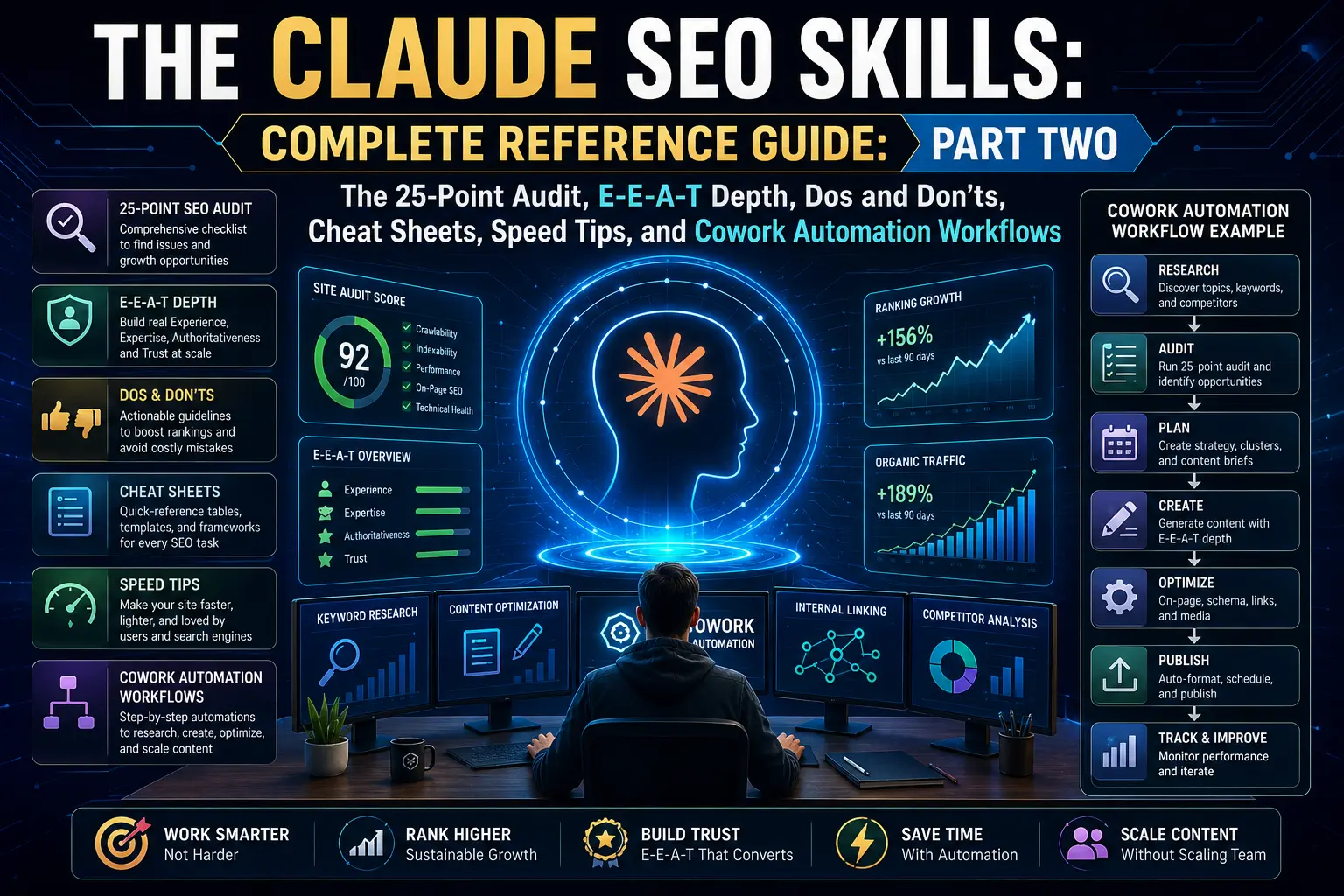
The 25-Point Audit, E-E-A-T Depth, Dos and Don’ts, Cheat Sheets, Speed Tips, and Cowork Automation Workflows
Continued from “THE CLAUDE SEO SKILLS: COMPLETE REFERENCE GUIDE: PART ONE”
THE 25-POINT AUDIT FRAMEWORK
This is the complete checklist Claude works through when you run the master URL audit prompt. Understanding the framework lets you ask better follow-up questions and catch any points the initial output may have covered too briefly.
The 25 points are organised into four categories: On-Page (7 points), Content (6 points), Technical (8 points), and Strategy (4 points). They are also classified by priority: High (11 points), Medium (11 points), and Low (3 points).
Audit Point – Category – Priority
01 — Title tag: length, keyword presence, click appeal — On-page — High
02 — Meta description: persuasiveness, keyword, CTA — On-page — High
03 — H1 tag: uniqueness, keyword match, clarity — On-page — High
04 — H2/H3 hierarchy: logical structure, variants — On-page — Medium
05 — Primary keyword placement: title, first 100 words, subheadings — On-page — High
06 — Keyword density: natural usage — On-page — Medium
07 — Semantic keyword coverage: related entities — On-page — Medium
08 — Content depth: word count vs top competitors — Content — High 0
9 — Search intent match: informational/commercial/transactional — Content — High
10 — Content gaps: subtopics competitors cover that you miss — Content — High
11 — Content freshness: last updated signals — Content — Medium
12 — E-E-A-T signals: author bio, credentials, citations, trust — Content — High
13 — FAQ / structured Q&A: for snippets and AI citation — Content — Medium
14 — Internal links out: links to relevant site pages — Technical — Medium
15 — Internal links in: other pages linking to this one — Technical — Medium
16 — URL structure: clean, keyword-inclusive — Technical — Low
17 — Image alt text: descriptive, keyword-relevant — Technical — Medium
18 — Page speed: Core Web Vitals signals — Technical — Medium
19 — Mobile content adequacy: same content on mobile — Technical — Medium
20 — Schema markup: FAQ, Article, HowTo, Author — Technical — Medium
21 — Canonical tag: correct version — Technical — Low
22 — Competitor benchmark: comparison to top 3 SERP results — Strategy — High
23 — SERP snippet preview: title and meta display — Strategy — Medium
24 — GEO readiness: structured for AI citation — Strategy — High
25 — Priority action matrix: top 5 by impact vs effort — Strategy — High
Category breakdown: On-page 7 points, Content 6 points, Technical 8 points, Strategy 4 points. Priority breakdown: High 11 points, Medium 11 points, Low 3 points.
THE E-E-A-T LAYER – WHY IT NOW DOMINATES EVERY AUDIT
E-E-A-T stands for Experience, Expertise, Authoritativeness, and Trustworthiness. It was introduced as E-A-T in Google’s Search Quality Rater Guidelines in 2014, with “Experience” added in December 2022 (source: Google Search Central; Mailchimp E-E-A-T Guide; LinkBuilder.com E-E-A-T Guide, June 2026).
Google’s Quality Rater Guidelines state explicitly: “Trust is the most important member of the E-E-A-T family because untrustworthy pages have low E-E-A-T no matter how Experienced, Expert, or Authoritative they may seem” (source: Google Search Quality Rater Guidelines, January 2025 update; cited by Mailchimp, iMark Infotech April 2026, and Living Proof Creative January 2026).
This is not a ranking factor in the technical sense – Google’s quality raters use E-E-A-T to evaluate results, and those evaluations inform algorithm development. But the practical effect is the same: content that demonstrates real experience, verified expertise, recognised authority, and transparent trustworthiness consistently outranks content that does not, and the gap has widened with every core update from 2024 through 2026.
The most important clarification for 2026: Google evaluates content quality regardless of whether it was written by a human or AI. Google’s helpful content guidance frames the question as “Who, How, and Why” – who created the content, how it was produced (including AI use), and why it was created (source: iMark Infotech, April 2026).
What this means for the audit workflow: Point 12 on the checklist – E-E-A-T signals – is now the highest-impact content dimension. When you run the competitor gap analysis (Prompt 4), the E-E-A-T comparison often reveals the decisive ranking factor. A page with better keyword optimization but anonymous authorship will consistently lose to a page with a named author who has verifiable credentials.
Google’s January 2025 Quality Rater Guidelines update went further: it instructed raters to detect fake authors, fake profile pictures, and fake expertise (source: Practical Ecommerce, “Google’s EEAT Done Right,” 2026). Fabricating E-E-A-T signals is not a shortcut – it is a risk Google is actively training its systems to identify.
An additional data point: a Wellows study analysing 2,400 AI Overview citations found that pages with strong E-E-A-T signals are 2.3 times more likely to be cited in AI Overviews (source: SEO-Kreativ E-E-A-T Guide 2026, April 2026). Danny Sullivan confirmed in January 2026 that “SEO for AI is still SEO” – meaning the same trust and quality signals that drive organic rankings also determine AI Overview citation priority (source: SEO-Kreativ, citing Sullivan’s January 2026 statement).
THE GEO/AEO LAYER – OPTIMIZING FOR AI SEARCH CITATION
Generative Engine Optimization is the practice of structuring content so that AI platforms – ChatGPT, Perplexity, Google AI Overviews, Claude – cite it when generating answers. It is the newest and most urgent SEO skill in 2026, and most agencies are not offering it yet.
The foundational research: the Princeton/Georgia Tech study (Aggarwal, Murahari, Rajpurohit, Kalyan, Narasimhan, Deshpande), published at the 30th ACM SIGKDD Conference on Knowledge Discovery and Data Mining in August 2024 (arXiv:2311.09735), tested nine content optimization strategies across 10,000 queries in 25 domains.
Key findings from the study:
Optimization Method — Visibility Improvement — Source Statistics addition — +41% — SeenRank analysis, May 2026 Quotation from named sources — +28% — SeenRank analysis, May 2026 Authoritative source citations — +30% — Mersel AI GEO Guide, April 2026 Cite Sources (lower-ranked sites) — +115% — DerivateX analysis, May 2026 Keyword stuffing — Negative effect — SeenRank analysis, May 2026 Combined statistics + fluency — Largest compound effect — Princeton/Georgia Tech original paper
Two techniques actively hurt: keyword stuffing and excessive meta-tag manipulation produced zero benefit and slight degradation. This is the most important finding for traditional SEO professionals because it proves that keyword density tactics do not transfer to generative engines (source: SeenRank, “The Princeton GEO Study, Explained for Marketers,” May 2026).
Prompt 6 in the library directly targets these three signal types: statistics, expert quotes, and authoritative citations. Running it as a second pass after any traditional SEO audit ensures your content is optimized for both traditional search and AI search citation simultaneously.
DOS AND DON’TS
What to always do:
Start every audit in a fresh conversation – context from previous sessions causes Claude to maintain consistency with earlier responses rather than producing fresh analysis. Pre-build a context block per client: niche, audience, product, market, competitor, business goal. Paste it first every time. Ask for the priority matrix at the end of every audit – without it, the output is a list, not a strategy. Request verbatim rewrites, not advice – “write me 3 alternative title tags under 60 characters” beats “suggest improvements.” Run the competitor URL alongside the client URL – a client audit without a competitor comparison is incomplete. Save your best prompt chains as reusable templates. Validate keyword volume with a free tool afterward – Claude does not have live search volume APIs. Run a separate GEO pass after traditional SEO – combining them produces shallow coverage of both. Cap scope at two focus areas per session. Document every conversation as a named file.
What to never do:
Dump 500-plus rows of GSC data without filtering – cap at 80-100 high-impression, non-branded rows. Ask everything in one giant prompt – chain separate prompts within one conversation instead. Accept the first output without a follow-up push – a single follow-up typically improves quality by 15 to 25 percent. Use Claude’s volume estimates as exact numbers – always validate with Google Keyword Planner. Skip the intent mapping step – mismatched intent is the most common reason good content fails to rank. Present Claude output to a client without reading it first. Change the target page mid-session – start a new conversation instead. Rely solely on Claude for technical crawl data – full site crawls still require Screaming Frog or equivalent.
PROS AND CONS
Pros: Zero tool subscription cost. Twelve minutes versus four hours per audit. Plain-language output by default. Adapts to any niche instantly. Scales to unlimited clients. Generates implementation briefs, not just findings. GEO/AEO capability built in. No learning curve on new tool interfaces. Works with pasted data or files in Cowork. Client-ready formatting on request.
Cons: Cannot crawl an entire site – page-by-page analysis only. No live search volume data. Cannot pull backlink profiles. Knowledge cutoff means the very latest algorithm changes may be missed – use web search in Claude to mitigate. URL access depends on the page being publicly accessible. Technical crawls across hundreds of pages still need Screaming Frog. Rank tracking requires a separate tool. Output quality depends on prompt quality – the prompts in this guide are the difference between generic and strategic output.
When to still use a paid tool: If your client portfolio exceeds 15 active retainers, Semrush’s site-wide crawl and its broader suite – PPC research, content marketing tools, social media, and competitive intelligence – justify the cost (source: Tekpon Semrush Pricing Review, April 2026). Below that threshold, Claude plus Cowork plus Screaming Frog’s free tier plus Google Search Console provides genuinely complete coverage.
THE CHEAT SHEET
Time benchmarks: URL audit 12 minutes, GSC analysis 20 minutes, keyword strategy V1 45 minutes, competitor gap 15 minutes, client report 10 minutes, GEO audit 20 minutes, full chain 90 minutes.
Annual savings: Ahrefs Lite approximately $1,548 (source: G2, April 2026). Semrush Pro approximately $1,679 (source: Tekpon, April 2026). SurferSEO approximately $1,068. Screaming Frog approximately $264. Junior SEO consultant $18,000-plus. Content strategist per-project approximately $7,200. Total: $28,000 or more.
Follow-up prompts that unlock better output: “Rank by impact versus effort.” “Make it client-ready.” “Give me the verbatim rewrite.” “What is the single most important fix?” “Add a GEO optimization layer.” “Format as a 30-day plan.” “Compare to a competitor: [URL].”
Context to always paste at the top: Website niche or industry. Target audience. Primary product or service. Geographic target market. Domain authority estimate. Main competitor. Primary business goal.
Free tools to pair: Google Search Console. Google Keyword Planner. PageSpeed Insights. Screaming Frog free tier (500 URLs). Ubersuggest free tier (3 per day). AnswerThePublic (2 per day). Google Trends.
Input-output reference:
You Give — You Get Back — Time Live page URL — 25-point audit + rewrite brief — 12 min GSC CSV (100 rows) — Quick wins + CTR fixes + cannibalisation map — 20 min 3-10 seed keywords — 50-80 keyword strategy + cluster map — 45 min Your URL + competitor URL — Gap analysis + competitive rewrite brief — 15 min Blog post text — GEO audit + AI-citation optimized rewrite — 20 min Full conversation history — Client-ready formatted report — 10 min
SPEED TIPS
Tip 1: Pre-build a context block. One paragraph per client – niche, audience, goals, domain authority, main competitor. Save it. Paste it first in every session. Saves ten minutes per audit.
Tip 2: The taxi audit sequence. Four prompts, twelve minutes: run the URL audit, request quick wins, rewrite the title and meta, identify the most important content gap. Save this four-prompt sequence on your phone.
Tip 3: Chain prompts, do not restart. Keep all prompts in one conversation. Claude builds context across the session. End with “synthesise all our findings into a client report.”
Tip 4: Pre-filter GSC data. Sort by impressions descending. Keep 200-plus only. Delete branded queries. Cap at 80-100 rows.
Tip 5: Build a prompt shortcut library. Save the six master prompts in Notion or Google Docs. Copy-paste, zero typing, zero forgetting the wording.
Tip 6: Ask for verbatim rewrites, not advice. “Write 3 alternative title tags under 60 characters, each including the keyword [keyword]” produces something you implement in five minutes. “Suggest improvements” produces something you have to interpret for twenty minutes.
Tip 7: Use the senior strategist framing. “You are a senior SEO strategist with 10 years of experience” activates a more commercially-aware, specific response pattern. Never skip this opening.
Tip 8: Push back on vague output. If Claude says “improve content depth,” reply: “Be specific. What 3 subtopics are missing from this page that the top 3 competitors all include?” The follow-up almost always produces the real answer.
Tip 9: Separate GEO from traditional SEO. Run the traditional audit first. Then run Prompt 6 as a separate second pass. Two focused sessions beat one sprawling one.
Tip 10: Use Claude to write FAQ sections. “Based on this audit, write 8 FAQ questions and answers optimized for Google featured snippets and AI Overviews.” FAQ sections are often the single highest-ROI content addition on any page – they capture featured snippets, feed AI answer boxes, and demonstrate topical depth in one addition.
COWORK AUTOMATION WORKFLOWS
These workflows go beyond the standard Claude chat process. They leverage Cowork’s file access, Projects, scheduling, and MCP connectors to build semi-autonomous SEO systems.
Workflow 1: The automated monthly retainer. Create a Cowork Project for each client. Attach the client’s SEO folder. Save the context instructions once. Each month: drop the latest GSC export into the folder. Type “run the monthly analysis using Prompt 2 and save the report.” Cowork reads the CSV, runs the three-section analysis, and saves a formatted report in the client folder. Week two: “audit these three priority URLs using Prompt 1 and produce rewrite briefs for each.” Week three: “update the keyword strategy based on the latest GSC data.” Week four: “compile everything into a client-ready report using Prompt 5.” Total hands-on time: under two hours per month per client. The rest is Cowork execution time.
Workflow 2: The weekly competitor monitor. Set a recurring weekly task in Cowork: “Check [client URL] against [competitor URL] for [target keyword] using the competitor gap prompt. If any new structural advantages appear, flag them in a summary document.” This runs every Monday morning while you are reviewing other work. The output is a brief document that either says “no significant changes” or flags a specific competitive gap that appeared in the past week.
Workflow 3: The new client pitch pipeline. Before any pitch meeting, open a new Cowork session. Point it to a temporary folder. Give it the prospect’s homepage URL and two key page URLs plus one competitor URL. Run: “Full taxi audit sequence on all three pages plus competitor gap analysis. Produce a three-page report formatted for a non-technical reader.” Walk into the meeting with a finished, specific, data-driven audit that your competitors would take days to produce. This workflow closes retainers more effectively than any slide deck.
Workflow 4: The GEO optimization batch. For content-heavy sites, point Cowork at the blog folder. Run: “Analyse the 10 most recent blog posts using Prompt 6. For each, produce a GEO readiness score and the top 3 improvements needed. Compile into a single prioritised report.” This batch process – which would take a human analyst an entire day – completes in a single Cowork session while you work on other tasks.
(Sources: Cowork capabilities described are based on documented features from Anthropic’s launch coverage – Ars Technica January 2026, DataCamp Tutorial January 2026, CybersecurityNews Projects feature March 2026, Medium/RevToolsAI April 2026, VentureBeat March 2026, AI.cc Step-by-Step Guide March 2026.)
PRODUCTIVITY WORKFLOWS (Claude Chat or Cowork)
The 3-prompt minimum audit: Prompt 1 (URL audit) into Prompt 4 (competitor gap) into Prompt 5 (client report). Three prompts, one conversation, 40 minutes, billable at $300 or more. Use weekly.
The monthly retainer: Week 1, URL audit on three pages. Week 2, GSC analysis plus quick wins. Week 3, keyword strategy update. Week 4, client report. Under three hours per month per client. Scales to ten-plus clients. Retainer pricing: $800 to $1,500 per month.
The new client onboarding audit: URL audit of homepage plus two top pages, keyword strategy V1, one competitor gap analysis. Ninety minutes of prep. Walk in with a finished assessment. No sales pitch required – the audit is the pitch.
THE SINGLE MOST VALUABLE HABIT
After every audit, save the full conversation or Cowork session as a named file: Client_AuditType_YYYY-MM-DD.md. In Cowork, this happens automatically within the Project.
Within three months, this library becomes three things simultaneously: training material for anyone you hire, case studies for your sales process, and the foundation of a proprietary methodology that no competitor can replicate because it was built from your actual client base.
E-E-A-T is a verification architecture, not a content checklist. Google’s systems are trained to detect trust signals across four dimensions simultaneously, and trust is the dimension that overrides all others (source: Redot Global E-E-A-T Authority Guide, March 2026). The same principle applies to your consulting practice: a documented body of real, specific, niche-relevant SEO work is how you build professional authority that cannot be faked and cannot be easily replicated.
Further Reading:
Claude for SEO: The Beginner’s Bible
Opus 4.8 Killed the SEO Manager Role. Most People Haven’t Realized Yet.
How Claude Opus 4.8 Is Reshaping SEO Workflows
FULL BIBLIOGRAPHY
- Aggarwal, P., Murahari, V., Rajpurohit, T., Kalyan, A., Narasimhan, K., and Deshpande, A. “GEO: Generative Engine Optimization.” ACM SIGKDD 2024. Princeton, Georgia Tech, Allen Institute for AI, IIT Delhi. arXiv:2311.09735. Cited for: GEO visibility data (+41% statistics, +28% quotes, +30% citations, +115% for lower-ranked sites).
- Google Search Central. Search Quality Rater Guidelines. Updated January 2025. Cited for: E-E-A-T framework, Trust as most important component, fake author detection guidance.
- Google Search Central. “What site owners should know about Google’s core updates.” Cited for: core update guidance, recovery timelines.
- G2. “Ahrefs Pricing 2026.” Updated April 16, 2026. Cited for: Ahrefs plans from $29/month (Starter) to $449/month (Advanced), Lite at $129/month.
- Tekpon. “Semrush Pricing Review 2026.” April 2026. Cited for: Semrush Pro at $139.95/month, Guru at $249.95/month, Business at $499.95/month.
- BrightSEO Tools. “SEMrush vs Ahrefs Pricing: Full Cost Breakdown (2026).” February 2026. Cited for: Ahrefs Lite $129/month vs Semrush Pro $139.95/month direct comparison.
- SEO-Kreativ. “E-E-A-T Guide 2026: Trust Signals, AI Overviews & Rankings.” April 2026. Cited for: Wellows study (2,400 AI Overview citations, 2.3x citation likelihood for strong E-E-A-T), Danny Sullivan January 2026 statement.
- Mailchimp. “What Is Google E-E-A-T and Why It Matters.” Cited for: E-E-A-T definitions, Quality Rater Guidelines context.
- iMark Infotech. “E-E-A-T Explained: Google’s Quality Standards Guide.” April 2026. Cited for: Google evaluates quality regardless of AI/human authorship, “Who, How, Why” framework.
- DerivateX. “The Princeton GEO Paper in Plain English: 5 Tactics That Boost AI Citation by 40%.” May 2026. Cited for: 115% visibility increase for Cite Sources on lower-ranked sites.
- SeenRank. “The Princeton GEO Study, Explained for Marketers.” May 2026. Cited for: +41% statistics, +28% quotes, keyword stuffing negative effect.
- Practical Ecommerce. “Google’s EEAT Done Right.” 2026. Cited for: January 2025 Quality Rater Guidelines update on detecting fake authors and profiles.
- Redot Global. “Build E-E-A-T Authority: 2026 Strategy for Google & AI.” March 2026. Cited for: E-E-A-T as verification architecture, Trust overriding all other dimensions.
- DataCamp. “Claude Cowork Tutorial.” January 2026. Cited for: Cowork capabilities, file access, agentic execution.
- CybersecurityNews. “Anthropic Launches Projects Feature for Claude Cowork Desktop.” March 21, 2026. Cited for: Projects feature, persistent context, MCP connectors.
- Medium/RevToolsAI. “Claude Cowork: The Essential Guide to Anthropic’s AI Desktop Agent.” April 2026. Cited for: Cowork GA, plugin ecosystem, scheduling, pricing tiers.
- VentureBeat. “Microsoft announces Copilot Cowork with help from Anthropic.” March 9, 2026. Cited for: Cowork desktop agent architecture, enterprise features.
- Ars Technica. “Anthropic launches Cowork, a Claude Code-like for general computing.” January 13, 2026. Cited for: original Cowork launch, file access model, task examples.
1 thought on “THE CLAUDE SEO SKILLS: COMPLETE REFERENCE GUIDE: PART TWO”