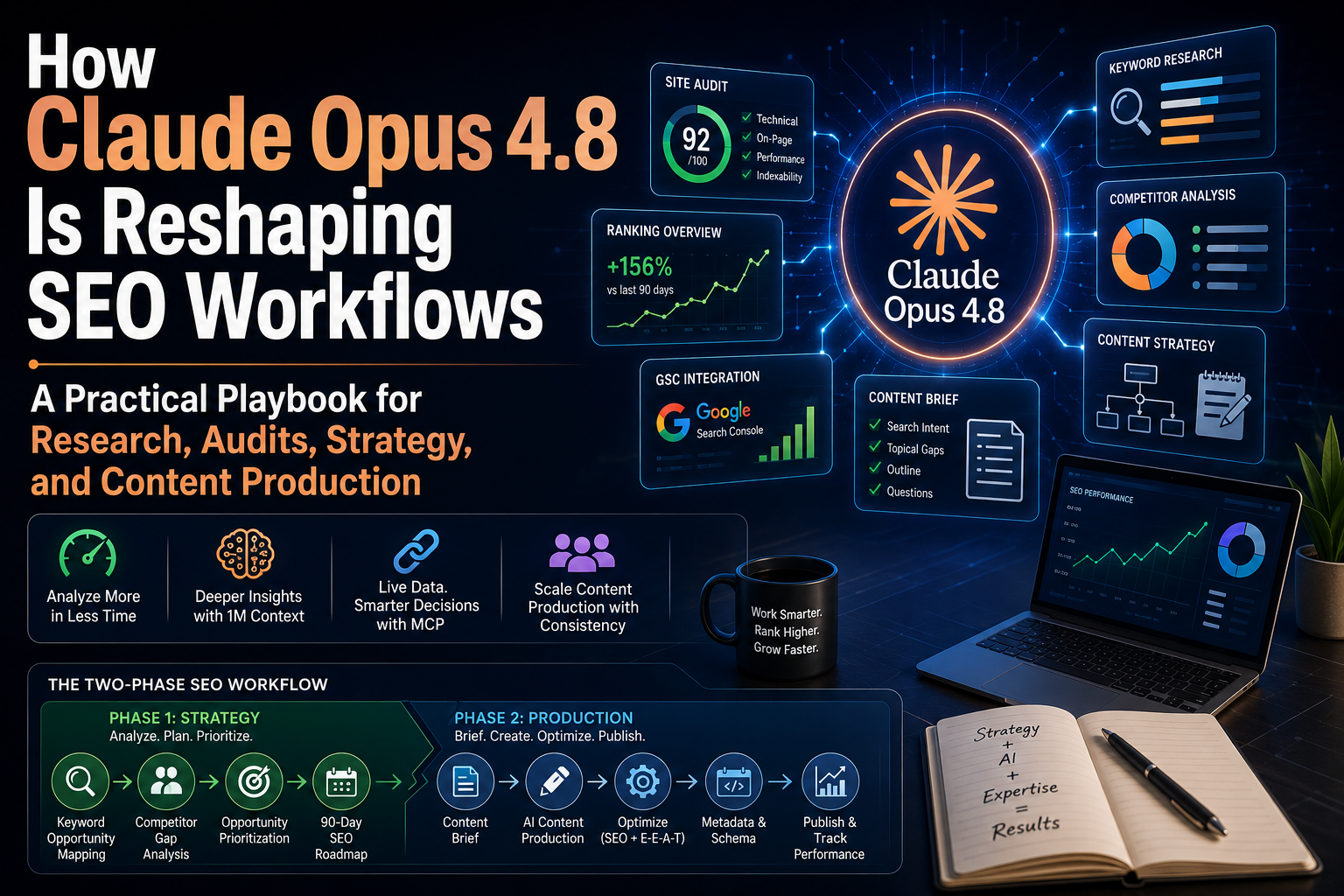
How Claude Opus 4.8 Is Reshaping SEO Workflows
Most AI discussions in SEO focus on content generation.
That’s the wrong conversation.
The real disruption isn’t that Claude Opus 4.8 can write articles.
It’s that it can perform much of the research, analysis, auditing, reporting, and strategic groundwork that traditionally consumed the majority of an SEO manager’s week.
When used correctly, Opus 4.8 isn’t a writing assistant.
It’s an operational layer.
And that’s a far more significant shift.
Six days after its release, marketers are already experimenting with Claude Opus 4.8 for keyword research, content briefs, technical audits, competitor analysis, and reporting. Most of them will reach the same conclusion:
“It’s impressive, but it’s still not replacing SEO expertise.”
That conclusion is both correct and misleading.
Because the question isn’t whether Claude replaces SEO professionals.
The question is:
How much of the execution layer can now be automated while humans focus on strategy, judgment, and expertise?
The answer is: far more than most teams realize.
Why Opus 4.8 Matters for SEO
Every major AI release promises better reasoning.
Most deliver incremental improvements.
Opus 4.8 feels different because several capabilities align unusually well with SEO workflows.
The first is its one-million-token context window.
For SEO practitioners, this changes what can be analyzed in a single session. Instead of reviewing samples, Claude can process large Search Console exports, multiple competitor pages, content inventories, and site-wide datasets without losing coherence halfway through the analysis.
The second is effort controls.
Rather than treating every task equally, Opus 4.8 allows users to allocate deeper reasoning when the problem requires it.
A quick content audit can be completed in minutes.
A competitive gap analysis can be instructed to think harder, producing substantially richer insights.
The third is live data access through MCP integrations.
This may be the most important development for SEO.
Historically, AI tools provided recommendations based on training data and assumptions.
With MCP-connected Google Search Console data, Claude can evaluate actual rankings, impressions, CTR, and page performance before making recommendations.
That transforms AI from an advisor into an analyst.
The Mistake Most Marketers Will Make
The typical workflow looks something like this:
A marketer opens Claude and asks:
“Create a complete SEO strategy for my SaaS product.”
Claude responds with pillar pages, content clusters, keyword categories, and editorial suggestions.
The output sounds sophisticated.
But it isn’t a strategy.
It’s a framework.
Without data from the site, competitors, and market, even the most advanced model is forced to generalize.
This is where many AI-driven SEO experiments fail.
The issue isn’t model quality.
It’s workflow design.
The most effective SEO use cases separate strategy from production.
Once you understand that distinction, the value of Opus 4.8 becomes far clearer.
Phase One: Strategy
The strategy phase is where humans and AI collaborate.
The objective is not content creation.
The objective is decision-making.
Three activities dominate this phase:
1. Keyword Opportunity Mapping
Instead of generating keyword lists, Claude should evaluate opportunities through three lenses:
- Search demand
- Competitive difficulty
- Business value
This immediately shifts keyword research away from vanity traffic and toward commercial outcomes.
The result isn’t a spreadsheet of keywords.
It’s a prioritized roadmap.
2. Competitive Gap Analysis
This is one of the most impressive capabilities of Opus 4.8.
By analyzing multiple ranking pages simultaneously, Claude can identify:
- recurring structures,
- common content patterns,
- missing topics,
- weak E-E-A-T signals,
- differentiation opportunities.
Tasks that previously consumed several hours can often be completed in minutes.
3. Roadmap Creation
Once opportunities and gaps are identified, Claude can transform them into an actionable 90-day plan.
Not a content calendar.
A business roadmap.
What gets optimized first.
What gets created next.
What delivers the highest ROI.
And what can wait.
The Missing Ingredient: E-E-A-T
Many AI-generated SEO strategies fail for one simple reason.
They ignore E-E-A-T.
Google’s emphasis on Experience, Expertise, Authoritativeness, and Trustworthiness continues to shape how content is evaluated.
This is where many marketers misunderstand AI.
Claude can accelerate production.
It cannot manufacture experience.
A strong article doesn’t merely explain a topic.
It demonstrates knowledge earned through practice.
Consider the difference:
Weak content:
“Project management software helps remote teams collaborate.”
Strong content:
“After implementing Asana across a 40-person remote team, weekly project review meetings fell from three hours to one while completion rates increased by 17%.”
The second statement contains experience.
Experience creates credibility.
Credibility creates trust.
And trust increasingly influences rankings.
The smartest SEO teams will use Claude to create first drafts and analysis while relying on subject matter experts to contribute insights, examples, and real-world context.
That combination is significantly more powerful than either human-only or AI-only workflows.
Phase Two: Production
Once strategy is complete, execution becomes repeatable.
This is where Opus 4.8 and MCP integrations become genuinely transformative.
A typical workflow now looks like this:
- Pull live Search Console data.
- Identify ranking opportunities.
- Analyze competing pages.
- Generate a content brief.
- Produce the article.
- Create metadata and schema recommendations.
- Prepare a publication package.
Because all of these steps exist within a single context window, the final content remains grounded in competitive realities rather than generic SEO advice.
The result is not simply faster content production.
It’s more informed content production.
Where Cowork Changes the Equation
The introduction of Cowork adds another layer.
Instead of treating SEO as a series of isolated tasks, Cowork enables persistent projects.
This means:
- strategies remain accessible,
- historical context persists,
- recurring workflows can be scheduled,
- reports can be automated,
- analyses can be repeated without rebuilding context each time.
For agencies and in-house teams, this creates operational consistency that previously required significant manual effort.
What Claude Still Doesn’t Replace
This is where realism matters.
Opus 4.8 does not eliminate the need for SEO professionals.
It automates large portions of execution.
But several areas remain deeply human.
These include:
- strategic judgment,
- brand positioning,
- editorial direction,
- stakeholder management,
- industry expertise,
- relationship-driven link acquisition.
Likewise, dedicated SEO tools still maintain advantages in:
- large-scale technical crawling,
- backlink intelligence,
- long-term rank tracking.
The future isn’t AI replacing SEO.
The future is AI eliminating repetitive SEO work.
The Bigger Shift
The most important lesson from Opus 4.8 isn’t technological.
It’s organizational.
For years, SEO teams spent enormous amounts of time gathering data, formatting reports, building briefs, and producing first drafts.
Those activities created value.
But they weren’t where expertise mattered most.
Today, much of that work can be automated.
The competitive advantage shifts elsewhere.
Toward:
- original research,
- first-hand experience,
- editorial quality,
- strategic thinking,
- E-E-A-T.
In other words, toward the things Google increasingly rewards.
Final Takeaway
Claude Opus 4.8 doesn’t eliminate SEO expertise.
It changes where expertise creates value.
Research, auditing, reporting, content briefing, and first-draft production are becoming increasingly automated.
Strategic thinking, editorial judgment, and authentic expertise are not.
The teams that thrive over the next three years won’t be those that resist AI.
They’ll be the ones that build systems where AI handles the operational workload while humans provide the experience, insight, and authority that search engines still struggle to replicate.
This is not the end of SEO managers.
It’s the beginning of a different kind of SEO work.
3 thoughts on “How Opus 4.8 Cut My SEO Research Time in Half”