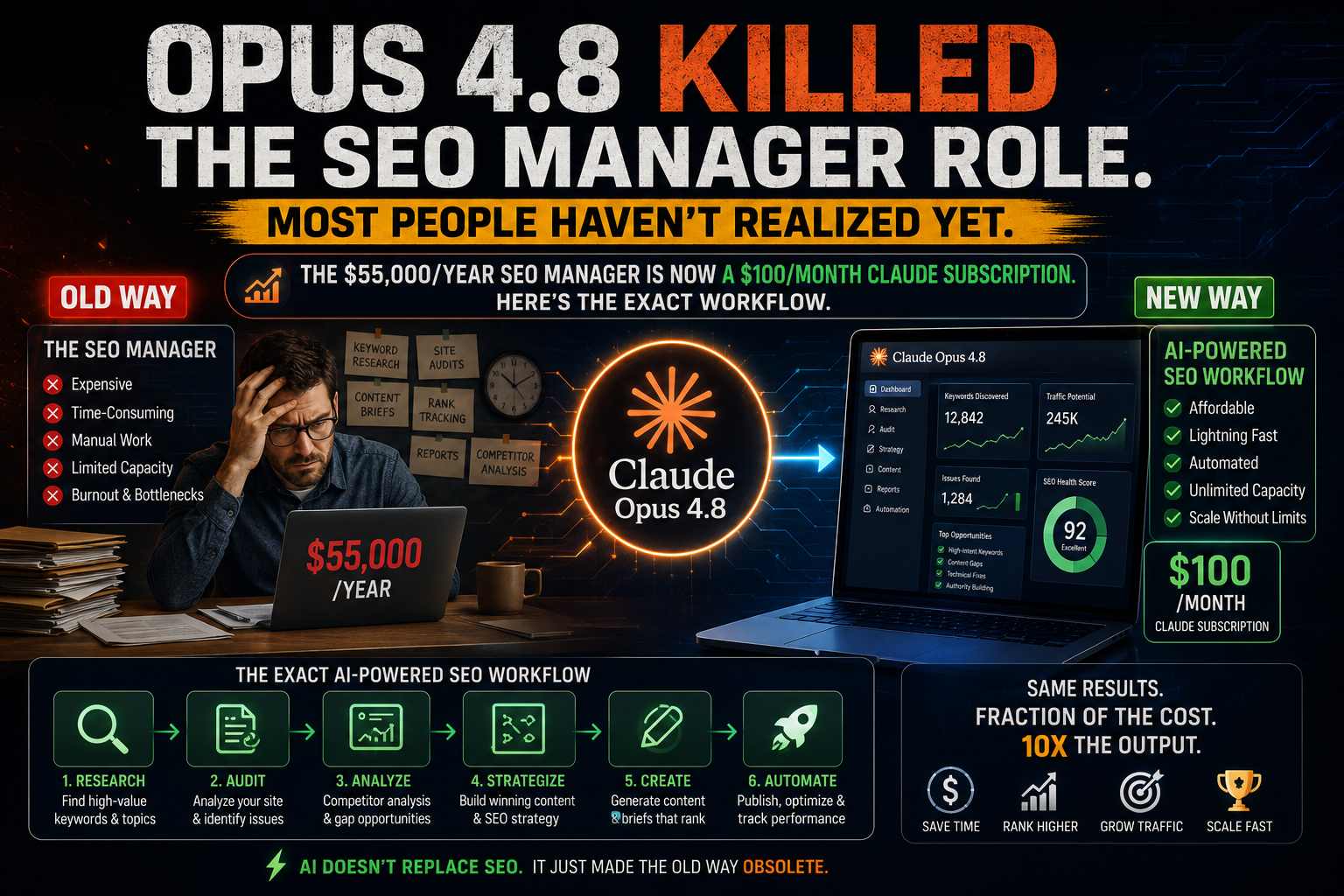
The $55,000/Year SEO Manager Is Now a $100/Month Claude Subscription. Here’s the Exact Workflow.
OPUS 4.8 JUST DROPPED. HERE IS HOW TO ACTUALLY RUN SEO WITH IT. The two-phase system that replaces your SEO manager – not with hype, but with a workflow that produces audits, strategies, and content at a pace and depth no single human can match.
Published June 3, 2026
THE PROBLEM THIS ARTICLE SOLVES
Claude Opus 4.8 launched on May 28, 2026 – six days ago. It is the most capable generally available model Anthropic has ever released. It scores 84% on Online-Mind2Web for browser-agent tasks, outperforms GPT-5.5 and Gemini 3.1 Pro on SWE-Bench Pro at 69.2%, and its fast mode runs at 2.5x speed at three times cheaper than previous models
(source: Anthropic announcement, May 28, 2026; The New Stack, June 2, 2026; MacRumors, May 28, 2026).
But almost everyone who tries to use it for SEO is about to make the same mistake.
They will open a single Opus 4.8 chat, cram their keyword research, competitor analysis, content strategy, and article writing into one sprawling conversation, watch the context turn to mush by message twelve, and conclude that AI still cannot do real SEO work.
They will be wrong. The model is not the problem. The workflow is.
This article documents the exact two-phase system that fixes it – and that, when combined with Cowork and MCP connectors for live data access, produces a complete SEO operation that replaces the need for a dedicated SEO manager for most businesses under 50 pages of active content.
WHAT MAKES OPUS 4.8 DIFFERENT FROM EVERY PREVIOUS MODEL FOR SEO
Three specific capabilities matter for SEO work. They are not marketing claims – they are architectural features with direct operational consequences.
First, the 1-million-token context window. Previous Opus models handled 200,000 tokens. Opus 4.8 can hold approximately 750,000 words of context in a single session (source: Let’s Data Science, May 30, 2026; Anthropic model documentation).
For SEO, this means you can paste an entire site’s GSC export – not 100 rows, but thousands – and Claude maintains coherent analysis across the full dataset. You can paste five competitor pages plus your own page and run a multi-competitor gap analysis in a single prompt.
The context constraint that forced previous workflows to be split into tiny sessions no longer applies at the same severity.
Second, effort controls. For the first time, users on claude.ai and Cowork can adjust how hard Claude thinks about a response (source: Technology.org, May 29, 2026; Anthropic announcement).
Effort defaults to “high” on Opus 4.8, with “extra” and “max” available for harder problems. For SEO, this is the difference between a quick-scan audit (standard effort, 90 seconds) and a deep competitive analysis where you want Claude to consider every structural nuance (max effort, several minutes of thinking time but dramatically richer output).
You control the trade-off between speed and depth per task, not per model.
Third, tool use and MCP integration. Opus 4.8 uses tools cleanly and follows instructions with the consistency that autonomous workflows require to run unattended (source: Anthropic announcement, citing Devin integration partner).
For SEO, this means Opus 4.8 connected to a Google Search Console MCP server does not just respond to your questions – it queries your live search data, retrieves current rankings and CTR figures, and grounds every recommendation in your actual performance numbers rather than hallucinated best practices.
There is also a fourth capability that most coverage has missed: mid-conversation system messages. Opus 4.8 accepts system-level instruction changes partway through a conversation via the API (source: Let’s Data Science, May 30, 2026).
For SEO workflows built through the API or Claude Code, this means you can shift Claude’s focus – from auditor mode to writer mode to report-formatting mode – without breaking the prompt cache or starting a new session. The practical effect is that a single agentic session can run an entire audit-to-content pipeline without the context resets that degraded output quality in previous models.
Combined, these four capabilities make Opus 4.8 the first model where a complete SEO workflow – from data analysis to strategy to content production to reporting – can run end-to-end with minimal human intervention and without the output quality degrading halfway through.
WHY MOST PEOPLE WILL USE IT WRONG
The failure pattern is predictable because it has repeated with every powerful model release since GPT-4.
A marketer opens Opus 4.8. They type: “I need a complete SEO strategy for my SaaS product.” They get back a generic framework – pillar pages, content clusters, keyword categories. It reads well. It is also indistinguishable from what ChatGPT, Gemini, or any other model would produce.
It contains no data specific to their site, their competitors, or their market. They refine: “Now write me an article targeting ‘best project management software.'” They get a competent article that will rank for nothing, because it was written without knowing what currently ranks, what those pages contain, or what gap exists that their article could fill.
The problem is not Opus 4.8’s capability. The problem is that they are using a strategic reasoning engine as a content generator and expecting it to produce strategy it was never given the data to formulate.
The fix is structural, not prompting-based. You cannot prompt your way out of a workflow problem.
THE TWO-PHASE SYSTEM
The system divides SEO work into two fundamentally different types of activity, each requiring a different tool configuration.
Phase 1 is Strategy. It is visual, exploratory, one-off, and decision-oriented. You are looking at data, comparing options, and making choices. This phase happens in the Claude interface – either claude.ai or Cowork – where you can see the analysis laid out, interact with it, and make decisions in real time.
Phase 2 is Production. It is repeatable, scaled, recurring, and execution-oriented. You are producing content, running audits, generating reports, and implementing the strategy decided in Phase 1.
This phase uses Opus 4.8 connected to MCP data sources – primarily Google Search Console, but also SERP data, PageSpeed, and site crawl information – so that every output is grounded in live data rather than the model’s training knowledge.
Strategy is a whiteboard. Production is a factory line. They require different tools, different prompts, and different operational cadences.
PHASE 1: STRATEGY – THREE PLAYS IN THE CLAUDE INTERFACE
Play 1: Keyword Research
The keyword research prompt produces a ranked, prioritized list – not a generic keyword dump. The critical difference is the three-axis ranking: volume multiplied by difficulty multiplied by business potential.
The prompt: “You are a senior SEO strategist. My business is [DESCRIBE IN 2-3 SENTENCES]. My target audience is [DESCRIBE]. My primary competitors are [LIST 2-3]. Generate a keyword strategy with these outputs:
1. A list of 60-80 keywords across short-tail, long-tail, question-based, comparison, and local variants.
2. For each keyword, estimate relative search volume (high/medium/low), relative competition (high/medium/low), and business alignment (direct revenue / lead gen / awareness).
3. Rank the top 20 by a combined score of all three axes.
4. Group all keywords into 5-8 content clusters, each with a pillar keyword and supporting terms.
5. For the top 5 clusters, recommend the content format and a one-sentence angle that would differentiate my content from what currently ranks.”
What Opus 4.8 does differently here versus previous models: the effort control at “extra” produces noticeably deeper competitive reasoning.
Where earlier models would list keywords and guess at difficulty, Opus 4.8 at extra effort cross-references what it knows about the competitive landscape, considers the content format that currently dominates the SERPs for each term, and produces differentiation angles that reflect actual competitive gaps rather than generic suggestions.
After running this prompt, validate the top 20 keywords for actual search volume using Google Keyword Planner (free) or Ubersuggest’s free tier. Claude’s relative estimates are approximately 80% accurate for ranking purposes, but actual volume numbers should come from a live data source.
Play 2: Competitor Analysis
The prompt: “Analyze these three competitor pages for [TARGET KEYWORD]: [URL 1], [URL 2], [URL 3]. For each page, report on: content depth and estimated word count, structural elements (FAQs, tables, comparison charts, schema), E-E-A-T signals (author credentials, citations, trust indicators), unique angle or format advantage, and the single biggest weakness.
Then tell me: what is the gap all three competitors share that my content could exploit? What would a page need to contain to outrank all three? Produce a content outline that addresses every gap.”
This produces a competitive picture that would take a human analyst two to four hours to assemble – reading three pages, comparing structures, identifying patterns, and synthesising a gap analysis.
Opus 4.8 does it in three to five minutes at extra effort, and the output is specific enough to hand directly to a writer.
Play 3: Phased Roadmap
The prompt: “Based on the keyword strategy and competitor analysis we have discussed, produce a 90-day SEO roadmap in three phases.
Phase 1 (Days 1-30): Quick wins – pages to optimize, meta rewrites, internal linking fixes that can produce results within one update cycle.
Phase 2 (Days 31-60): Medium-term – new content to produce, targeting the top 10 keywords from our strategy, with briefs for each piece.
Phase 3 (Days 61-90): Long-term – authority-building content, link-worthy assets, and the GEO/AEO optimization pass. Format each phase as an action table: action, target keyword or page, responsible person, expected outcome, deadline.”
By the end of these three plays, you have a prioritized keyword list, a clear competitive picture with specific gaps identified, and a content calendar with implementation briefs. This is the strategy phase. It happens once per quarter, takes about two hours, and produces the roadmap that Phase 2 executes against.
PHASE 2: PRODUCTION – OPUS 4.8 PLUS MCP LIVE DATA
This is the operational unlock that makes the system genuinely different from using any AI model as a writing assistant.
What MCP Is and Why It Matters
MCP – the Model Context Protocol – is an open standard released by Anthropic in late 2024 that gives Claude a structured, secure way to call external APIs in real time instead of relying on training data or pasted information (source: SEOptimer MCP Guide, May 2026; Nacho Conesa Claude-GSC Integration Guide, April 2026).
For SEO, the critical MCP connector is Google Search Console. Multiple implementations exist:
The AminForou GSC MCP server (open source, 500+ GitHub stars) connects Google Search Console directly to Claude, enabling queries like “which pages have the most impressions but the lowest CTR this month?” in plain English (source: SEOptimer, May 2026; GitHub/AminForou, April 2026).
The Suganthan GSC MCP server provides 20 free analysis tools including quick-win detection, content decay monitoring, cannibalization auditing, and CTR benchmarking – all queryable through natural language (source: Suganthan.com, April 2026).
The Windsor.ai connector offers a no-code setup that takes under two minutes and pulls the full 16-month GSC data history (source: Windsor.ai, April 2026).
The Supermetrics MCP connector provides enterprise-grade GSC integration with the full 16-month history and handles all API connections and authentication behind the scenes (source: Supermetrics, June 2026).
The Composio Tool Router enables dynamic tool loading from GSC and other apps through a single MCP endpoint, with full support for both Claude Desktop and Cowork (source: Composio, June 2026).
When Opus 4.8 is connected to GSC via any of these MCP servers, you can ask: “Which of my pages ranks between position 4 and 15 with more than 500 impressions this month?” and Claude queries your live data, not its training knowledge. The answer is your actual data, from your actual site, as of today.
This is the difference between an AI that gives you SEO advice and an AI that gives you SEO analysis of your site.
The Weekly Production Loop
Once the strategy phase has produced a keyword list and content calendar, the production phase becomes a repeatable weekly loop:
Week starts. Open a fresh Opus 4.8 chat (or a Cowork project session with persistent context). The GSC MCP connector is active. You type: “This week’s target keyword is [keyword from my roadmap]. Pull my current GSC data for this keyword and related terms.
Show me what pages, if any, already rank for it, their current position, impressions, and CTR.”
Opus 4.8 queries your live GSC data, returns the current state, and you now know whether you are optimizing an existing page or creating a new one.
Next prompt: “Search the web for the top 5 pages currently ranking for this keyword. Analyze them for content depth, structure, E-E-A-T signals, and gaps.
Produce a content brief: target word count, required sections, FAQ topics, and the differentiation angle based on what the competitors are missing.”
Opus 4.8 searches the live web, analyses the current SERP landscape, and produces a brief grounded in what actually ranks today – not what ranked when the model was trained.
Next prompt: “Write the article based on this brief. Target the keyword naturally. Include an FAQ section of 5 questions optimized for featured snippets and AI Overview citation.
Use specific data points and cite sources where relevant. Match the tone of [your brand voice description or a sample article URL].”
Opus 4.8 writes the article. Because it has the brief, the competitive analysis, and the live data all in the same conversation context (possible now because of the 1M token window), the article is structured to outrank specific competitors on specific dimensions rather than written to generic best practices.
Final prompt: “Format this as a client-ready document with the meta title (under 60 characters), meta description (under 155 characters), recommended URL slug, internal linking suggestions from my existing content, and a schema markup recommendation.”
The output is a complete, publish-ready content package. Review it, adjust the voice, publish.
Total time per article: 30 to 45 minutes including review, compared to four to eight hours for a human SEO manager producing the same depth of research-backed, competitively-grounded content.
THE COWORK LAYER – TURNING THE WEEKLY LOOP INTO AN AUTONOMOUS SYSTEM
Everything described in Phase 2 can be elevated further with Cowork.
Cowork is Anthropic’s desktop agent, launched January 2026 and promoted to general availability in April 2026 (source: DataCamp, January 2026; Medium/RevToolsAI, April 2026). It takes the agentic architecture behind Claude Code – file access, multi-step execution, tool integration – and wraps it in a desktop interface that requires no terminal and no code.
For SEO, Cowork changes the operational model in four specific ways.
First, projects maintain persistent context. Instead of re-explaining your niche, audience, and goals every session, a Cowork Project retains its instructions and task history across sessions (source: CybersecurityNews, March 2026).
Your “Client X SEO” project remembers the keyword strategy, the competitive landscape, and the content calendar from last week’s session. Monday morning, you open the project and type “run this week’s content production for keyword #7 on the roadmap” and the context is already there.
Second, file access means no copy-pasting. Cowork reads and writes files directly in your project folder (source: Ars Technica, January 2026; AI.cc, March 2026).
Drop a GSC export into the folder, type “analyze this month’s GSC data and flag any pages that dropped more than 3 positions,” and Cowork reads the CSV, runs the analysis, and saves the report as a new document in the same folder.
No browser tabs. No clipboard gymnastics.
Third, scheduled tasks create recurring automation. Set a weekly recurring prompt: “Every Monday, pull the latest GSC data via MCP, compared to last week, flag position changes greater than 3, identify any new cannibalization, and save a weekly SEO report in the project folder.”
This runs automatically while you work on other things (source: Medium/RevToolsAI, April 2026). The caveat: tasks only run while your machine is awake and the app is open.
Fourth, MCP connectors in Cowork gain filesystem access. Data fetched from GSC or other services can be saved locally, and local files can serve as input to MCP queries (source: Medium/RevToolsAI, April 2026).
This means your Cowork SEO project can maintain a running log of weekly GSC snapshots, and Claude can compare across weeks to identify trends that a single-session analysis would miss.
The result is a system where the human role shifts from doing SEO analysis to reviewing SEO analysis. You set the strategy in Phase 1. You configure the production system in Phase 2. Cowork executes the weekly loop. You review the output, adjust the voice, approve the content, and publish.
WHAT OPUS 4.8 SEES THAT OTHER MODELS DO NOT – THE EXCLUSIVE CAPABILITIES
Several capabilities are specific to Opus 4.8 in the Claude ecosystem and are not available in competing models. These are documented in Anthropic’s announcement and partner reports but have not been widely discussed in the SEO context.
Effort controls at the task level. No other model offers user-adjustable reasoning effort per message. For SEO, this means you can run a quick-scan audit at standard effort (fast, surface-level, good for triage) and a deep competitive analysis at max effort (slower, but dramatically richer reasoning about competitive positioning and content gaps) within the same conversation.
GPT-5.5 and Gemini 3.1 Pro do not offer this granularity (source: Anthropic announcement; Technology.org, May 29, 2026).
Four times fewer unflagged errors. Anthropic’s evaluations show Opus 4.8 is approximately four times less likely than Opus 4.7 to let flaws pass unremarked (source: Anthropic announcement; MacRumors, May 28, 2026).
For SEO audit workflows, this means the model actively flags when its analysis is uncertain rather than presenting a confident but potentially wrong recommendation.
When Claude says “this page appears to target [keyword] but I am not confident – the intent signals are mixed,” that uncertainty flag is itself valuable information that prevents you from optimizing in the wrong direction.
Strongest browser-agent performance. Opus 4.8 scored 84% on Online-Mind2Web, a meaningful jump over both Opus 4.7 and GPT-5.5 (source: Anthropic announcement).
For SEO workflows that involve Claude navigating live web pages – reading competitor content, checking SERP features, analyzing page structure – this means more reliable and accurate page reading than any alternative model.
Dynamic workflows with parallel subagents. While this feature is primarily aimed at Claude Code for enterprise-scale code migrations, the architectural principle applies to SEO: Opus 4.8 can coordinate multiple analysis threads simultaneously.
(source: TechCrunch, May 28, 2026; MacRumors, May 28, 2026).
A future iteration of this capability – running parallel audits of twenty pages simultaneously rather than sequentially – would compress a full site audit from hours to minutes.
Prosocial alignment and user autonomy. Opus 4.8 scored at Mythos-level on prosocial traits including supporting user autonomy and acting in the user’s best interest (source: Axios, May 28, 2026).
For SEO, this manifests as Claude proactively warning you when a recommendation might have unintended consequences – “this meta title change will improve CTR for this keyword but may cannibalize your other page targeting the same cluster” – rather than blindly optimizing each page in isolation.
A PRACTICAL EXAMPLE: FROM ZERO TO PUBLISH-READY IN 40 MINUTES
Here is a concrete walkthrough using the two-phase system.
Scenario: You run a B2B SaaS company selling project management software. You have completed Phase 1 and your roadmap says this week’s article targets the keyword “project management for remote teams.”
Minute 0-5: Open your Cowork project. GSC MCP is connected. Type: “Pull my current GSC data for any queries containing ‘project management’ and ‘remote.’ Show me what I currently rank for, position, impressions, and CTR.”
Opus 4.8 queries your live GSC data and returns: you have one page ranking at position 14 for “project management tools for remote teams” with 820 impressions and 1.2% CTR. Two other pages rank for related terms but at positions 20+.
Minute 5-12: “Search the web for the top 5 pages currently ranking for ‘project management for remote teams.’ Analyze each for: word count, structure, E-E-A-T signals, unique angle. Identify the content gap all five share.”
Opus 4.8 searches, reads the five pages, and reports: all five are listicle-format articles comparing tools. None includes original data on remote team productivity. None has a named author with actual remote team management experience. The gap: a practitioner’s perspective with real usage data, not another comparison list.
Minute 12-18: “Produce a content brief: recommended angle, target word count, required sections, FAQ topics, differentiation strategy, and internal linking opportunities from my existing content.”
The brief recommends: 2,800-word practitioner guide, not a listicle. Lead with original survey data or usage metrics from your own platform. Include a comparison section but frame it from a user’s workflow perspective, not a feature checklist.
FAQ section with 6 questions targeting featured snippets. Internal links to your pricing page, your integrations page, and your remote work category page.
Minute 18-35: “Write the article based on this brief. Use a professional but conversational tone. Include specific data points. Format for readability with clear subheadings, a summary table, and FAQ schema.”
Opus 4.8 writes the full article. Because the entire context – your GSC data, the competitive analysis, the content brief, and the differentiation strategy – is in the same conversation, the article is structurally designed to outrank the specific competitors identified in the analysis, not written to generic best practices.
Minute 35-40: “Format the final package: meta title under 60 characters, meta description under 155 characters, URL slug, internal linking map, and schema recommendation.”
Output: a complete, publish-ready content package. You review, adjust the voice, and publish.
Total elapsed time: 40 minutes. Total cost: one Opus 4.8 session on a Pro or Max plan. No Ahrefs. No Semrush. No freelance writer. No SEO consultant.
THE RULE OF THUMB
Thinking, deciding, exploring? Use the Claude interface. Visual, one-off, strategic.
Producing, repeating, scaling? Use Opus 4.8 plus MCP. Fast, grounded, consistent.
Strategy is a whiteboard. Production is a factory line.
WHAT THIS DOES NOT REPLACE
Honest framing matters more than hype.
This system does not replace a senior SEO strategist who has spent ten years building intuition about algorithm behavior, competitive dynamics, and the subtle editorial judgments that separate content that ranks from content that merely reads well. That intuition is irreplaceable.
What it replaces is the labor beneath the strategy – the four to six hours of analysis, the tool-switching, the data cleaning, the report formatting, the first-draft writing, and the repetitive weekly production cycle that consumes 80% of most SEO managers’ time but produces only 20% of their value.
The system frees the strategist to be a strategist. It automates the analyst and the production line.
This system also does not replace backlink analysis (Ahrefs retains its advantage), full site-wide technical crawls across thousands of pages (Screaming Frog is still needed), or rank tracking over time (a dedicated rank tracker is required).
These are genuine gaps. Acknowledging them is more useful than pretending they do not exist.
THE COST COMPARISON
Traditional SEO manager stack (annual): SEO manager salary or retainer $36,000 to $72,000. Ahrefs $1,548. Semrush $1,680. SurferSEO $1,068. Screaming Frog $264. Content writers (12 articles/month) $14,400 to $28,800. Total: $55,000 to $105,000 per year.
Opus 4.8 system stack (annual): Claude Max plan $100/month ($1,200/year). GSC MCP connector (open source, free). Google Search Console (free). Google Keyword Planner (free). Screaming Frog free tier (free). Human review time (5 hours/week at $50/hour, $13,000/year). Total: approximately $14,200 per year.
Savings: $40,000 to $90,000 per year, depending on the traditional stack being replaced.
(Sources: Claude pricing from Anthropic product page; GSC MCP from SEOptimer, May 2026, and Suganthan.com, April 2026; tool pricing from G2 April 2026 and Tekpon April 2026; SEO manager salary from Glassdoor and Indeed averages, 2026.)
THE WEEKLY OPERATING RHYTHM
Monday: Open Cowork project. Cowork’s scheduled task has already pulled this week’s GSC snapshot and flagged position changes. Review the automated weekly report. Identify this week’s content target from the roadmap.
Tuesday-Wednesday: Run the production loop for this week’s article. 40 minutes from GSC data pull to publish-ready content package.
Thursday: Run a quick-scan audit (standard effort) on three existing high-value pages. Flag any that need refreshing based on competitive movement. Total time: 20 minutes.
Friday: Compile the weekly client report using Prompt 5. Total time: 10 minutes.
Total weekly time investment: approximately 2 hours. Weekly output: one new article, three page audits, one client report, one automated GSC monitoring report.
That is an SEO operation. Not a chat session. An operation.
SOURCES
- Anthropic. “Introducing Claude Opus 4.8.” May 28, 2026. anthropic.com/news/claude-opus-4-8. Cited for: Opus 4.8 capabilities, effort controls, 84% Online-Mind2Web, 4x fewer unflagged errors, fast mode pricing, dynamic workflows.
- The New Stack. “Claude Opus 4.8 is here: effort controls, dynamic workflows, cheaper fast mode, better honesty, less deception.” June 2, 2026. Cited for: benchmark comparisons, prosocial alignment, Opus 4.7 reception context.
- MacRumors. “Anthropic Launches Claude Opus 4.8 With Gains in Coding and Honesty.” May 28, 2026. Cited for: SWE-Bench Pro 69.2%, dynamic workflows feature, effort controls.
- Technology.org. “Anthropic Releases Claude Opus 4.8 With Dynamic Workflows.” May 29, 2026. Cited for: 41-day development cycle, effort control implementation, API pricing ($5/$25 per million tokens standard, $10/$50 fast mode), mid-conversation system messages.
- Let’s Data Science. “Anthropic Releases Claude Opus 4.8 With Faster, Higher-Effort Modes.” May 30, 2026. Cited for: 1M context window, 128k max output, 1,024-token cacheable prompt minimum, mid-conversation system messages.
- Axios. “Anthropic releases a new model, Opus 4.8.” May 28, 2026. Cited for: prosocial traits, Mythos-level alignment, affordability emphasis.
- TechCrunch. “Anthropic releases Opus 4.8 with a new ‘dynamic workflow’ tool.” May 28, 2026. Cited for: parallel subagents, codebase-scale capability.
- 9to5Mac. “Anthropic upgrades Claude with the new Opus 4.8 model.” May 28, 2026. Cited for: Mythos-class model upcoming, Opus 4.7 context.
- SEOptimer. “Top SEO MCP Servers in 2026: Tools and Use Cases.” May 2026. Cited for: MCP architecture for SEO, AminForou GSC server, time savings.
- Suganthan.com. “Google Search Console MCP: Step by Step Setup Guide.” April 2026. Cited for: 20 free GSC analysis tools, OAuth setup, npm package.
- Windsor.ai. “How to Send Google Search Console Data to Claude.” April 2026. Cited for: no-code GSC setup, 16-month data history.
- Supermetrics. “Connect Google Search Console to Claude.” June 2026. Cited for: enterprise GSC connector, 200,000+ companies using Supermetrics.
- Composio. “Google Search Console MCP Integration with Claude Cowork.” June 2026. Cited for: dynamic tool loading, Cowork MCP support.
- TheStacc. “MCP for Google Search Console (2026): 7-Step Setup Guide.” April 2026. Cited for: 1,200 queries/minute free tier, read-only default, destructive operation controls.
- Nacho Conesa. “How to Connect Claude to Google Search Console.” April 2026. Cited for: plain-English query examples, always-on analyst capability.
- DataCamp. “Claude Cowork Tutorial.” January 2026. Cited for: Cowork launch, sandboxed VM, agentic execution model.
- CybersecurityNews. “Anthropic Launches Projects Feature for Claude Cowork Desktop.” March 2026. Cited for: Projects feature, persistent context, MCP connectors with filesystem access.
- Medium/RevToolsAI. “Claude Cowork: The Essential Guide.” April 2026. Cited for: Cowork GA April 2026, plugins, scheduling, pricing tiers, platform comparison.
- VentureBeat. “Microsoft announces Copilot Cowork with help from Anthropic.” March 2026. Cited for: Cowork desktop agent architecture, Microsoft partnership.
- Ars Technica. “Anthropic launches Cowork, a Claude Code-like for general computing.” January 2026. Cited for: original Cowork launch, folder access model.
2 thoughts on “Opus 4.8 Killed the SEO Manager Role. Most People Haven’t Realized Yet.”