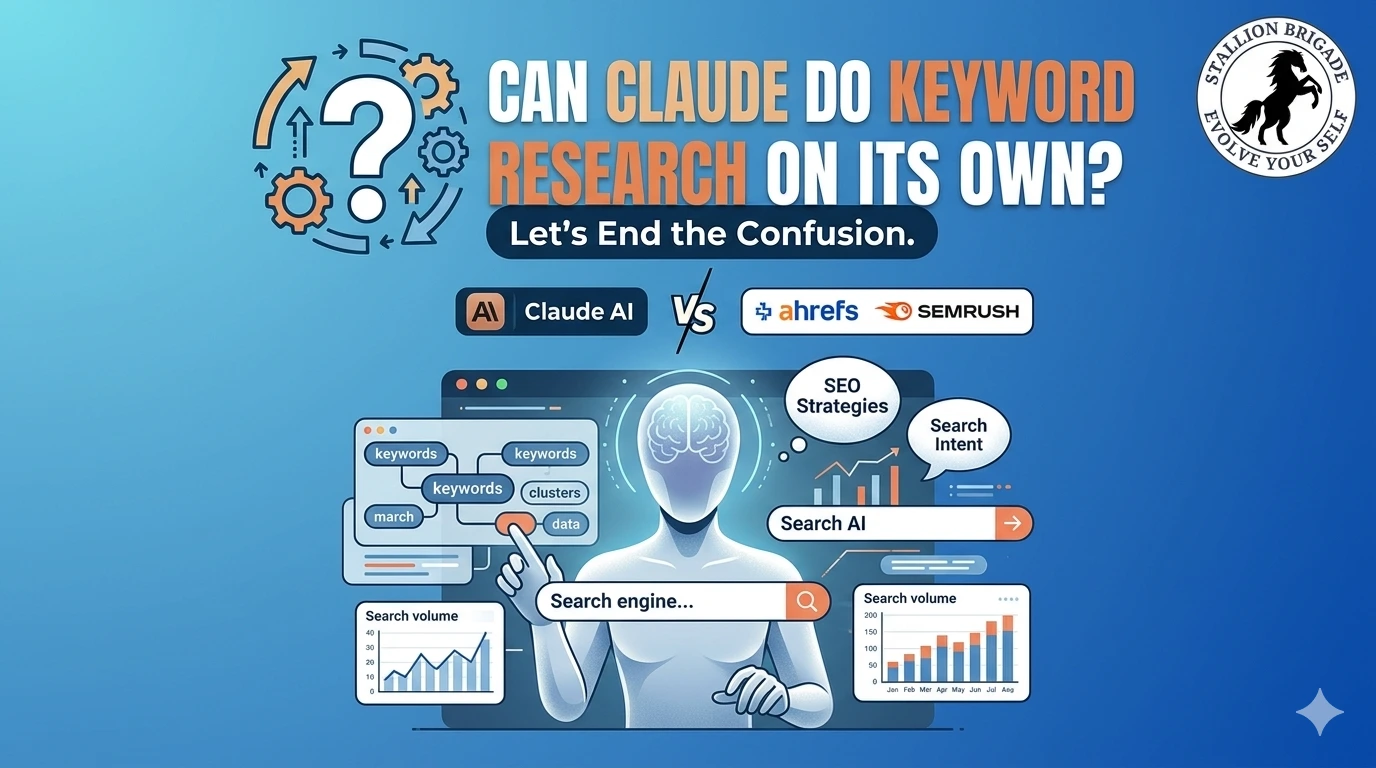
The Truth About Claude and Keyword Research (Most SEOs Have This Wrong)
The Short Answer
No – and yes, but not the way most people think.
Claude cannot pull live search volumes, check real-time rankings, or tell you what’s trending in search right now. Its training has a knowledge cutoff and no live connection to Google’s index. Ask it for keyword data from scratch and it will either refuse honestly or – worse – hand you plausible-looking numbers it invented. This isn’t a hidden flaw; it’s documented behavior. As SEO platform ClickRank puts it, Claude’s knowledge cutoff means it cannot access current SERP data, trending topics, or real-time search volumes – it’s best used after you know what to target, not for deciding what to target.
But here’s what Claude can do: take the keyword data you already have and turn it into a strategic action plan faster and better than most SEO tools. That distinction is everything. Claude is not a keyword research tool. It is a keyword thinking tool. Once you understand that line, the confusion disappears.
Where People Go Wrong
The most common mistake is treating Claude like a search database. Users open a new chat and type: “Give me the best keywords for a fitness blog targeting US readers.”
Claude returns a list. It looks clean and authoritative. The problem: every volume, difficulty score, and trend signal is fabricated from training data that may be months or years behind the current SERP. You are not getting keyword research. You are getting Claude’s best guess at what keyword research might look like – and guesses don’t rank pages.
This is the exact failure mode practitioners keep flagging. As one agency keyword-research guide notes, people prompt Claude for ideas, get a generic list with no data attached, and conclude Claude isn’t useful for research – but the conclusion is wrong; the setup is wrong. Claude was never designed to replace Ahrefs or SEMrush. It was designed to reason, synthesize, and prioritize. Those are different jobs.
What Claude Actually Does With Keyword Data
Feed Claude real data and the output changes completely. Here is a proper workflow:
Step 1 – Export your raw data. Pull a keyword export from any of these:
- Google Search Console (queries + impressions + CTR + position)
- SEMrush or Ahrefs (keyword list with volume, difficulty, CPC)
- Google Analytics (pages driving organic traffic)
- Google Keyword Planner (volume ranges)
Step 2 – Paste or upload into Claude. Drop the CSV or paste the table directly. Claude’s large context window handles hundreds or thousands of keywords at once without losing coherence – its document-analysis strength is genuinely exceptional for processing entire audits and exports in one pass.
Step 3 – Give Claude the strategic brief. Tell it what to do with the data:
- “Cluster these 400 keywords by search intent – informational, commercial, transactional.”
- “Flag keyword cannibalization – keywords where two or more of my pages compete for the same query.”
- “Identify the 15 highest-priority keywords: ranking positions 4–10, volume above 500, low competition.”
- “Find content gaps – keywords I’m getting impressions for but have no dedicated page targeting.”
That last one is where Claude earns its keep. Spotting 47 posts that drive impressions but have no page built for the actual query is the kind of insight that takes an analyst half a day manually. Claude does it in 90 seconds.
One critical accuracy rule: demand provenance. The best keyword Skills built for Claude now explicitly label every metric as Measured, User-provided, or Estimated – and never present an estimate as measured. Adopt the same habit in your prompts: “Label any number you didn’t get from my data as an estimate.” It’s the single best guard against silent hallucination.
A Real Example
One SEO team fed Claude a GSC export of 2,700 search queries from a B2B SaaS client. The prompt: cross-reference organic queries with paid ad terms and find the overlap and gaps.
The output: 351 opportunities to reduce paid spend where organic was already strong, 33 queries where paid and organic should amplify each other, and 41 content gaps where paid was the only presence – meaning new pages to build. That analysis, done manually with VLOOKUP across two spreadsheets, would have taken a full afternoon. No keyword database was involved – Claude reasoned across data that already existed.
The Line You Need to Know
| Task | Claude (alone) | Paid SEO Tool |
| Live search volume | ✗ Cannot do it | ✓ |
| Keyword difficulty score | ✗ Will guess | ✓ |
| Real-time ranking data | ✗ No access | ✓ |
| Clustering by intent | ✓ Excellent | Partial |
| Cannibalization detection | ✓ With your data | Partial |
| Content gap from GSC export | ✓ Excellent | Manual |
| Prioritization strategy | ✓ Excellent | ✗ |
| Writing the brief from clusters | ✓ Excellent | ✗ |
The pattern is clear: Claude owns the strategy layer. Your data tool owns the measurement layer. Neither replaces the other – they complete each other.
The 2026 Update: MCP Closes the Gap (Partly)
Here’s the nuance most “Claude can’t do keyword research” takes miss, and it’s worth knowing. With a Model Context Protocol (MCP) connector, Claude can now call Ahrefs or SEMrush directly and pull live volume and difficulty data inside the conversation – no manual export, no copy-paste. When connected this way, Claude runs seed expansion, intent classification, and clustering with real data at every step.
But read that carefully: the data still comes from the connected tool, not from Claude. MCP doesn’t give Claude its own keyword database – it gives Claude a pipe to yours. The mental model holds: Claude reasons, the tool measures. MCP just removes the copy-paste step between them.
The Correct Mental Model
Think of Claude as a senior SEO strategist who has no internet access on their laptop. You bring them the data. They tell you what it means and what to do next. That strategist is useless without the data – and very expensive to hire at $3,000 a month when Claude does the same thinking for $20.
The confusion about Claude and keyword research comes from treating it like a data source when it’s actually a reasoning engine. Fix the mental model and the workflow becomes obvious.
5 FAQs: Claude and Keyword Research
Q1: Can Claude generate keyword ideas without any data from me?
It can brainstorm topic areas and seed concepts from your niche – useful for ideation, and genuinely good at simulating the exact language a specific professional audience would type, which generic tools often miss. But treat every output as a starting point to validate in GSC, SEMrush, or Ahrefs, not as verified data. Volume and difficulty numbers Claude invents without real data are not reliable.
Q2: Which is better for keyword research – Claude or ChatGPT?
Neither is a keyword research tool on its own. For clustering and prioritizing exported data, Claude’s instruction-following is more precise with large structured inputs. ChatGPT is faster for generating initial topic ideas in bulk. For actual volume and difficulty data, you need a dedicated source – or an MCP connection – regardless of which AI you use.
Q3: Can I paste my full Ahrefs keyword export into Claude?
Yes. Claude’s context window handles substantial exports. For very large files (5,000+ rows), filter to your top 1,000–2,000 rows by relevance first – you’ll get cleaner strategic output than dumping everything raw.
Q4: What is the best prompt for clustering keywords with Claude?
Start with intent: “You are an SEO strategist. Cluster the following keywords by search intent – informational, commercial investigation, and transactional. Then identify which cluster I should prioritize based on business value and ranking difficulty. Label any metric you didn’t get from my data as an estimate.” Add your data below.
Q5: Can Claude replace my GSC or Ahrefs subscription if I use it for keyword work?
No. Claude needs their output to function. GSC is free and non-negotiable – your source of truth for what Google already sees. Ahrefs and SEMrush provide the volume and difficulty data Claude cannot invent. The $20 Claude subscription replaces the analyst time, not the data source.
Claude does not do keyword research. It does something harder – it figures out what your keyword data actually means. That’s the job most SEO tools leave unfinished.
About the author: This guide reflects hands-on experience running Claude-assisted keyword workflows on real client data, cross-referenced against current SEO-platform documentation and practitioner guides. Claude’s capabilities and knowledge cutoff change with each model release – verify current behavior against Anthropic’s documentation and always validate AI-surfaced metrics against your own tool data before acting on them.