Generic Isn’t a Vibe – It’s a Number. Why Your Claude SEO Content Doesn’t Rank
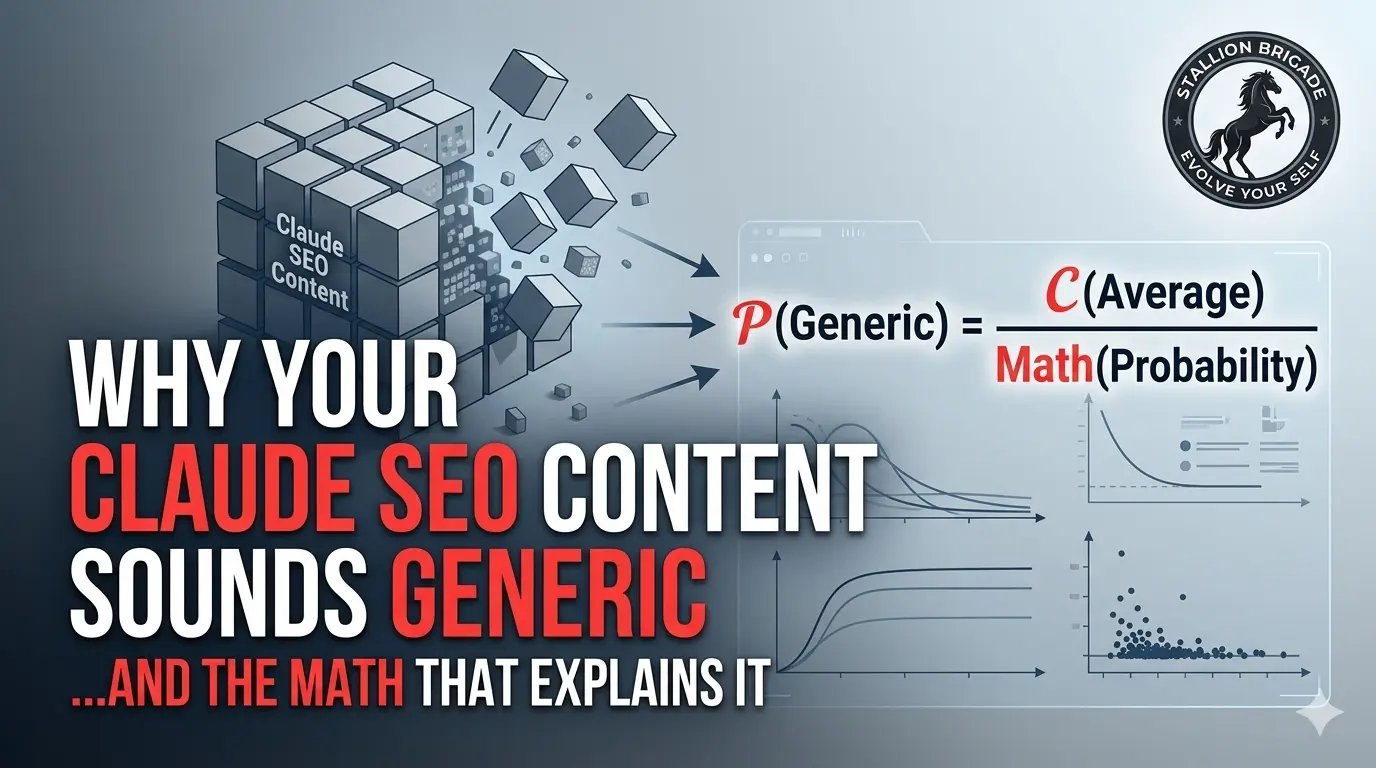
Here’s what nobody on page one will tell you: “generic” isn’t a vibe. It’s a number.
In 2026, Google literally measures the semantic distance between your page and everything else ranking for the same query. Content with a cosine similarity score above 0.88 to the existing top results doesn’t read as “fresh” to the algorithm – it reads as a duplicate of meaning, and only one page per meaning tends to win. Every other “generic” post quietly loses. So when your Claude draft feels flat, the real problem isn’t that a reader will cringe at “delve.” It’s that your page just landed inside an embedding cluster Google has already filled.
That reframing changes everything about how you fix it. Let me show you.
The actual mechanism (not the cliché)
Most articles tell you Claude sounds generic because it overuses “pivotal,” “robust,” and “seamless.” True, but shallow. The vocabulary is a symptom. The disease is statistical.
Every large language model predicts the most probable next token. For a common topic, the most probable phrasing is – by definition – the phrasing everyone else already used. Claude trained on the internet. The internet is now saturated with AI writing. Each model generation learns from the last one’s output, so the voice gets flatter with every cycle. Left alone, Claude doesn’t write badly. It writes averagely. And average is exactly what Google’s similarity scoring is built to filter.
This is why the “humanize my text” prompts fail. Swapping “leverage” for “use” lowers your AI-detector score but does nothing to your embedding position. You’ve changed the words, not the meaning. The cluster doesn’t care about your synonyms.
What changed in 2026 – and why the stakes jumped
This stopped being a style problem and became a survival problem in early 2026.
The March 2026 Google core update named scaled content abuse as its primary target. The damage was not subtle: sites publishing hundreds of unedited AI pages saw 50-80% of organic traffic vanish inside two weeks, while sites publishing 50-100 edited AI articles with real expertise saw traffic climb 30-80%. Same tool. Opposite outcome. The variable was originality, not authorship.
Then came the part page one is barely covering. Google Research published its Scalable Cluster Termination System (S-CTS), which flags repetitive semantic templates using embeddings and Sentence-BERT-style similarity – and over a six-month window it terminated roughly 50,000 clusters covering 130,000 channels of synthetic, templated output. Read that as the direction of travel: detection is moving from “is this AI?” to “is this the same meaning as a thousand other pages?” Google’s own framing is blunt – if you publish original work, you are not the target. Sameness is the target.
A useful gut-check from a 2025 Originality.ai audit of 500,000 AI pages: about 31% showed thin-content signals. Nearly a third of AI output was generic enough to be a liability on arrival.
The contrarian fix: stop humanizing, start de-duplicating
Here’s the angle I’d stake my own client’s work on. The goal isn’t to make Claude sound human. It’s to make Claude say something the existing cluster doesn’t.
A page can sound perfectly human and still be a semantic duplicate. A page can sound a little rough and still rank – because it carries information that the top five lack. Google rewards the second one. Optimize for distance from the cluster, not for passing a detector.
That means your inputs matter more than your prompt polish. In my own production work, the articles that hold rankings are the ones where I fed Claude something it could not have known: a client’s real before/after numbers, a contrarian take I’d argue out loud, a screenshot of an actual SERP. The drafts I “humanized” with banned-word lists but no proprietary input flatlined just the same. The detector passed. The traffic didn’t come.
The step-by-step workflow that creates distance
Step 1 – Set effort to High, then stop fiddling. In claude.ai, the effort control sits by the model selector. For writing, leave Opus on High so it reasons through your specific angle instead of pattern-matching. But know its ceiling: effort amplifies your prompt, it doesn’t replace it. High effort on a vague brief just buys you a thorough average.
Step 2 – Feed the live cluster, then attack it. Paste the current top-five titles, their H2s, and the People Also Ask box into Claude. Then give it the real instruction: “Identify what all five of these already say. Write a piece that says what they don’t.” You’re using the cluster as a map of what to avoid, not a template to echo.
Step 3 – Pull this week’s conversation from X and Grok. Grok runs on live X data, so it surfaces debates, new tools, and contrarian takes from the past seven days – material outside Claude’s training cutoff and usually absent from page one. Hand Claude 5-10 recent posts and tell it to prioritize them over its training knowledge. This is your single fastest source of genuine information gain.
Step 4 – Inject your proprietary layer. Drop in your data, your client examples, your named opinion. This is the E-E-A-T that survived March 2026: demonstrable first-hand experience that cannot be manufactured at content-factory speed.
Step 5 – Write extractable semantic units. AI Overviews favor self-contained passages of roughly 134-167 words that answer completely without leaning on “this” or “that approach.” Front-load the answer, define terms inline. You’re optimizing for citation, not just reading.
The principle worth keeping
Generic Claude output is a measurable position, not a personality flaw. You don’t escape it by swapping adjectives. You escape it by moving your page’s meaning away from the crowd – with live SERP intelligence, this week’s X/Grok signal, and proprietary input that no other prompt on earth could reproduce.
Stop humanizing the words. Start differentiating the meaning. That’s the whole game in 2026.
FAQs
1. Does Google penalize Claude-written content specifically?
No. Google’s position hasn’t changed: it evaluates quality, not how content was produced. The March 2026 update hammered scaled, thin, templated content – which is disproportionately AI output, but hand-written sameness fails identically. Edited Claude content with real expertise can rank as well as anything.
2. If I run my draft through a humanizer, will it rank?
Probably not on that basis alone. Humanizers lower AI-detector scores by changing vocabulary, but they don’t change your content’s semantic position relative to competitors. You can pass every detector and still sit inside a saturated embedding cluster Google filters. Differentiation of meaning is what moves rankings.
3. How do I actually measure if my content is “too similar”?
Practically: read the top five results, then ask whether your page adds a fact, angle, or data point none of them contain. If you can’t name what’s new, neither can Google. For a harder signal, content aligned closely with query intent (cosine similarity above ~0.88 to the query, while staying distinct from competitors) earns far higher AI Overview citation rates.
4. What effort level should I use in Claude for SEO writing?
High for nearly all writing and analysis – it’s the recommended default for intelligence-sensitive work. Drop to Medium only for repetitive, low-stakes drafts. Max and Xhigh are built for long agentic or coding runs, not standard articles, and won’t make your prose less generic if the inputs are thin.
5. Why does Grok help when Claude can’t?
Claude has a fixed training cutoff and no live index. Grok is built on real-time X data, so it surfaces what’s being said this week – emerging tools, fresh debates, contrarian takes – that haven’t reached page one yet. Feeding that into Claude is the fastest route to information gain the existing cluster lacks.
Note: ranking-factor correlations and Google’s detection-system details above are drawn from 2026 industry research and published Google Research papers; Google rarely confirms exact production deployments, so treat the specific numbers as strong directional signals rather than fixed guarantees.
For more related articles click here: