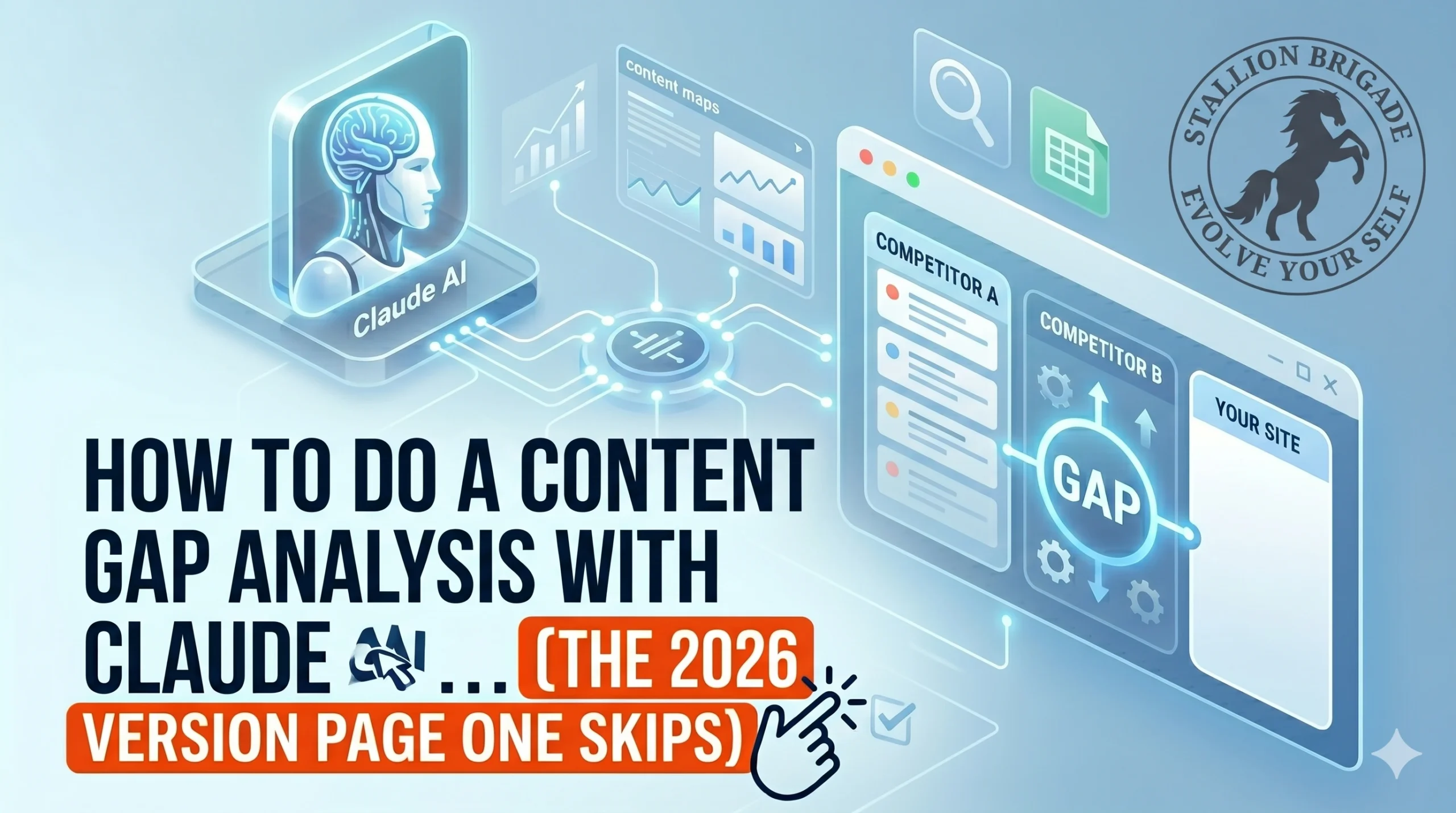
The Content Gap You’re Missing Isn’t a Keyword Gap – It’s a Citation Gap
The keyword gap you’ve been chasing isn’t the gap that’s costing you traffic anymore. The citation gap is.
Here’s the shift almost every “content gap analysis with Claude” guide misses: a competitor ranking below you on Google can consistently beat you in AI answers if their content is structured to be pulled as independent passages. That’s not a keyword problem a standard gap analysis catches. It’s a structural problem – and it’s where Claude’s real advantage lives in 2026. The data backs this hard: Moz’s 2026 analysis of 40,000 Google AI Mode queries found 88% of AI Mode citations come from pages not in the organic top 10. Every buyer question a competitor answers inside ChatGPT, Claude, or Google’s AI Overview but you don’t is measurable pipeline exposure. The old “find keywords they rank for and you don’t” approach catches none of it.
So let me give you both layers: the classic gap analysis that still matters, and the citation-gap analysis that page one barely mentions – written from the perspective of someone who runs both on live client sites, not a theorist summarizing tool docs.
Layer 1: The classic gap analysis (still necessary, no longer sufficient)
This is the workflow every listicle hands you, and it’s a fine starting point. The standard prompt:
“Identify content topics and formats that [Competitor 1], [Competitor 2], and [Competitor 3] have created but are missing from [my site]. Rank these gaps by estimated traffic value and conversion potential. For each, give me one angle neither I nor they currently cover.”
That last clause is the part most people drop, and it’s the most valuable. The difference between data and strategy is interpretation. “Competitor X published about AI” is data. “Competitor X covered AI but missed solopreneur budgeting – we should own that angle” is strategy. Claude is genuinely good at that second move if you ask for it. Without the “angle neither of us covers” instruction, you get a list of topics to copy – which just makes you the eleventh identical page in the cluster.
Feed Claude real inputs to make this work: paste competitor sitemaps (grab them at /sitemap.xml), an Ahrefs or SEMrush keyword-gap CSV export, and your own URL list. Claude can’t crawl live or invent search volume – it clusters and prioritizes the data you give it.
Layer 2: The citation gap (the 2026 frontier)
This is the analysis that actually separates winners now, and it’s barely covered on page one.
Instead of matching keywords, you cluster competitor URLs by topic architecture, identify which buyer questions each cluster answers, and find the patterns in how they structure content for extractability. This isn’t a vibe – it’s now peer-reviewed. The GEO-SFE study (Yu et al., arXiv, March 2026) kept semantic content identical and changed only structural features – formatting, hierarchy, chunking – then measured citation rates across six generative engines. The finding: structure alone moves citation rates, independent of the words. Shorter paragraphs with one claim per block, data in tables rather than inline, and comparison grids produced the strongest passage-level citation gains.
And length is a myth worth killing: Ahrefs studied 174,048 pages across 560,346 AI Overviews and found a Spearman correlation of just 0.04 between word count and citation position – essentially zero. Extractability beats length, every time.
The step-by-step:
- Pick competitors by AI presence, not market cap. Test your most important commercial queries in ChatGPT, Claude, and Perplexity. Record which brands appear in the answers. Those are the competitors to analyze – they’ve already proven they understand citation structure. Picking competitors by brand name is the most common mistake in this whole workflow.
- Cluster their architecture. Have Claude read the competitor sitemaps and group URLs by topic cluster and the buyer questions each answer.
- Map the citation strategy. Ask Claude to identify which content blocks are structured as independent, pullable passages versus buried in prose. The most extractable pattern, per GEO research, is question-heading → one-sentence direct answer → explanation.
- Score gaps by pipeline potential, then by white space. The highest-value category is the buyer questions no competitor has answered yet – pure white space.
The execution layer page one forgets
A gap list is worthless if it’s too big to execute. This is where I’ve watched smart teams stall: Claude hands them 80 gaps and they freeze.
The discipline: cap it. Pick the top 10 “ship first” gaps and commit to one new page per week over 90 days, each built around a citable block structure – lead with the quotable fact, make the first 200 words self-contained, add a comparison table where the query fits. Then measure – test a consistent set of priority buyer queries monthly across ChatGPT, Claude, Perplexity, and AI Overviews, and watch citation rate, not just ranking. The reason this matters: analysis of Q2 2026 citation data shows that primary research, comparison matrices, and extractable content earn citations across all five answer surfaces for 6–12 months post-publish.
One caveat worth your attention, because it reshapes strategy: roughly 84% of AI citations come from earned third-party media rather than brand-owned pages (Muck Rack, May 2026). So closing your owned citation gaps is necessary but not the whole game – original data that earns mentions elsewhere compounds faster.
The reason to cap competitors matters too: analyze three, not fifteen. More than that produces a gap list you can’t action inside a quarter, and an un-actioned analysis is just expensive procrastination.
The unfair-advantage step: make Claude think like you
Here’s the move that turns a generic gap report into yours. Before running anything, give Claude a short content-strategy profile – three to five bullets on your content pillars, your voice, and crucially your positioning: what makes your take different. That positioning line becomes a filter. When Claude finds a gap, it checks whether your angle would actually be different before recommending it. You’re not writing a brand book; you’re giving Claude enough to think like you instead of like the average of your niche. This single file is the difference between a gap analysis anyone could run and one only you could.
The bottom line
A content gap analysis with Claude in 2026 has two layers. The keyword gap tells you what to write. The citation gap tells you whether anyone – human or AI – will ever surface it. Run only the first and you’ll publish technically complete pages that lose in AI answers to competitors ranking beneath you. Run both, cap your scope, feed Claude your positioning, and you get a prioritized list of pages that close real pipeline exposure.
Stop asking “what are they ranking for that I’m not?” Start asking “what are they getting cited for that I’m not?” That’s the gap that pays.
FAQs
1. What’s the best Claude prompt for a content gap analysis? Start with: “Identify topics and formats [Competitor 1, 2, 3] cover that [my site] doesn’t. Rank by traffic value and conversion potential, and give me one angle neither of us covers for each.” The final clause is critical – it pushes Claude from listing topics to finding differentiated angles. Feed it real competitor sitemaps and a keyword-gap export, since Claude can’t crawl live.
2. Can Claude do a content gap analysis without paid SEO tools? Partly. Claude clusters and prioritizes any data you give it – competitor sitemaps (free at /sitemap.xml), your own content list, and pasted SERP results. But for accurate keyword volume and difficulty, you still need an Ahrefs or SEMrush export to feed in. Claude does the strategic reasoning; the paid tool supplies the quantitative data it can’t invent.
3. What is a citation gap, and why does it matter more now? A citation gap is a buyer question your competitor gets quoted for inside AI answers (ChatGPT, Claude, Perplexity, AI Overviews) while you don’t. It matters because AI citation correlates with content structure, not just ranking – Moz found 88% of AI Mode citations come from pages outside the organic top 10. So a site ranking below you on Google can still win the AI answer. Closing citation gaps is increasingly where qualified traffic is won.
4. How many competitors should I analyze at once? Three is the practical sweet spot. Pick them by testing your priority commercial queries in AI tools and noting which brands appear – not by market cap or brand recognition. Analyzing more than three or four produces a gap list too large to execute inside a 90-day window, which kills momentum before you ship anything.
5. How do I stop Claude’s gap analysis from being generic? Give it a short content-strategy profile first – your pillars, voice, and positioning in three to five bullets. That positioning becomes a filter Claude uses to check whether your angle on each gap would genuinely differ from competitors. Without it, Claude returns topics anyone could chase; with it, you get gaps matched to what only you can own.
About the author: This guide reflects hands-on experience running Claude-assisted content gap and citation analyses for client sites, cross-referenced against current GEO research including the GEO-SFE framework (arXiv, 2026), Ahrefs’ AI Overview datasets, and Moz’s 2026 AI Mode study. AI citation behavior and the structural signals that drive selection are evolving quickly through 2026 – treat the citation-rate figures here as directional findings from current industry analysis and validate against your own monthly query testing rather than as fixed guarantees.
For more related articles click here: