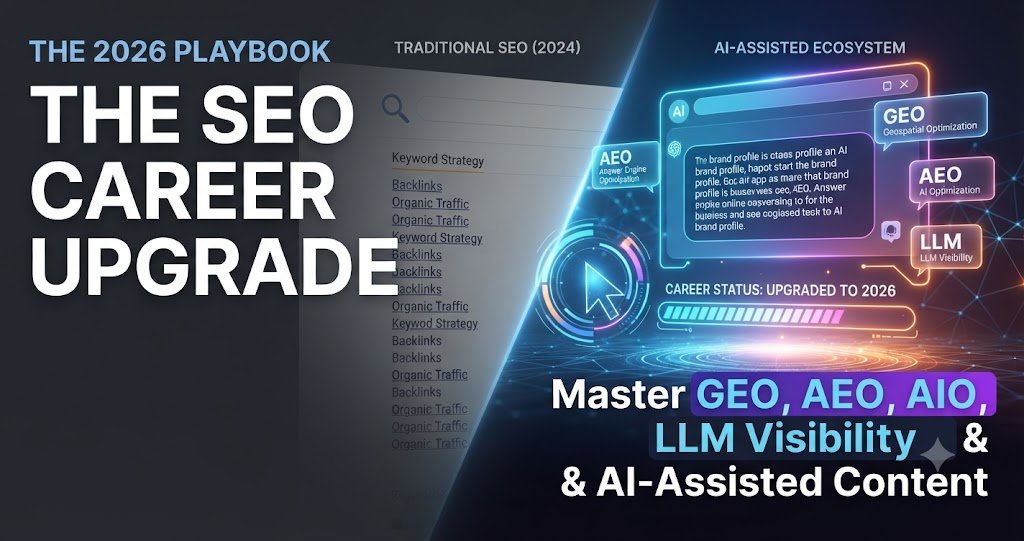
Go Beyond SEO: The Complete 2026 Roadmap to GEO, AEO, AIO, AI Search & LLM Visibility
If you want to develop this as a serious professional specialization, I would treat GEO/AEO/AIO not as five disconnected “new SEO techniques,” but as one integrated discipline:
AI-Era Search & Content Strategy
A practical 2026 roadmap for GEO, AEO, AIO, LLM visibility, AI-search optimization, content architecture and AI-assisted research
I checked the latest 2026 Google and OpenAI guidance as well as recent GEO research. One important conclusion is already clear: AI search has not replaced SEO. It has expanded the search optimization problem. Google explicitly says its AI search features are grounded in its existing Search systems and that traditional SEO best practices remain relevant. (ccn.web.tr)
Also, the terminology is still unsettled. GEO, AEO and AIO are not universally standardized disciplines, so your advantage should be understanding the underlying systems rather than memorizing labels.
1. First understand the new search ecosystem
The old mental model was:
Query → Google → SERP → Website → Click
The emerging model is closer to:
User need → conversational query → retrieval/search → source selection → synthesis → answer → citation/link → recommendation/action
And increasingly:
User → AI agent → web/search/tools → sources → decision/action
Google’s own documentation describes AI Overviews/AI Mode as using Search systems and retrieval techniques to surface relevant web content. (ccn.web.tr)
OpenAI’s current publisher guidance similarly emphasizes making content discoverable and citable in ChatGPT Search and specifically identifies OAI-SearchBot as the crawler relevant to search discovery. (help.openai.com)
So your ultimate discipline becomes:
How do we make an organization discoverable, retrievable, understandable, citable, credible and recommendable across search engines and AI systems?
That is a much stronger professional proposition than simply “GEO.”
2. Your master framework
I recommend that you organize everything you learn into seven layers:
AI-ERA SEARCH
│
┌──────────────┼──────────────┐
│ │ │
SEO AEO GEO
│ │ │
└──────────────┼──────────────┘
│
AI / LLM
VISIBILITY
│
CONTENT ARCHITECTURE
│
ENTITY + AUTHORITY
│
AI-ASSISTED RESEARCH
│
MEASUREMENT & TESTING
And beneath all seven:
Technical accessibility + crawlability + indexability + information quality + trust
That foundation remains essential.
3. MODULE 1 – Advanced SEO foundation
Do not skip this because you are moving into AI.
Google’s May 2026 AI-search guidance explicitly says SEO remains relevant to its generative AI features. (ccn.web.tr)
Master:
Technical SEO
- Crawling
- Rendering
- Indexing
- Canonicals
- Robots.txt
- XML sitemaps
- HTTP status codes
- JavaScript SEO
- Mobile performance
- Core Web Vitals
- Site architecture
- Log analysis
On-page SEO
- Search intent
- Titles
- Headings
- Content structure
- Internal linking
- Image optimization
- Entity references
- Metadata
Semantic SEO
- Topics
- Entities
- Attributes
- Relationships
- Search intent
- Query expansion
- Context
- Information gain
Authority
- Backlinks
- Digital PR
- Brand mentions
- Author credibility
- First-party expertise
- Third-party validation
Your practical project
Take one website and conduct a:
2026 AI-Ready SEO Audit
Score:
- Crawlability
- Indexability
- Content quality
- Entity clarity
- Topical authority
- Internal linking
- Structured data
- Author signals
- External authority
4. MODULE 2 – AEO
Answer Engine Optimization
AEO is about designing information so that answer systems can identify and communicate the answer efficiently.
Don’t reduce AEO to:
“Put questions in H2s.”
That’s only the most superficial level.
Learn:
Question intelligence
- Who
- What
- Why
- How
- When
- Where
- Which
- Comparison
- Cost
- Alternatives
- Best-for
- Troubleshooting
Query transformation
Traditional:
“best CRM software”
Conversational:
“Which CRM is best for a 20-person B2B SaaS company with a small sales team?”
Learn to map:
keyword → question → intent → scenario → decision
Answer architecture
Learn to structure pages with:
Direct answer → explanation → evidence → examples → comparison → caveats → next step
Advanced AEO
Study:
- Featured snippets
- People Also Ask
- FAQ systems
- Q&A structures
- Conversational search
- Voice search
- AI answers
- Follow-up questions
- Query fan-out
Important 2026 caveat: don’t over-invest in old “FAQ schema = AEO” thinking. Google removed FAQ rich-result documentation in 2026. (developers.google.com)
5. MODULE 3 – GEO
Generative Engine Optimization
This should become one of your flagship specialties.
The 2026 research literature increasingly treats GEO as a multi-stage visibility problem, not simply “ranking inside ChatGPT.” A recent survey describes the pipeline as involving search activation, crawling/indexing, retrieval, reranking, context allocation, citation, factual absorption and user behavior. (arxiv.org)
That’s an extremely important insight.
Your GEO model
I would teach it as:
1. Discoverability
Can the system find the source?
2. Retrieval
Can relevant content be retrieved?
3. Selection
Does the system choose your source?
4. Context allocation
Does enough of your content enter the model’s working context?
5. Citation
Does the system cite you?
6. Absorption
Does your information actually influence the answer?
7. Recommendation
Does the model recommend the brand/entity?
8. Conversion
Does the user click, contact, subscribe or purchase?
This is far more sophisticated than:
“How do I get ChatGPT to mention my website?”
6. GEO tactics to master
Study the relationship between:
Original information
First-hand experience
Statistics
Expert opinions
Clear definitions
Unique frameworks
Comparative information
Evidence
Citations
Brand/entity consistency
External mentions
Topical authority
Google’s 2026 guidance specifically emphasizes non-commodity content for generative AI features. (developers.google.com)
That’s a major strategic signal.
The future isn’t:
“Generate 10,000 AI articles.”
It is:
“Create information that AI systems have a reason to retrieve.”
7. MODULE 4 – AIO
I would use AIO = AI Optimization in your professional curriculum, but explicitly explain that the acronym is used inconsistently in the industry.
Your definition:
AI Optimization is the broader discipline of preparing digital information, entities, content, websites and brands for discovery, interpretation and use by AI systems.
AIO therefore encompasses:
SEO + AEO + GEO + Entity Optimization + AI-readable content + machine accessibility + AI visibility measurement
Think of it as the umbrella discipline.
8. MODULE 5 – LLM Visibility
This is where your specialization can become genuinely advanced.
Don’t ask merely:
“Does ChatGPT mention my company?”
Measure multiple dimensions.
Build an LLM Visibility Score
For each query:
Visibility
Was the brand mentioned?
Position
Where did it appear?
Prominence
Was it central or incidental?
Citation
Was the website/source cited?
Accuracy
Was the information correct?
Sentiment
Was the description positive, neutral or negative?
Competitor share
Which competitors were mentioned?
Recommendation
Was the brand recommended?
Source quality
Which sources influenced the answer?
Consistency
Does the result repeat across runs?
9. The 2026 measurement problem
This is an area where you can build original intellectual property.
Recent GEO research highlights substantial variability between runs and limited evidence that individual optimization tactics produce stable cross-platform effects. (arxiv.org)
Another 2026 empirical study found that AI-generated search experiences can retrieve substantially different sources from traditional Google results and can vary across repeated or slightly modified queries. (arxiv.org)
Therefore:
Never report:
“We tested ChatGPT once and our brand appeared.”
Instead:
100 queries × 5 variants × 3–5 runs × multiple platforms
Then calculate:
Mention Rate
Citation Rate
Recommendation Rate
Source Overlap
Competitor Share of Voice
Answer Accuracy
That would make your work much more scientifically credible.
10. MODULE 6 – AI Search Optimization
This is broader than GEO.
You should study:
- AI Overviews
- AI Mode
- Search Console
- Discover
- Top Stories
- Preferred Sources
- Search appearance
- Structured data
Google now documents AI Overviews and AI Mode as part of its Search ecosystem, and AI Mode data is incorporated into Search Console reporting. (developers.google.com)
Google also expanded Preferred Sources into AI Overviews and AI Mode in 2026. (developers.google.com)
ChatGPT
Understand:
- Search discovery
- OAI-SearchBot
- Search citations
- Referral traffic
- Publisher controls
- robots.txt
- GPTBot vs OAI-SearchBot
OpenAI explicitly distinguishes search discovery from model-training controls; allowing search crawling is not the same thing as allowing training. (help.openai.com)
Other systems
Research:
- Gemini
- Perplexity
- Claude
- Copilot
- AI-native search engines
- Browser agents
- AI shopping systems
- AI recommendation systems
Claude, for example, now supports web search with citations and multi-step searching, demonstrating why optimization increasingly concerns systems that dynamically retrieve web information rather than relying only on static model knowledge. (docs.anthropic.com)
11. MODULE 7 – Entity SEO
I would make this a major pillar of your curriculum.
Learn:
Entities
Person
Organization
Product
Place
Concept
Event
Service
Then:
Attributes
Name
Description
Category
Location
Founder
Products
Services
Relationships
Credentials
Publications
Then:
Entity relationships
Nashaat Quadri
│
├── Digital Marketing
├── SEO
├── Content Marketing
├── GEO
├── AI Search
├── Publications
├── Speaking
└── Organizations
This becomes especially important for personal branding.
Your goal isn’t simply:
“Nashaat Quadri has a website.”
Your goal is:
“Nashaat Quadri is an identifiable, consistently described expert entity associated with specific topics across many authoritative sources.”
12. MODULE 8 – Knowledge Graphs
Study:
- Schema.org
- JSON-LD
- Wikidata
- Knowledge Graph concepts
- Entity resolution
- SameAs
- Organization schema
- Person schema
- Article schema
- ProfilePage
- Author relationships
- Product entities
- Place entities
Google continues to use structured data to understand page content and support eligible search features. (developers.google.com)
But remember:
Structured data is an interpretation aid, not a magic ranking button.
13. MODULE 9 – Content Architecture
This may ultimately become one of your strongest skills.
Move from:
Keyword → Article
to:
Entity → Topic → Intent → Journey → Content System
Example:
Entity
AI Search
↓
Pillar
AI Search Strategy
↓
Clusters
AI Overviews
AI Mode
GEO
AEO
LLM visibility
AI citations
AI content
Entity SEO
↓
Questions
What is GEO?
How does AI search work?
How does ChatGPT select sources?
How can brands measure AI visibility?
↓
Commercial intent
AI search consultancy
AI search audit
GEO tools
AI visibility software
This creates a knowledge architecture, not a pile of blog posts.
14. Your content architecture model
I recommend this:
PILLAR
│
┌──────────┼──────────┐
│ │ │
TOPIC ENTITY INTENT
│ │ │
CLUSTER RELATIONSHIP QUERY
│ │ │
ARTICLES REFERENCES ANSWERS
│ │ │
└──────────┼──────────┘
│
EVIDENCE
│
AUTHORITY
│
AI RETRIEVAL
15. MODULE 10 – Information Gain
This should be one of your signature concepts.
Ask of every article:
What does this page contain that the other 20 pages don’t?
Possible sources:
- Original research
- First-party data
- Expert interviews
- Experiments
- Surveys
- Proprietary frameworks
- Calculations
- Case studies
- Screenshots
- Real-world experience
- Unique examples
This is where AI-generated commodity content becomes vulnerable.
Google’s current guidance explicitly warns against scaled content created primarily to manipulate Search, including low-value mass AI-generated pages. (developers.google.com)
16. MODULE 11 – AI-Assisted Research
This should become a professional research methodology, not merely “ask ChatGPT to research.”
Build a workflow:
Step 1 – Define the research question
Bad:
“Tell me about GEO.”
Good:
“What measurable factors influence whether a brand is cited in AI-generated search responses?”
Step 2 – Hypothesis
Example:
Brands with strong third-party authority and distinctive first-party information will receive higher AI citation rates than brands relying primarily on generic SEO content.
Step 3 – Search
Use:
- Google Scholar
- AI search
- Industry publications
- Government sources
- Academic papers
- First-party documentation
- Reddit/forums where appropriate
- Company documentation
Step 4 – Source classification
Classify evidence:
Primary
Secondary
Expert
Commercial
Anecdotal
Unverified
Step 5 – AI-assisted extraction
Use AI to extract:
- Claims
- Statistics
- Contradictions
- Definitions
- Trends
- Entities
- Citations
- Research gaps
Step 6 – Human verification
This is critical.
AI should be:
Research assistant
not
Research authority.
Step 7 – Synthesis
Create:
Evidence → Pattern → Insight → Hypothesis → Recommendation
Step 8 – Original contribution
Ask:
What can I add that wasn’t already there?
That’s how you transition from content creator to thought leader.
17. MODULE 12 – AI-assisted content production
Build a sophisticated workflow.
Stage 1
Research
↓
Stage 2
SERP analysis
↓
Stage 3
AI search analysis
↓
Stage 4
Competitor content analysis
↓
Stage 5
Entity extraction
↓
Stage 6
Content brief
↓
Stage 7
Human expert input
↓
Stage 8
AI-assisted drafting
↓
Stage 9
Fact verification
↓
Stage 10
Originality / information gain
↓
Stage 11
SEO optimization
↓
Stage 12
GEO/AEO optimization
↓
Stage 13
Human editorial review
↓
Stage 14
Distribution
↓
Stage 15
Measurement
This is the AI Content Operating System you should learn to design.
18. MODULE 13 – Technical AI accessibility
You need to understand the machines that access your content.
Study:
robots.txt
XML sitemap
meta robots
canonical
structured data
rendering
accessibility
ARIA
crawl permissions
bot management
content APIs
RSS/feeds
machine-readable information
For example, OpenAI currently identifies OAI-SearchBot for ChatGPT search discovery and GPTBot separately for potential training controls. (help.openai.com)
Google’s current guidance also makes clear that pages need to be crawlable/indexable and eligible for Search to be eligible for its generative search features. (ccn.web.tr)
19. MODULE 14 – AI agents
This is the next frontier you should learn.
Don’t stop at:
AI answers
Study:
AI agents → websites → actions
Examples:
AI agent:
finds hotel → compares → checks availability → books
or:
finds software → evaluates → visits website → starts signup
This means future optimization may increasingly involve:
machine-readable interfaces + accessibility + structured information + APIs + transactional compatibility.
Google’s 2026 AI-search guidance already includes initial discussion of AI agents. (developers.google.com)
20. MODULE 15 – Measurement
Build a professional dashboard.
Traditional SEO
Organic traffic
Impressions
Clicks
CTR
Rankings
Conversions
AEO
Answer visibility
Featured snippets
Question coverage
PAA visibility
GEO
AI mentions
AI citations
Citation share
Recommendation rate
Source frequency
LLM
Brand presence
Entity accuracy
Sentiment
Competitor share
Prompt coverage
Business
Leads
Revenue
Assisted conversions
Brand searches
Direct traffic
Pipeline influence
21. Create your own AI Visibility Score
This is where I think Nashaat Quadri can create intellectual property.
For example:
QVIS
Quadri Visibility Index for Search & AI
Potential components:
| Dimension | Weight |
| Search visibility | 15% |
| AI mention visibility | 15% |
| Citation visibility | 15% |
| Entity authority | 15% |
| Content authority | 15% |
| Third-party authority | 10% |
| Recommendation visibility | 10% |
| Conversion impact | 5% |
Don’t use these weights blindly. Research and validate them.
Eventually, you could publish:
The Quadri AI Visibility Index – 2027
That becomes your proprietary research asset.
22. What NOT to waste time on
This is equally important.
❌ Don’t become obsessed with llms.txt
Google’s June 2026 documentation explicitly says llms.txt is not needed for Google Search and does not positively or negatively affect visibility/rankings, although publishers may maintain it for other services. (developers.google.com)
❌ Don’t mass-produce AI articles
Google’s spam policies explicitly include low-value scaled AI content under scaled-content abuse. (developers.google.com)
❌ Don’t believe “GEO hacks”
There is no established universal:
“Do X and ChatGPT will cite you.”
The current research itself warns that evidence for stable, cross-platform causal effects is still limited. (arxiv.org)
❌ Don’t equate citations with visibility
A page can be:
retrieved but not cited
or:
cited but barely influential
or:
mentioned without a citation.
Measure the whole pipeline.
❌ Don’t abandon traditional SEO
That’s probably one of the biggest mistakes a 2026 “GEO expert” can make.
23. Your 12-month learning roadmap
MONTHS 1–2
Advanced SEO + Search Systems
Master:
- Technical SEO
- Search intent
- Semantic SEO
- Entities
- Information architecture
- Search Console
- Structured data
Project: Complete an AI-ready SEO audit.
MONTHS 3–4
AEO
Master:
- Conversational search
- Question intelligence
- Answer architecture
- Query expansion
- Search journeys
- Featured snippets
- AI answers
Project: Build a 500-question Answer Intelligence Database.
MONTHS 5–6
GEO
Master:
- Retrieval
- Citation
- Source selection
- Authority
- Information gain
- AI visibility
- Prompt testing
Project: Run a 100-query GEO experiment.
MONTHS 7–8
LLM Visibility
Test:
ChatGPT
Gemini
Claude
Perplexity
and relevant Google AI experiences.
Build:
AI Visibility Dashboard
MONTHS 9–10
Content Architecture
Build:
- Entity maps
- Topic maps
- Content clusters
- Search journeys
- Knowledge architecture
- Content refresh systems
Project: Redesign an entire website’s content architecture.
MONTHS 11–12
AI Research + Thought Leadership
Publish:
1 white paper
1 major research study
1 ebook
12+ expert articles
12 podcast episodes
12+ LinkedIn research posts
1 webinar/masterclass
24. Your weekly learning schedule
I’d make this manageable alongside your existing work.
Monday
1 hour – Search/SEO
Tuesday
1 hour – AI/GEO research
Wednesday
1 hour – Experiment
Thursday
1 hour – Content architecture
Friday
1 hour – AI-assisted research
Saturday
2–3 hours – Build
Sunday
1 hour – Publish/document
The crucial part:
Every week you should produce something.
Not just consume courses.
25. Your portfolio should ultimately contain these 10 projects
If you complete these, you’ll have an extraordinary professional portfolio:
Project 1
AI-Ready SEO Audit Framework
Project 2
500-Question AEO Database
Project 3
100-Query GEO Experiment
Project 4
LLM Brand Visibility Dashboard
Project 5
Entity Authority Audit
Project 6
AI Content Architecture Framework
Project 7
AI-Assisted Research Methodology
Project 8
AI Citation Gap Analysis
Project 9
AI Brand Visibility Index
Project 10
AI Search Strategy Playbook
These are much more valuable in an interview than simply listing:
“GEO, AEO, ChatGPT, Gemini, AI.”
26. And this should become your professional specialization
I’d position you as:
Nashaat Quadri
AI-Era Content & Search Strategist
Specializing in:
SEO + AEO + GEO + Entity SEO + LLM Visibility + AI Search + Content Intelligence
And your core proposition:
I help organizations transition from ranking in search engines to becoming discoverable, citable and recommendable across search engines and AI systems.
That’s substantially more defensible than calling yourself an “AI SEO Expert.”
27. The 2026 reality you should keep in mind
The field is still young.
That’s actually excellent news for you.
A July 2026 critical survey of GEO research found 45 relevant studies from 2023–2026 and concluded that terminology, metrics and evidence standards remain heterogeneous. It also found that many published techniques have been tested only in constrained settings rather than demonstrating durable cross-platform effects. (arxiv.org)
In other words:
Don’t merely learn the field. Help define the field.
That is where I see the biggest opportunity for your personal brand.
Your long SEO/content experience gives you something many new AI-search practitioners don’t have: you understand the pre-AI search ecosystem. Your next step is to combine that experience with rigorous experimentation in AI retrieval, citations, entities, content architecture and measurement.
And because Google is still actively changing its AI-search documentation in 2026-for example, adding AI-search optimization guidance, expanding Preferred Sources into AI features, changing Search Console treatment of AI Mode, and removing outdated FAQ guidance-you should treat this as a living discipline, not a fixed certification syllabus. (developers.google.com)
The ultimate learning loop
LEARN → TEST → MEASURE → DOCUMENT → PUBLISH → DISCUSS → TEACH → REFINE
That loop can simultaneously build your skills, portfolio, authority, personal brand, books, white papers, podcast and eventually consulting/speaking opportunities.