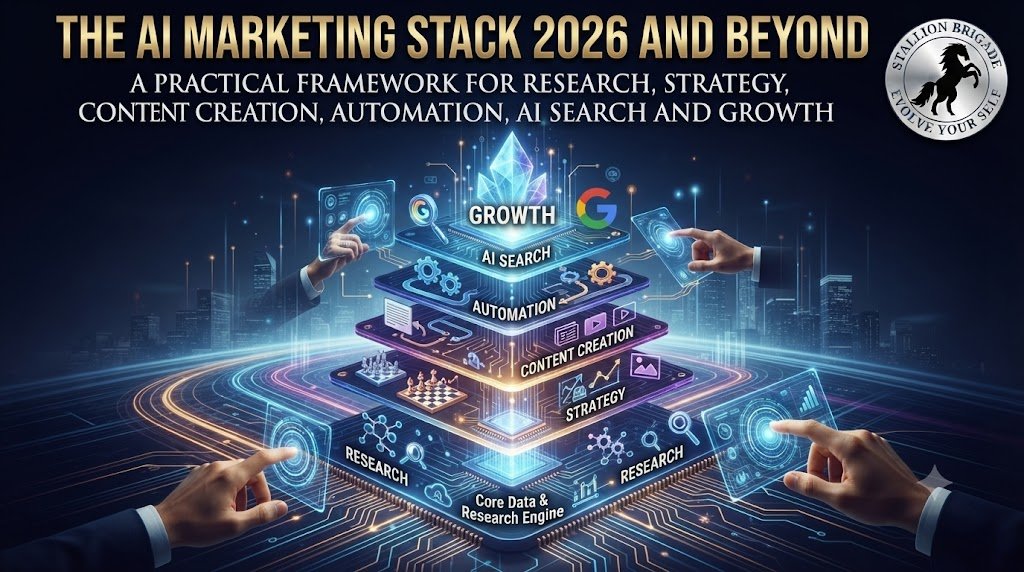
A practical framework for research, strategy, content creation, automation, AI Search and growth
There is a strange problem with AI marketing in 2026.
The number of AI tools is exploding.
But having more tools doesn’t necessarily make a marketing team more productive.
It can make the team slower.
The most important shift is that AI is moving from a content-production tool to a marketing operating layer. Google, for example, says AI Mode had passed 1 billion monthly active users by May 2026, while Google Ads and Analytics are adding agentic capabilities that can move from insight toward action. (blog.google)
Every new tool introduces:
- another login
- another subscription
- another workflow
- another data silo
- another interface to learn
- another AI-generated output to review
- another integration that can break
- another person who needs to understand it
And suddenly the team that was supposed to save time with AI is spending its time managing AI tools.
That’s the paradox of the 2026 AI marketing stack:
More AI does not automatically mean more productivity. Better-designed workflows do.
A recent Zapier analysis found that overlapping tools are already a barrier to realizing AI value, while its 2026 research also found that most professionals expect AI spending to increase. (Zapier)
So the question is no longer:
“What are the best AI tools?”
The better question is:
“What marketing work are we trying to improve: and which combination of tools can improve it without making the system harder to operate?”
1. The AI Marketing Pyramid Is a Map, Not a Ranking
The AI-tool pyramid in this guide should not be interpreted as:
Top = best.
It isn’t.
Position does not prove:
- quality
- reliability
- value
- suitability
- ROI
- ease of adoption
The same tool can also belong to multiple categories.
For example, an AI assistant can support research, writing, analysis, coding, strategy and automation.
A platform such as Gamma can support presentations, documents and visual content.
An automation platform can become an AI-agent platform.
A video platform can increasingly handle scripting, avatars, voice, editing and localization.
So think of the pyramid as a functional map.
Your job is not to own the whole pyramid.
Your job is to build the smallest stack that reliably moves work from idea to outcome.
2. The 2026 Reality: AI Is Becoming the Baseline
AI adoption is no longer an interesting differentiator by itself.
HubSpot’s 2026 marketing research describes AI as increasingly becoming table stakes and reports that 98% of surveyed marketing teams use AI in some form. Its research also says that the more advanced use cases are moving beyond simple content generation toward strategic intelligence and business-context-driven decisions. (HubSpot Offers)
That distinction matters.
In the first phase of generative AI, marketers asked:
“Can AI write this?”
Now the better question is:
“Can AI help us make better marketing decisions?”
That is a much bigger opportunity.
AI can help determine:
- what customers are asking
- which audiences are changing
- what competitors are doing
- where demand is emerging
- which content is underperforming
- which leads deserve attention
- which campaigns need intervention
- which opportunities are worth pursuing
Content generation is only one part of that system.
3. Start With the Work, Not the Software
Before buying an AI tool, write down the workflow.
For example:
Customer research → strategy → content brief → production → review → publishing → distribution → measurement → optimization
Now identify the bottleneck.
Is it:
- research?
- writing?
- design?
- video?
- repetitive reporting?
- lead qualification?
- campaign analysis?
- SEO?
- AI Search visibility?
- automation?
- approval?
- data fragmentation?
Only then should you evaluate software.
A useful rule is:
Don’t start with “What can this tool do?” Start with “Which recurring problem will this tool remove?”
4. Layer One: Your General AI Assistant
Examples from the current ecosystem include:
- ChatGPT
- Claude
- Perplexity
- Gemini
Don’t begin by asking which one is universally “best.”
Instead, run the same real marketing brief through the assistants.
Give them:
- the same audience
- the same product
- the same objective
- the same source material
- the same constraints
- the same desired output
Then evaluate:
1. Strategic usefulness
Did it understand the business problem?
2. Factual reliability
Did it distinguish evidence from assumptions?
3. Depth
Did it surface insights you hadn’t considered?
4. Editing burden
How much human correction was required?
5. Workflow fit
Can the team actually use it repeatedly?
6. Integration
Can it work with the information and tools your team already uses?
The winner of your internal test doesn’t need to be the winner of somebody else’s benchmark.
It needs to be the assistant your team can use well every week.
5. The AI Assistant Is Becoming an Interface to Work
This is one of the biggest changes of 2026.
AI assistants are increasingly moving from:
“Ask me a question.”
toward:
“Give me a goal and let me help execute the workflow.”
Google’s 2026 Search developments illustrate this transition particularly clearly: Google introduced Search agents that can operate in the background to monitor information, while its marketing products are gaining agentic capabilities that can surface insights and help marketers take action. (blog.google)
This changes how marketers should think about assistants.
The assistant isn’t simply another writing application.
It can become a control layer across knowledge, analysis and execution.
6. Layer Two: Research and Knowledge
The Pin places tools such as:
- Gemini
- NotebookLM
- Grammarly
in the research/writing area.
The important distinction here is not the brand.
It is the quality of the information you provide.
AI research becomes dramatically more useful when you give it trusted material:
- product documentation
- research papers
- customer interviews
- campaign data
- sales transcripts
- analytics
- internal reports
- approved messaging
- case studies
- competitor evidence
This leads to one of the most important principles in AI marketing:
Context beats clever prompting.
A beautifully written prompt with weak information can produce a beautifully written bad answer.
A simple prompt with excellent source material can produce a much more useful result.
7. Fluent Does Not Mean True
This deserves its own rule.
An AI can produce a confident paragraph.
That does not make the paragraph evidence.
For marketing teams, the workflow should therefore be:
AI research → source identification → verification → human judgment → publication
not:
AI research → copy → publish
This becomes particularly important for:
- statistics
- market sizes
- customer claims
- medical claims
- financial claims
- legal statements
- product specifications
- competitor information
- current events
The more consequential the claim, the stronger the verification requirement.
8. Layer Three: Productivity
The Pin includes tools such as:
- Notion
- Otio
- Wispr
- Manus
But productivity should not mean:
“We have an AI note-taking tool.”
It should mean:
“We removed a repeated source of friction from the workflow.”
Find one task your team performs every day.
For example:
Meeting → transcript → summary → action items → task assignment
Now measure the current process.
Perhaps it takes:
45 minutes.
Introduce AI.
Now measure the entire process:
recording + transcription + AI processing + review + corrections + assignment.
Maybe the new process takes:
12 minutes.
That is a meaningful improvement.
But if AI produces the first draft in two minutes and your team spends 25 minutes fixing it, you haven’t saved 43 minutes.
You’ve created a different workflow.
9. The Full-Cycle Productivity Test
Never measure only:
Time to first output.
Measure:
Time to acceptable final output.
That’s a much better AI productivity metric.
Track:
Setup time
Generation time
Review time
Correction time
Approval time
Publishing time
=
True workflow time
This simple calculation can eliminate a surprising amount of AI-tool hype.
10. Layer Four: Development and No-Code
The Pin includes:
- Cursor
- Lovable
- Replit
- Base44
- Gamma
- Emergent
This category represents another major change:
Marketers can increasingly prototype software.
A marketer no longer necessarily needs to wait for a full engineering cycle to test a simple idea.
They can prototype:
- calculators
- landing pages
- campaign dashboards
- internal tools
- lead qualification interfaces
- content utilities
- interactive reports
- simple customer experiences
- research tools
But there is an important rule:
Prototype quickly. Connect production systems carefully.
Start with:
sample data → controlled test → user feedback → security review → production integration
Do not immediately connect an experimental AI-generated application to:
- customer databases
- payment systems
- sensitive personal data
- production CRM records
- critical business infrastructure
Speed is useful.
Uncontrolled access is not.
11. Layer Five: Content Creation
The Pin includes tools such as:
- HeyGen
- Synthesia
- Descript
- OpusClip
- Beehiiv
- Gamma
- Chatbase
This is where many marketing teams make their first AI mistake.
They optimize for:
content volume.
But the internet does not need another thousand average videos.
The question is:
Can AI help us make one strong idea travel further?
For example:
One research report
could become:
- an article
- LinkedIn post
- newsletter
- YouTube video
- YouTube Short
- Instagram Reel
- infographic
- podcast discussion
- sales presentation
- webinar
- lead magnet
This is content orchestration.
The value isn’t producing more ideas.
It is increasing the useful lifespan and distribution of the ideas you already own.
12. AI Video Has Changed the Economics of Content
AI video and synthetic media have moved rapidly beyond simple talking avatars.
Current tools increasingly combine:
- text-to-video
- image-to-video
- AI avatars
- synthetic voices
- automatic editing
- subtitles
- localization
- background generation
- music
- visual effects
- repurposing
Google’s 2026 marketing push also places generative AI directly inside advertising and creative workflows, including AI-generated assets for campaigns. (Google)
That means the bottleneck is shifting.
It used to be:
“Can we create the asset?”
Increasingly it becomes:
“Do we have a good enough idea to deserve an asset?”
That is a strategic problem: not a software problem.
13. Layer Six: Visual and Audio Creation
The Pin highlights:
- Midjourney
- Runway
- Kling
- Higgsfield
- Veo
- ElevenLabs
- Suno
- Artlist
Again, don’t judge the tool by its demo.
Judge the production workflow.
Run one controlled creative brief through the candidate tools.
Evaluate:
Creative quality
Does it fit the concept?
Brand fit
Does it look like your brand?
Consistency
Can you reproduce the style?
Editing burden
How much manual correction is required?
Rights
Can you legally use the output for your intended purpose?
Export
Can you get the resolution, format and duration you actually need?
Revision speed
How quickly can you fix something?
Cost
What is the true cost per usable asset?
The important metric isn’t:
“How impressive was the demo?”
It is:
“How many usable, publishable assets can this workflow produce at an acceptable cost?”
14. A New Layer the Original Pyramid Needs: AI Search & SEO
This is perhaps the biggest addition I would make to the 2026 version.
Your marketing stack should not stop at:
create → automate.
It also needs:
DISCOVER → RETRIEVE → CITE → CONVERT
AI Search is changing how customers discover information.
Google says AI Mode had surpassed one billion monthly active users by May 2026. It also says AI Mode queries have more than doubled each quarter since launch and that overall Search queries reached an all-time high. (blog.google)
Google’s AI Search guidance describes systems that can explore multiple related searches before generating an answer.
This means marketers need tools and processes for:
- traditional SEO
- keyword intelligence
- content gaps
- entity research
- AI visibility
- citation monitoring
- competitor visibility
- content retrieval
- search intent
- AI-answer analysis
The important point:
AI Search optimization is not a separate replacement for SEO. It is an additional layer on top of strong search fundamentals.
Google continues to emphasize technical accessibility, useful content and established SEO fundamentals for AI Search. (blog.google)
15. Search Is Becoming Multimodal
This is another easily overlooked development.
Google reported in June 2026 that more than one in six AI Mode queries were entirely non-text, while image searches were growing by more than 40% month over month. Google also reported more than 25 billion monthly Google Lens searches, with 1 in 5 showing commercial intent. (Google)
That means the future marketing asset isn’t always:
a webpage containing keywords.
It can be:
- an image
- a product photograph
- a video
- a voice query
- a screenshot
- a visual demonstration
- structured product information
- a YouTube video
- a conversational answer
Search optimization is becoming increasingly multimodal.
16. Layer Seven: Automation
At the foundation of the Pin are:
- Canva
- Figma
- Design
- Lindy
- n8n
- Make
- Zapier
- Apollo
- Clay
- Apify
These aren’t interchangeable.
And automation is where poor tool selection can become particularly expensive.
An automation isn’t valuable because it has 20 steps.
It’s valuable because it reliably removes a meaningful amount of manual work.
Consider:
Lead arrives
↓
Enrichment
↓
Qualification
↓
CRM update
↓
Personalized outreach
↓
Sales notification
↓
Follow-up
That’s a workflow.
But now ask:
- What happens if enrichment fails?
- What happens if the email is wrong?
- What happens if the lead is duplicated?
- What happens if the AI misclassifies the prospect?
- Who owns the exception?
- Can someone pause the automation?
- Is there an audit trail?
A mature automation system needs failure handling, not just successful-path design.
17. The AI Agent Era
This is where 2026 becomes different from 2024.
A chatbot waits for instructions.
An automation follows predefined rules.
An AI agent can increasingly:
observe → reason → decide → use tools → evaluate → continue
This creates enormous opportunities for marketing.
Imagine an SEO agent that:
- monitors Search Console
- detects declining pages
- analyzes search queries
- identifies possible causes
- compares competing pages
- prepares a refresh brief
- proposes internal links
- creates a draft
- sends it for human approval
The important word is:
approval.
The agent can perform the work.
The human remains accountable for the decision.
18. Automation Does Not Mean Autonomy
This distinction will become increasingly important.
Automation
“Do this sequence.”
AI-assisted workflow
“Analyze this and suggest what should happen.”
Agentic workflow
“Work toward this goal using approved tools and constraints.”
Autonomous system
“Act without requiring human approval.”
These are not the same thing.
The closer your workflow gets to autonomous action, the more important you need:
- permissions
- monitoring
- logging
- human escalation
- rollback
- spending limits
- data controls
- quality gates
19. The Hidden Layer: Data
There is another part missing from most AI-tool pyramids.
Data.
Your AI tools are only as useful as the information they can safely access.
Imagine two marketing teams.
Team A
Uses 15 AI tools.
But customer data lives separately in:
- CRM
- spreadsheets
- analytics
- support software
- project management
- ad platforms
Team B
Uses six tools.
But its important business context is connected and accessible.
Team B may have a much stronger AI system.
This is why AI marketing maturity increasingly depends on:
context architecture.
20. Context Is the New Competitive Advantage
An AI model may be available to everyone.
Your company’s:
- customer data
- campaign history
- product knowledge
- sales calls
- proprietary research
- customer objections
- winning creatives
- internal processes
- brand voice
- first-party insights
are not.
This creates a strategic equation:
Generic AI capability = increasingly commoditized
Proprietary context + AI capability = differentiated advantage
That’s why connecting AI to your real business knowledge can be more valuable than buying another standalone AI writer.
21. Marketing AI Is Moving Toward Intelligence, Not Just Automation
This may be the most important transition.
Phase 1
AI creates.
Phase 2
AI automates.
Phase 3
AI analyzes.
Phase 4
AI recommends.
Phase 5
AI executes within boundaries.
Phase 6
Humans supervise an interconnected AI marketing system.
Google’s 2026 marketing products reflect this direction: Ask Advisor is positioned as an AI agent inside Google Ads and Analytics that can surface insights and help marketers take action. (blog.google)
So the future marketing team may not be:
human + 20 tools.
It may become:
human strategist + AI assistants + specialized agents + connected business data + controlled automation.
22. The Stack Should Become Smaller as It Becomes Smarter
This sounds counterintuitive.
But it is important.
You don’t want:
ChatGPT + Claude + Gemini + Perplexity + five AI writers + three image generators + four video generators + six automation tools + three analytics assistants
just because they exist.
Instead:
Core layer
1–2 general AI assistants.
Knowledge layer
One reliable research/knowledge system.
Content layer
A small set of creation tools.
Automation layer
One primary automation platform, supplemented only when necessary.
Data layer
CRM + analytics + clean first-party information.
Search layer
SEO + AI Search visibility + measurement.
Agent layer
Only where an agent can safely own a repeatable workflow.
This is a composable stack, not a collection.
23. The One-Owner Rule
Every AI workflow should have an owner.
Not:
“Marketing owns it.”
But:
“Priya owns the weekly lead-enrichment workflow.”
The owner should know:
- what the workflow does
- what success means
- where it can fail
- how to pause it
- how to fix it
- what data it uses
- how much it costs
Without ownership, automation becomes nobody’s responsibility.
24. The One-Use-Case Rule
Before adding a new AI tool, define:
The task
What exactly will it do?
The baseline
How do we do it today?
The cost
How much time and money does today’s process consume?
The target
What improvement would justify adoption?
The test
What real workflow will we use?
The owner
Who will maintain it?
The exit criteria
When will we stop using it?
This prevents AI-tool accumulation.
25. The Full AI Tool Evaluation Framework
Instead of asking:
“Is this tool good?”
score it against your own workflow.
Workflow Fit
Does it solve a real repeated problem?
Output Quality
Is the result actually usable?
Context
Can it work with your information?
Integration
Does it connect to your existing stack?
Reliability
Does it behave consistently?
Review Burden
How much human correction is required?
Total Cost
Include subscriptions, API usage and human review.
Data Risk
What information does it access?
Scalability
Does it still work when volume increases?
Exit Cost
Can you replace it without rebuilding your business?
26. The “AI ROI” Formula Needs Updating
Don’t calculate AI ROI like this:
hours saved × hourly cost
That’s incomplete.
A better approximation is:
AI value = time saved + quality improvement + revenue impact + decision speed − software cost − review cost − rework − risk
For content, for example:
100 AI-generated articles
is not necessarily better than
20 high-value articles
if the first set requires heavy editing and produces little business value.
The metric should be:
Value per completed workflow.
Not:
Output per prompt.
27. The Biggest Hidden Cost: Review
AI makes creation cheap.
It can make quality control expensive.
Suppose a team generates:
10× more content.
But every piece requires:
- fact checking
- brand review
- SEO review
- legal review
- editing
- image review
- publishing
- updating
The team may have increased its workload.
This is why the real bottleneck may shift from:
production
to:
verification.
The answer isn’t necessarily to remove human review.
It is to design a risk-based review.
Low-risk tasks:
high automation
High-risk tasks:
mandatory human review
28. The Human-in-the-Loop Matrix for Marketing AI
| Marketing Task | AI Role | Human Ownership |
| Brainstorming | High | Medium |
| Keyword clustering | High | Medium |
| Research synthesis | High | High |
| Competitor analysis | High | High |
| Strategy | Assist | Very high |
| Positioning | Assist | Very high |
| First draft | High | High |
| Fact verification | Assist | Very high |
| Original research | Assist | Very high |
| Design variations | High | Medium |
| Video editing | High | Medium |
| Repurposing | Very high | Medium |
| Reporting | Very high | Medium |
| Performance diagnosis | High | High |
| Budget decisions | Assist | Very high |
| Lead qualification | High | High |
| Customer communication | Assist | High |
| Campaign execution | High | High |
| Autonomous spending | Limited | Very high |
| Brand/legal decisions | Assist | Very high |
The principle is simple:
The more consequential the decision, the stronger the human control.
29. The New Marketing Stack Is Not a Pyramid
Ultimately, the pyramid is useful for discovering tools.
But a real marketing operation looks more like this:
BUSINESS GOAL
↓
CUSTOMER + DATA
↓
STRATEGY
↓
AI RESEARCH
↓
CONTENT / CREATIVE
↓
DISTRIBUTION
↓
AUTOMATION
↓
MEASUREMENT
↓
AI ANALYSIS
↓
HUMAN DECISION
↓
OPTIMIZATION
The loop matters more than the tools.
30. An AI Marketing Stack for 2027 and Beyond
A mature stack could eventually look like:
Layer 1 : Intelligence
ChatGPT / Claude / Gemini / Perplexity
Layer 2 : Knowledge
Company knowledge base + research sources + first-party data
Layer 3 : Search Intelligence
SEO + AI Search + citation/visibility monitoring
Layer 4 : Creation
Text + image + video + audio + presentations
Layer 5 : Productivity
Notes + meetings + documents + collaboration
Layer 6 : Development
AI coding + no-code + rapid prototyping
Layer 7 : Automation
n8n / Make / Zapier / other workflow infrastructure
Layer 8 : Agents
Specialized agents operating within controlled boundaries
Layer 9 : Measurement
Analytics + attribution + CRM + AI visibility + business KPIs
Layer 10 : Human Governance
Strategy + brand + ethics + risk + accountability
The final layer is not optional.
It is the layer that makes the rest trustworthy.
31. Seven Experiments Every Marketing Team Can Run
Instead of buying ten tools, run seven experiments.
Experiment 1: Research
Give three assistants the same research brief.
Measure:
accuracy + depth + editing time.
Experiment 2: Content
Take one existing article.
Use AI to refresh it.
Measure:
time saved + quality + factual corrections.
Experiment 3: Repurposing
Turn one long-form asset into ten short-form assets.
Measure:
production time + usable outputs.
Experiment 4: Creative
Create the same campaign concept with two AI creative workflows.
Measure:
usable assets per hour.
Experiment 5: Automation
Automate one repetitive marketing handoff.
Measure:
time saved + failure rate.
Experiment 6: AI Search
Track how your brand and key pages appear across AI-powered search experiences.
Measure:
visibility + citations + qualified traffic + conversions.
Experiment 7: Agent
Give an AI agent one bounded workflow.
Define:
- allowed actions
- prohibited actions
- data access
- approval points
- success condition
- failure condition
Then test it with synthetic or sample data before production.
32. What NOT to Do
Don’t buy tools because they are trending.
A viral demo isn’t a business case.
Don’t replace your stack every month.
Constant switching destroys learning.
Don’t give every employee access to every AI platform.
Choice overload is real.
Don’t automate a broken workflow.
AI will make a bad process faster.
Don’t connect agents to sensitive systems without controls.
Capability without governance creates risk.
Don’t publish AI output simply because it sounds professional.
Fluency isn’t verification.
Don’t measure prompts.
Measure completed outcomes.
Don’t optimize for content volume.
Optimize for useful business impact.
Don’t confuse AI adoption with transformation.
Using AI is not the same as redesigning work around AI.
33. The Most Important Question for 2027
Instead of asking:
“Which AI tools should we add?”
ask:
“Which marketing workflows should become fundamentally different because AI now exists?”
That question produces much better answers.
Maybe:
Research takes 30 minutes instead of 3 hours.
Maybe:
One strategist can produce five campaign variations instead of one.
Maybe:
A lead is enriched and routed automatically.
Maybe:
A weekly SEO report becomes an always-on monitoring system.
Maybe:
One research project becomes 30 distribution assets.
Maybe:
An AI agent identifies problems before the marketer notices them.
That’s transformation.
34. The AI Marketing Stack Principle
The goal isn’t:
More tools.
The goal isn’t:
More content.
The goal isn’t:
More automation.
The goal is:
More useful work, completed faster, with better decisions.
That’s the real promise of AI marketing.
And the strongest marketing teams in the years ahead may not be the teams with the biggest AI stacks.
They may be the teams with:
the clearest strategy,
the cleanest data,
the fewest unnecessary tools,
the smartest workflows,
the strongest human judgment,
and
the discipline to measure what actually improves the business.
The 2026 AI Marketing Stack Checklist
Before adding another AI tool, ask:
WORK
What exact task are we improving?
BASELINE
How long does it take today?
OUTPUT
What does a successful result look like?
QUALITY
How much review is required?
CONTEXT
What information does the AI need?
INTEGRATION
Where does this fit into our existing stack?
DATA
What information will it access?
RISK
What happens if it gets something wrong?
OWNERSHIP
Who is responsible?
MEASUREMENT
What KPI should I improve?
COST
What is the full cost, including human review?
EXIT
What happens if we stop using the tool?
If you can’t answer these questions, you probably aren’t ready to add the tool.
The Final Lesson
The AI marketing revolution isn’t really about having access to hundreds of AI applications.
It’s about turning intelligence into a repeatable operating system.
The winning stack isn’t:
Tool + Tool + Tool + Tool.
It is:
Data + Intelligence + Workflow + Automation + Measurement + Human Judgment.
And perhaps the most important principle for the next few years is this:
Buy capacity you can use: not complexity you have to manage.
Start with one assistant.
One real marketing problem.
One measurable workflow.
One owner.
One success metric.
Then expand.
Because the objective isn’t to build the biggest AI stack.
It’s to build the smallest AI stack that gives your marketing team an unfair amount of leverage.
The future marketing stack isn’t a collection of AI tools.
It’s an intelligent system for turning customer insight into action.
2026 “eye-opening facts” worth turning into callout boxes
1. AI Search is now enormous.
Google said in May 2026 that AI Mode had passed 1 billion monthly active users, while queries had more than doubled each quarter since launch. Google also said overall Search queries reached an all-time high. (blog.google)
2. Search is becoming multimodal.
Google reported that more than 1 in 6 AI Mode queries were entirely non-text, while image searches were growing more than 40% month over month. Google Lens was processing 25+ billion visual searches per month. (Google)
3. Marketing AI is moving beyond content generation.
HubSpot’s 2026 research reports that 98% of surveyed marketing teams use AI in some form, while its research highlights strategic intelligence and business-context-driven applications as more advanced use cases. These are survey/vendor-reported figures, so they should be presented as such. (HubSpot Offers)
4. AI agents are moving into mainstream marketing infrastructure.
Google has introduced agentic capabilities across Ads and Analytics, including Ask Advisor, while its Search ecosystem is also moving toward agents that can monitor information and perform more complex tasks. (blog.google)
5. India is particularly interesting.
Google India says Google and YouTube appear in 93% of consumer journeys for discovering a new brand, product or retailer in India. That makes the combination of Search, YouTube and AI particularly important for Indian marketers. (blog.google)
6. The AI-tool explosion itself is becoming a problem.
Zapier reports that 26% of professionals surveyed cited overlapping tools as a barrier to AI value, while 86% expected AI spending to increase over the following year. (Zapier)
One major change I recommend to the Pin
I would change the headline from:
The Best AI Tools for Marketing in 2026
to:
The AI Marketing Stack 2026
A practical operating system for research, content, AI Search, automation and growth
That change is strategically important.
“Best AI Tools” puts you into a never-ending comparison/ranking battle. Tool lists become obsolete quickly.
“AI Marketing Stack” allows you to own the framework rather than the vendor list.
Don’t become an AI-tool collector. Become an AI-workflow architect.
That is a much stronger personal-brand territory for 2026–27.