
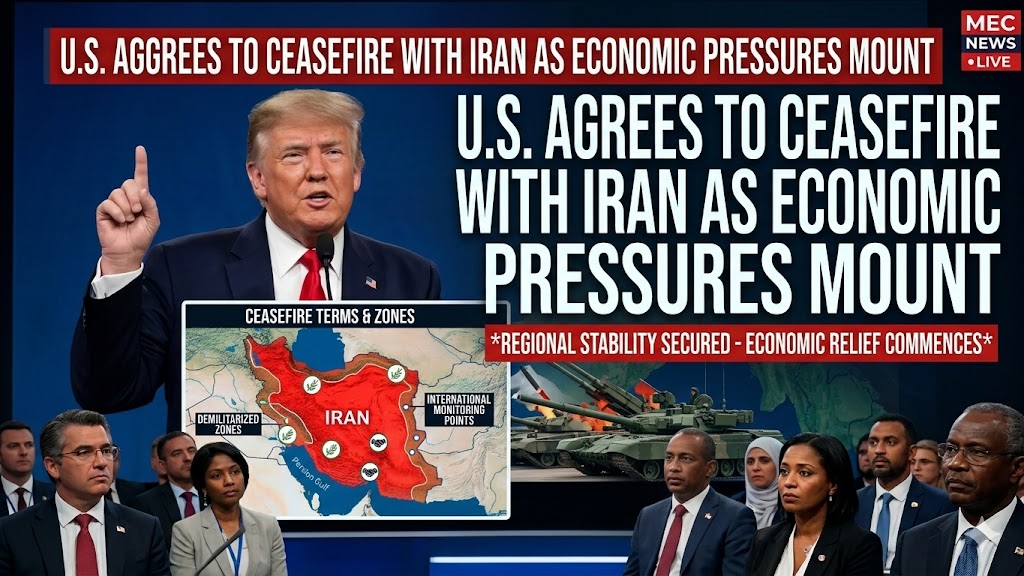
Washington/Dubai, 8th April — The United States has agreed to a temporary ceasefire with Iran following weeks of escalating conflict, amid mounting economic and political pressures linked to disruptions in global energy supplies.
U.S. President Donald Trump confirmed that Washington had accepted a proposal from Tehran outlining terms for de-escalation, including a two-week pause in hostilities. The decision marks a shift in tone after earlier warnings of intensified military action.
Trump said the move followed what he described as the achievement of key military objectives. However, the agreement comes as Iran continues to exert control over the Strait of Hormuz, a critical route for global energy shipments.
Energy Disruptions Drive Economic Strain
The partial closure of the strait has significantly disrupted oil and gas flows, affecting up to a quarter of global supply. As a result, energy prices have surged, contributing to increased inflationary pressures and market volatility worldwide.
Benchmark oil prices rose sharply during the crisis, with physical crude shipments trading at elevated levels and U.S. fuel prices approaching record highs. Analysts say the surge has placed additional strain on an already slowing U.S. economy, with rising unemployment and declining growth adding to concerns.
Impact on Global and Regional Economies
The economic fallout has extended beyond the United States. Gulf economies, heavily dependent on energy exports, have faced infrastructure damage and reduced output, raising fears of recession in parts of the region.
Energy companies with investments in the Middle East, including major U.S. firms, have also been exposed to disruptions, amplifying the broader economic impact.
Political and Strategic Pressures
Analysts say a combination of market instability, domestic political pressure, and rising costs influenced Washington’s decision to pursue a ceasefire.
Economic headwinds, including volatile financial markets and declining public support, have narrowed the administration’s options. Experts note that prolonged conflict risked further destabilizing both domestic and global economic conditions.
Miscalculation on Energy Risks
Observers suggest that initial U.S. strategy may not have fully accounted for the potential consequences of disruptions to energy supply routes. While the United States remains a major energy producer, its economy remains sensitive to global price movements.
Energy analysts also highlighted structural challenges, including reliance on fossil fuels and limited resilience to global supply shocks, which may have intensified the impact.
Outlook
While the ceasefire offers a temporary pause in hostilities, uncertainty remains over the durability of the agreement and the broader geopolitical landscape. Analysts say long-term stability will depend on sustained diplomatic engagement and efforts to strengthen global energy resilience.