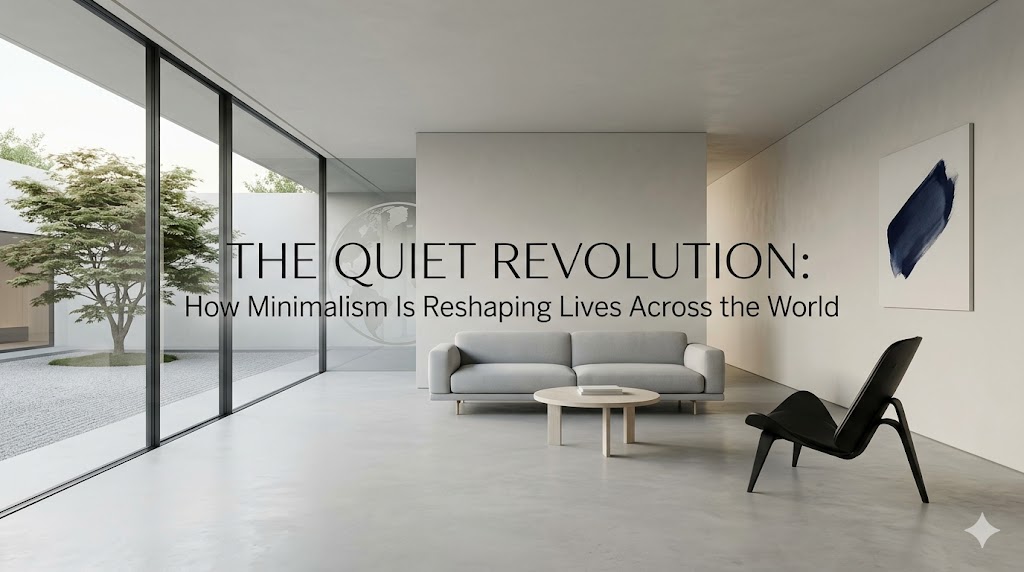
Minimalism Across the World

Living Spaces
By all appearances, the modern world runs on more – more consumption, more speed, more ambition. Yet, quietly, a countercurrent is taking shape across continents. From Tokyo’s introspective youth to China’s “lying flat” movement and the West’s financial independence seekers, a new philosophy is emerging: less is not just more – it is better.
🌱 A Global Shift Toward Less
Minimalism has evolved from a design aesthetic into a full-fledged global lifestyle movement. Across regions, individuals – especially younger generations – are rethinking what success means. Rather than chasing accumulation, they are choosing intentional living, reduced consumption, and emotional clarity. (vietnam.vn)
Economic pressures, environmental concerns, and rising mental stress are key drivers behind this shift. As growth slows and costs rise, the idea of “having everything” is losing its appeal. Instead, many are embracing a life of reduction rather than accumulation. (vietnam.vn)
Japan: The “Satori Generation” and Enlightened Simplicity


Goodbye Clutter
In Japan, minimalism has taken on a philosophical tone through the so-called “Satori generation.” These young people, shaped by economic stagnation, have moved away from material ambitions and high-pressure career paths.
They are described as being “free from material desires,” preferring to live in the present and focus on what they already have rather than pursuing excess. (Wikipedia)
For them, minimalism is not deprivation – it is liberation from expectations. Smaller homes, fewer possessions, and simplified lifestyles reflect a deeper cultural shift:
👉 Happiness is not tied to ownership, but to contentment.
China: “Tang Ping” and the Rejection of the Rat Race


In China, the minimalist trend has taken a more radical and symbolic form: “Tang Ping” (lying flat).
This movement represents a quiet rebellion against relentless work culture. Young people are choosing to scale back ambitions, reduce consumption, and prioritize mental well-being over material success. (Wikipedia)
“Lying flat” is not laziness – it is a conscious refusal to participate in a system perceived as exhausting and unrewarding.
It reflects a deeper realization:
👉 More effort does not always equal more fulfillment
In fact, many adherents adopt a “low-desire life,” focusing only on essential needs and psychological balance. (Wikipedia)
🌍 The West: FIRE, Downshifting, and Intentional Wealth


In Western countries, minimalism has merged with financial strategy through movements like FIRE (Financial Independence, Retire Early).
Here, minimalism is about:
- Cutting unnecessary expenses
- Saving aggressively
- Achieving financial freedom
Alongside this is the concept of “downshifting” – a deliberate move away from high-stress careers toward simpler, more balanced lives. (Wikipedia)
Rather than climbing endlessly, people are asking:
👉 What is enough?
This has led to a new definition of success – one rooted in time, freedom, and personal fulfillment rather than consumption.

Décor
🧠 The Core Philosophy: “Less but Better”
Across all regions, minimalism shares a common foundation:
✔️ Fewer possessions
✔️ Higher quality items
✔️ Intentional buying
Consumers today increasingly prefer value over volume, focusing on items that truly matter rather than accumulating excess.
This shift is not only practical – it is deeply psychological.

Minimalism & Green Living
How Minimalism Transforms the Mind
Experts across psychology and behavioral science increasingly point to the cognitive benefits of minimalism.
👉 Minimalism improves:
- Focus
- Emotional well-being
- Decision-making
Minimalists’ bedrooms
By reducing clutter – both physical and mental – individuals experience greater clarity and reduced stress.
Studies indicate that minimalists report higher life satisfaction, reduced anxiety, and improved overall happiness. (PMC)
Owning fewer possessions forces individuals to evaluate what truly matters, leading to more intentional and meaningful living. (ResearchGate)

Possessions of Minimalists
🎨 Minimalism Beyond Lifestyle: Design, Business, and Communication
Minimalism is not confined to homes – it is reshaping how businesses and brands operate.
👉 Minimalism helps:
- Cut through noise
- Improve clarity and communication
- Build trust in branding
In a world overloaded with information, simplicity stands out. Clean design, clear messaging, and focused offerings are now seen as signals of confidence and credibility.
Brands that adopt minimalist principles often communicate more effectively because they remove distractions and highlight what truly matters.
🛠️ Everyday Practices of Minimalism
Minimalism is not an abstract idea – it is practiced through simple, daily habits:
🧹 Decluttering
Removing unnecessary items from living spaces
🛒 Intentional Consumption
Buying only what is needed and valued
📱 Digital Minimalism
Reducing screen time and digital noise
📅 Time Simplification
Prioritizing meaningful activities over busyness
🌱 Sustainable Living
Reducing waste and environmental impact
These practices create not just cleaner spaces – but clearer lives.
🌍 The Benefits: More Than Just Simplicity
Minimalism delivers tangible improvements across multiple dimensions:
🧠 Mental Health
Less clutter reduces anxiety and enhances mindfulness (Climate Consulting)
💰 Financial Stability
Lower consumption leads to higher savings
🌱 Environmental Impact
Reduced waste and resource use support sustainability (Climate Consulting)
❤️ Relationships
More time for people, less time for possessions
⚡ Productivity
Fewer distractions improve efficiency
⚖️ A Subtle Critique: Choice or Compulsion?
Yet, minimalism is not without complexity.
In some regions, particularly in Asia, minimalist lifestyles may reflect economic pressures rather than purely philosophical choices. Movements like “Tang Ping” and the “Satori generation” also reveal a sense of disillusionment with traditional success models.
This raises an important question:
👉 Is minimalism a lifestyle upgrade – or a response to systemic challenges?
The answer may lie somewhere in between.

Minimalists’ Dresses
🔮 The Future of Minimalism
Minimalism is evolving into what some call “conscious living.”
Future trends include:
- Digital minimalism in an AI-driven world
- Sustainable minimalism tied to climate awareness
- “Warm minimalism” combining comfort with simplicity
What remains constant is its core promise:
👉 Clarity in a world of excess
🧠 Final Insight: The Power of Less
Minimalism is not about giving things up – it is about gaining control.
In Japan, it brings calm.
In China, it offers resistance.
In the West, it delivers freedom.
Across the world, it is redefining success; not as accumulation, but as alignment with what truly matters.
In an age of overload, minimalism is not just a trend – it is a quiet revolution.