
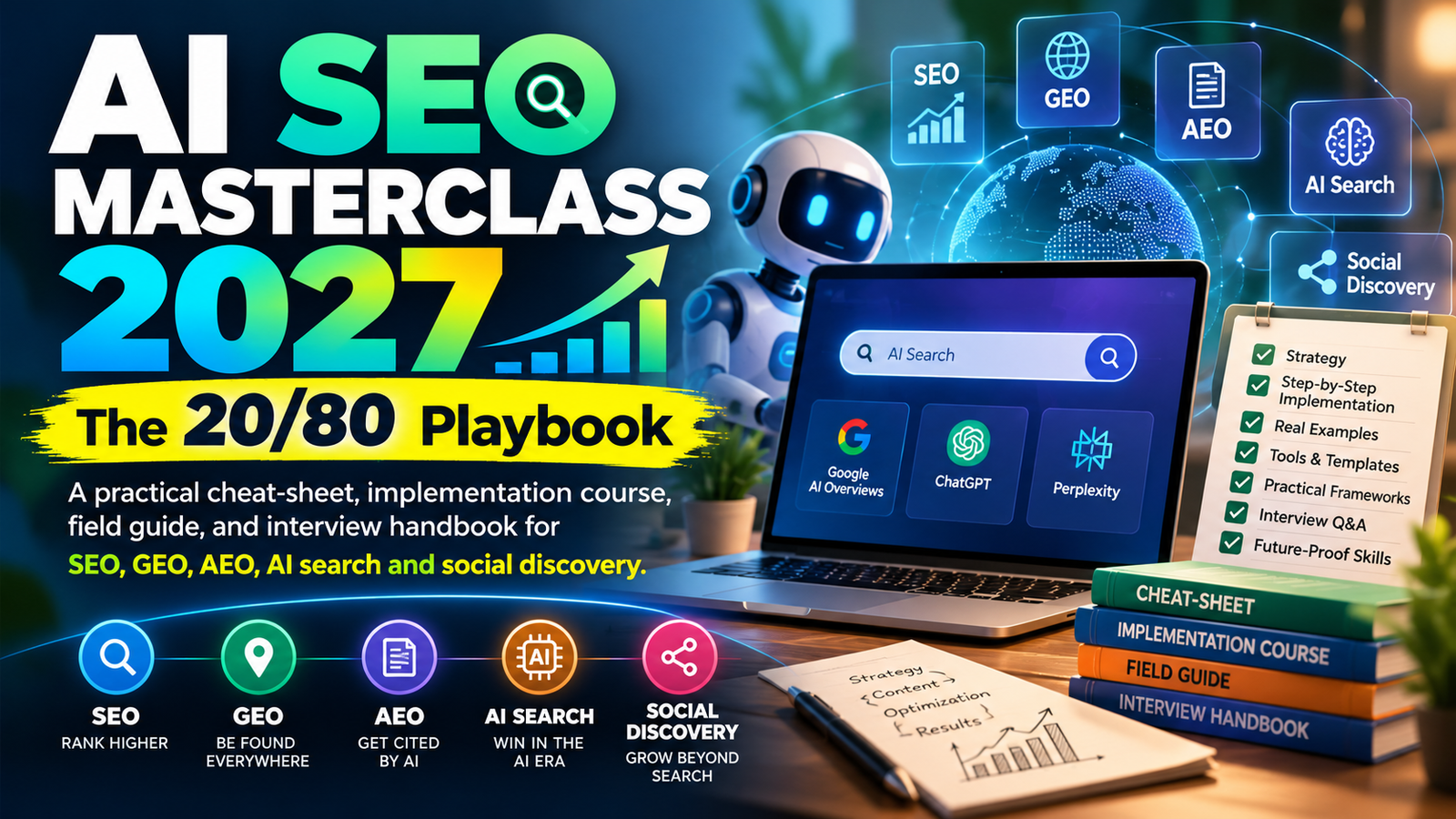
The 20/80 Playbook
A practical cheat-sheet, implementation course, field guide, and interview handbook for SEO, GEO, AEO, AI search and social discovery.
CORE PROMISE Master the few durable systems that compound: technical eligibility, genuinely useful content, topic/entity clarity, credible reputation, multi-platform discovery, and measurement tied to business outcomes.
Edition: 28 October 2026 | Built for entrepreneurs, SEO practitioners, content strategists and growth teams
How to use this book
This is designed to be used, not merely read. Work through the first five chapters in order, then use the platform playbooks and interview bank as reference material. A solo operator can complete the core exercises in 60–90 minutes per working day; a team can divide them across technical SEO, content, social, and analytics owners.
• Read the 20/80 checklist first and fix the biggest blockers before producing more content.
• Choose one business, one audience, and one primary conversion goal for the exercises.
• Implement one chapter at a time; record a baseline before changing anything.
• Re-check official platform guidance every month. AI search products, reporting and policies change quickly.
• Treat every tactic as a hypothesis to test—not as a guaranteed ranking formula.
A note on evidence and terminology
“AI SEO” is an umbrella label, not a single standardized discipline. GEO usually refers to improving visibility in generative answers; AEO focuses on being useful for direct answers; AIO is used inconsistently to mean AI optimization or AI search optimization. The practical work overlaps substantially with SEO. Google’s published guidance says foundational SEO and eligibility remain central to AI Overviews and AI Mode, and that there are no special extra technical requirements just for those features. Search engines and answer engines do not disclose every ranking or retrieval signal, so this book separates official guidance from reasonable practitioner hypotheses.
Contents
• 1. The new search landscape: what changed and what did not
• 2. The 20/80 AI SEO checklist
• 3. Technical foundations: eligibility before optimization
• 4. Search intent, topic architecture and query fan-out
• 5. Content engineered for humans and machine retrieval
• 6. E-E-A-T, entities, reputation and off-site evidence
• 7. Google AI Overviews, AI Mode and other answer engines
• 8. Reddit, LinkedIn, X and Instagram: social search strategy
• 9. AI-assisted workflows, prompts and automation
• 10. Measurement: visibility, citations, traffic and revenue
• 11. A practical 90-day implementation roadmap
• 12. Templates, audit sheets and weekly operating rhythm
• 13. AI SEO career map and portfolio projects
• 14. 70 interview questions and model answers
• 15. Glossary and trusted reference library
- The new search landscape: what changed and what did not
Search is expanding from a list of links into a mixed discovery journey: classic results, AI-generated summaries, conversational research, video and social search, community recommendations, product discovery, and brand-led demand. The user may still begin with a search engine, but may also ask an AI assistant, scan Reddit, watch a Reel, or ask their professional network.
What is changing
• Queries are becoming longer and more contextual. People ask multi-part questions, request comparisons, and refine follow-up questions instead of issuing one short keyword.
• AI systems may retrieve multiple sources, synthesize an answer, and show links or citations. Google describes query fan-out as a process that can issue related searches to gather information for a complex query.
• Zero-click and assisted journeys can increase: a person may learn about a brand in an AI answer and visit later through branded search, direct traffic, or another channel.
• Social platforms are search and recommendation environments in their own right. Profiles, captions, on-platform language, relevance, trust and meaningful engagement can affect discovery.
• Original evidence becomes more valuable. When generic explanations are easy to generate, first-hand tests, customer data, expert commentary, clear examples, tools and distinctive analysis give users a reason to choose a source.
• Measurement must expand beyond average keyword position. Teams need to watch qualified organic traffic, conversions, branded demand, visibility in AI answers where observable, and contribution to pipeline.
What has not disappeared
• Crawlability, indexability, useful page architecture, internal links, relevant titles, fast and accessible pages, and clean canonicalization still matter.
• Search intent still matters. A page that does not satisfy the task is unlikely to perform sustainably, regardless of formatting.
• Backlinks, mentions and reputation remain useful evidence of authority and discovery, although no single link metric guarantees visibility.
• Content quality is not the same as length. A concise page that fully solves a narrow task can outperform a bloated guide.
• Technical SEO does not replace marketing strategy. SEO work should connect to customer needs, product value, and business outcomes.
THE SHIFT Do not abandon ranking fundamentals. Build on them so your brand can be found, understood, trusted and chosen across more discovery surfaces.
A useful mental model: five layers
Layer Question Typical work
- Eligibility Can the system access and index the useful page? Robots, status codes, canonicals, sitemap, rendering, internal links
- Relevance Does the page answer the actual need? Intent research, content briefs, topic coverage, examples
- Confidence Why should a person or system trust this source? Expertise, evidence, transparent authorship, citations, reputation
- Discoverability Where do target users and answer systems encounter the brand? Search, AI answers, communities, professional networks, video
- Outcomes Does visibility create meaningful business value? Leads, qualified sessions, demos, sales, retention, assisted conversions
- The 20/80 AI SEO checklist
The 80/20 principle is a prioritization heuristic, not a measured law that exactly 20% of tasks always cause 80% of outcomes. The list below ranks work by likely leverage for many websites. Your actual priorities depend on the site’s current bottlenecks, competition, market and business model.
Rank Priority Leverage Why it matters How to execute
1 Fix indexing and crawl blockers Very high A blocked, noindexed, canonicalized-away or broken page cannot earn normal organic visibility. Coverage/indexing audit; URL Inspection; server logs when appropriate
2 Map intent to one strong page per meaningful need Very high Relevance and task satisfaction beat producing many overlapping pages. SERP review; customer questions; query clusters; conversion intent
3 Publish first-hand value, not generic AI paraphrases Very high Distinctive data, examples, experience and useful tools create a reason to cite, link or return. Original research; expert interviews; tested workflows; case studies
4 Build coherent topical architecture High Connected pages help users navigate and clarify the site’s subject coverage. Pillar pages; supporting pages; contextual internal links; pruning cannibalization
5 Make entities and authorship clear High Consistent business facts, authors, products and expertise reduce ambiguity for readers and systems. About/contact pages; author bios; Organization/Product schema where appropriate
6 Earn credible third-party evidence High Independent discussion, references, reviews and relevant links can build awareness and trust. Digital PR; partnerships; expert contributions; genuine community participation
7 Use answer-friendly structure without writing for bots High Clear headings, direct answers, definitions, steps, comparisons and caveats improve usability. Question-led sections; concise lead answers; tables; FAQs where genuinely useful
8 Strengthen internal links and page discoverability High Important pages should be reachable through descriptive, relevant links. Navigation; breadcrumbs; hub pages; contextual links
9 Make pages usable on mobile and accessible High Poor experience undermines conversion and can limit effective engagement. Mobile QA; readable layout; image optimization; accessible controls
10 Build a multi-platform authority footprint High Customers discover expertise in communities and feeds as well as web search. Reddit, LinkedIn, X, Instagram, YouTube and industry sites—selected by audience
11 Measure conversions and branded demand High Traffic alone can hide low-quality visits or value created outside last-click analytics. GSC, analytics, CRM, lead quality, branded query trends, assisted conversions
12 Use structured data accurately Medium-high Schema can clarify page entities and eligibility for supported search features, but does not guarantee rich results or AI citations. Validate relevant schema; keep markup consistent with visible content
13 Refresh pages when facts or user needs change Medium-high Useful maintenance preserves accuracy and closes content gaps. Review dates, product changes, dead links, outdated screenshots, SERP shifts
14 Improve media discoverability Medium Useful image/video assets can serve visual and multimodal discovery. Descriptive filenames, alt text, captions, transcripts, strong media pages
15 Automate repetitive analysis with human QA Medium AI can speed clustering, briefs, QA and reporting—but errors can scale just as fast. Templates, scripts, workflows, review gates, source checks
The 30-minute weekly triage
- 10 minutes: inspect Search Console for indexing anomalies, major page/query changes, and search appearance reporting available to your property.
- 5 minutes: review the highest-value landing pages and check whether their intent, facts, examples and calls to action remain accurate.
- 5 minutes: review conversions and lead quality, not just clicks.
- 5 minutes: inspect competitor or community conversations for emerging customer questions.
- 5 minutes: choose one high-impact fix, assign an owner and record a due date.
DO NOT START WITH Mass-generating 100 articles, stuffing FAQs with keywords, buying low-quality links, chasing every acronym, or assuming a schema type will force an AI citation. - Technical foundations: eligibility before optimization
Technical SEO creates the conditions under which a page can be discovered, processed and served. It does not guarantee ranking. Start with the highest-value templates and URLs rather than treating every technical issue as equally urgent.
The technical checklist
Area Action
Indexability Important pages return a successful HTTP status, are not accidentally noindexed, and are not blocked from crawling where crawling is required.
Canonicalization Each duplicate or near-duplicate URL has a sensible canonical strategy; internal links and sitemaps reinforce preferred URLs.
Robots and bots Review robots.txt and meta robots intentionally. Understand the difference between Googlebot, other crawlers, and AI-specific user agents. Do not block a crawler accidentally if you want its associated search experience to retrieve pages.
Sitemaps Include canonical, indexable URLs that you want discovered. Keep them valid and updated. A sitemap is a discovery hint, not an indexing guarantee.
Rendering Check that important content and links are present in the rendered page, not only in inaccessible scripts or interaction states.
Internal links Important pages should be reachable through crawlable links, not only through site search, forms or scripts. Use descriptive anchors that help users.
Status codes and redirects Fix 404s that break important journeys, redirect chains, loops, and soft 404s. Use permanent redirects when a move is genuinely permanent.
Mobile and page experience Check responsive layouts, readability, interaction, Core Web Vitals and intrusive elements. Avoid optimizing one metric at the expense of the overall task.
Structured data Use supported types that accurately describe visible page content. Validate syntax and eligibility; never mark up information that users cannot see or that is false.
Security and trust HTTPS, transparent business identity, contact details, privacy practices and secure forms support user confidence.
AI crawler controls: practical note
OpenAI documents OAI-SearchBot for discovery in ChatGPT search and GPTBot for a separate model-training-related purpose. The controls are independent. If ChatGPT search visibility matters, review the current official crawler documentation and your robots.txt/server configuration. Do not assume that allowing one crawler automatically means allowing every use case. Similar checks should be made for other providers whose search products matter to your audience.
Quick audit sequence
6. Select 10–20 commercially important URLs and test them individually.
7. Inspect HTTP status, robots directives, canonical, rendered content, title, H1, internal links and sitemap inclusion.
8. Compare indexed URLs against intended indexable URLs. Investigate gaps rather than trying to force every URL into the index.
9. Check duplicate, parameter, tag, archive and faceted-navigation patterns.
10. Review crawl and index reports in the search tools available to the site.
11. Prioritize issues by impact × confidence × effort. Fix the issue that blocks the most valuable pages first.
Robots.txt versus noindex
Robots.txt controls crawling; it is not a reliable way to remove an already indexed URL from results. A noindex directive must be accessible to a crawler for it to be seen. If a URL is blocked from crawling, the crawler may not see a noindex on that page. Use the right control for the actual goal, and verify behavior in the relevant search tool.
PRACTICE LAB Find one important page that is not receiving impressions. Check whether it is indexable, whether its canonical points to itself or a legitimate alternative, whether it is internally linked, and whether the content clearly answers a distinct search need.
- Search intent, topic architecture and query fan-out
Keyword lists are not a strategy. A strategy maps real customer needs to pages, assets, channels and conversion paths. In AI search, a single question can expand into related subquestions, comparisons, constraints and follow-up tasks. Google calls one such pattern query fan-out: generating related searches to gather evidence for a complex response.
Intent mapping workflow - Define the audience and business problem in the customer’s language.
- Collect queries from Search Console, keyword tools, sales calls, support tickets, community threads, reviews and internal site search.
- Group by the task the searcher is trying to complete—not merely by shared words.
- Inspect current results and the formats that satisfy the intent: guides, product pages, comparisons, local pages, videos, tools or discussions.
- Choose one primary URL for each distinct need. Merge overlapping pages where they compete without serving different intents.
- Add supporting pages only when they provide a genuinely different, useful subtask or audience path.
- Connect the cluster with contextual internal links and clear next steps.
- Review the cluster quarterly or after a meaningful shift in product, SERP layout or user behavior.
Example: a B2B agency selling AI search optimization
Search need Best-fit asset Next step
What is AI search optimization? Clear introductory guide with definitions and limits Read the methodology
How do I measure AI visibility? Measurement tutorial and sample dashboard Download audit sheet
Which agency should we hire? Service page with process, evidence, fit and limitations Book a discovery call
How do I audit my site? Step-by-step checklist and practical examples Request a technical review
Does Reddit affect AI answers? Evidence-led explainer separating observed patterns from claims Explore the community strategy
AI SEO consultant versus traditional SEO agency Comparison page explaining scope, deliverables and trade-offs Discuss business goals
Query fan-out exercise
Start with: “How can a mid-sized SaaS company improve AI search visibility?” Map likely follow-up questions: Is the site crawlable? Which product pages answer commercial questions? What evidence do buyers trust? Which competitors are cited? What does Search Console show? What happens on ChatGPT search? Which communities discuss the product? How will visibility translate into pipeline? Turn only the questions that deserve a durable answer into content assets; do not publish every possible variation as a separate page.
Avoid these architecture traps
• One page for every tiny keyword variation.
• Many near-identical city or product pages with little unique value.
• Pillar pages that link nowhere and supporting pages orphaned from navigation.
• Internal links that all use the same exact-match anchor regardless of context.
• Creating a giant glossary when buyers need examples, comparisons or implementation help.
5. Content engineered for humans and machine retrieval
The goal is not to write “for an LLM.” The goal is to make the answer easy for a human to find, verify and use—and to present the information clearly enough that retrieval and summarization systems can identify the relevant passage.
A high-utility content structure
20. Title: accurately describe the task, audience and outcome. Avoid unsupported superlatives.
21. Opening answer: give a concise, direct response to the main question, then explain scope and exceptions.
22. Logical headings: organize the page around subquestions and decision steps, not keyword repetition.
23. Original value: add tested examples, screenshots, calculations, interviews, templates, data or a defensible point of view.
24. Evidence: cite primary sources for factual claims, show dates where facts change, and separate facts from interpretation.
25. Comparisons: explain criteria, trade-offs, who each option suits, and when an option is not suitable.
26. Definitions: introduce specialized terms plainly and use them consistently.
27. Useful media: add diagrams, demonstrations, descriptive captions, transcripts or alt text where they help.
28. Authorship and accountability: show who created or reviewed the content and why they are qualified where relevant.
29. Internal links: help readers move to the next meaningful step.
30. Conversion path: offer an appropriate next action without interrupting the answer.
31. Maintenance: update when evidence, products, laws, prices or workflows change; do not refresh dates without meaningful revision.
Content quality scorecard
Dimension 0 = missing 1 = adequate 2 = strong
Intent fit Does not solve task Answers main question Solves task and anticipates real constraints
Originality Generic paraphrase Some useful examples Distinctive data, experience, tool or insight
Trust Unsupported claims Some sources and clear author Primary evidence, transparent limits and accountable expertise
Structure Hard to scan Logical headings Direct answers, clear hierarchy and task flow
Completeness Important gaps Covers expected subtopics Covers decision-critical questions without filler
Actionability No next steps General advice Specific steps, checks, examples and success criteria
Experience Difficult on mobile Usable Readable, accessible, fast enough and easy to navigate
Use the score as an editorial discussion tool, not as a search-engine ranking formula. A page scoring 12/14 is not guaranteed to outrank a page scoring 9/14.
A content brief template
• Business goal and target audience:
• Primary user task / search intent:
• Primary URL and its role in the site:
• What the audience already knows:
• Questions the page must answer:
• Unique contribution (data, expertise, case study, tool, or experience):
• Primary sources and claims requiring verification:
• Competitor coverage gaps (not copy instructions):
• Recommended outline and media:
• Internal links in and out:
• Author / reviewer and evidence of expertise:
• Primary CTA and conversion event:
• Update trigger and owner:
AI-generated content: a safe workflow
AI can assist with clustering, outline options, transcript analysis, title variants, structured extraction, schema drafts and QA. It can also invent citations, flatten nuance, repeat common claims and produce plausible errors. Google’s guidance focuses on helpfulness, reliability and purpose—not on a simple ban on AI-assisted writing. Scaled content made primarily to manipulate search rankings can violate spam policies regardless of how it was produced.
• Use AI to accelerate research organization, not to replace source verification.
• Give it the target audience, task, constraints, primary evidence and prohibited assumptions.
• Require citations or source URLs for factual research, then manually verify them.
• Add first-hand insight, examples and expert review before publication.
• Run factual, legal, product, accessibility and brand-voice checks as appropriate.
• Publish only when the page offers value beyond a generic summary of existing results.
6. E-E-A-T, entities, reputation and off-site evidence
E-E-A-T means Experience, Expertise, Authoritativeness and Trustworthiness. Google describes it as a framework used in quality evaluation, not a single ranking factor. Trust is central to the concept. Treat it as a way to audit whether users can understand who is responsible for a claim and why the claim deserves confidence.
Build trust on the site
• Use accurate author and reviewer bios; never invent credentials, clients or experience.
• Maintain a clear About page, contact routes, business identity and editorial standards.
• Explain methods: how was a test conducted, what sample was used, what limitations apply?
• Link to primary research or official documentation for consequential claims.
• Keep product, pricing, service, location and policy information consistent.
• Show real examples and case studies with permission, context, baseline, intervention and results.
• Correct material errors and make significant updates transparent.
Build reputation beyond the site
• Contribute useful expert commentary to relevant publications and industry communities.
• Participate in conversations where the audience already asks for help.
• Develop partnerships, original research and useful assets others may independently reference.
• Encourage genuine reviews through compliant customer processes; never fabricate reviews or suppress legitimate criticism.
• Keep brand facts consistent across official profiles and reputable listings where relevant.
• Use digital PR to make something worth discussing—not just to place a link.
Entity clarity checklist
• Brand name, product names, authors, services and locations are consistent across key pages.
• Each important concept has a clear definition and relationship to the business.
• Organization, Person, Product, Article, Breadcrumb and other structured data are used only where appropriate and truthful.
• Visible content and structured data agree; schema is not a hidden keyword-stuffing field.
• Brand mentions and third-party references are earned and contextually relevant.
IMPORTANT Do not promise that a Knowledge Graph entry, schema markup, a Wikipedia page, a specific number of backlinks, or a mention on one platform guarantees AI citations. These may help clarity or reputation in particular contexts, but no universal guarantee exists.
- Google AI Overviews, AI Mode and other answer engines
AI Overviews and AI Mode are distinct experiences and may surface different responses and links. Their presence depends on the query and system behavior. The most reliable foundation remains making useful pages crawlable, indexable, clear, trustworthy and relevant. Do not treat “AI optimization” as a separate technical switch.
Google AI search: practical actions
• Ensure the page is eligible to appear in Google Search and can be served with a snippet.
• Make the most valuable information visible in text and clearly organized.
• Use original, non-commodity information where the business can credibly provide it.
• Support important claims with reliable evidence and transparent limitations.
• Keep local, shopping, image and video information accurate if those formats matter to the business.
• Use Search Console’s available reporting to compare generative AI visibility with overall search performance; features and reports may evolve.
• Study query patterns, not only exact keywords: comparisons, constraints, follow-up questions and decision tasks.
• Do not use special “AI schema,” artificial hidden text, or a magic word count as a substitute for quality and eligibility.
ChatGPT search and other AI discovery
AI assistants may use search indexes, retrieval, third-party sources and product-specific systems. Their citation behavior is not identical. Check current documentation for each service that matters to your audience. For ChatGPT search, review the official OpenAI crawler documentation, especially the distinction between OAI-SearchBot and GPTBot. Verify your own site’s accessibility and monitor actual referral/lead data instead of assuming that every AI mention can be observed.
How to run a visibility sample - Build a fixed set of 20–50 realistic customer prompts across informational, comparison, commercial and local intents.
- Run the prompts on a consistent schedule and record date, region, platform, logged-in state and relevant settings.
- Capture whether your brand appears, whether your site is cited, which competitors appear, and whether the answer is accurate.
- Repeat prompts where results are volatile; do not infer a stable trend from one answer.
- Track a share-of-observed-mentions metric, but label it as a sample rather than a universal ranking measure.
- Compare observed visibility with referral traffic, branded search, qualified leads and customer feedback.
Sample prompt set
• What are the best options for [problem] for a [business type] with [constraint]?
• Compare [brand] with [competitor] for [use case]. What are the trade-offs?
• How do I implement [task] step by step, and what mistakes should I avoid?
• Which providers specialize in [service] for [industry] and what evidence supports the recommendation?
• What should I check before buying [product/service]?
• What is the most reliable source for [claim], and what are its limitations? - Reddit, LinkedIn, X and Instagram: social search strategy
Social visibility is not a loophole for manipulating AI answers. It is a way to be useful where customers already research, compare and discuss solutions. Social platforms have different norms, ranking systems and anti-spam policies. Choose platforms based on audience behavior and product category, then create native value.
Reddit: community trust before promotion
Reddit can reveal the language customers use, objections they raise, product alternatives they trust and problems that existing content fails to solve. Community-specific rules matter. Reddit’s official guidance says promotion is not automatically spam, but some communities prohibit it; repeated unwanted promotion, repetitive posts and automated promotional behavior can trigger removal or bans.
• Listen first: review relevant subreddits and community rules before posting.
• Classify recurring questions, objections, terminology, comparisons and unresolved problems.
• Answer directly with experience or evidence; disclose your affiliation when relevant.
• Link only when the link materially helps and the community allows it.
• Never create fake accounts, manufacture votes, automate repetitive comments or seed fake testimonials.
• Turn recurring questions into better site resources, but do not copy private or sensitive user content without permission.
• Measure useful outcomes: quality discussions, referral sessions, branded queries and insight into product objections—not karma alone.
LinkedIn: professional discovery and credibility
• Align the headline, About section, experience, featured work and services with the expertise you genuinely offer.
• Use the language your target buyers use for roles, problems and outcomes; avoid stuffing every keyword into the profile.
• Publish specific observations, case studies, frameworks, practical walkthroughs and thoughtful disagreement.
• Make the opening lines useful before the “see more” cutoff; use examples and clear takeaways.
• Engage with relevant experts and buyer conversations with substantive comments, not automated engagement pods.
• Use documents, carousels, short videos and long-form posts when each format helps explain the idea.
• Convert attention into a useful next step: a resource, conversation, demo or newsletter—not a generic pitch on every post.
X: real-time expertise and searchable conversations
• Use clear topic language in posts and profile fields; hashtags are optional context, not a substitute for relevance.
• Share original observations, concise analyses, charts, experiments, source links and practical threads.
• Reply where you can add new evidence or clarify a misconception.
• Use search filters to research current conversations, customer language and expert perspectives.
• Avoid duplicate or near-duplicate posts, automated replies, hashtag abuse and repetitive multi-account posting.
• Measure quality of conversation, profile visits, link visits and downstream actions—not raw impressions alone.
Instagram: visual search and recommendation
• Make the account name, bio and profile category clear about what you do and whom you help.
• Use natural descriptive keywords in captions and on-screen text where relevant.
• Make the first seconds of a Reel communicate the problem, result or question clearly.
• Use subtitles, useful demonstrations, original visuals, descriptive alt text where available and accessible design.
• Build content series around recurring questions, objections, tutorials, before/after explanations and customer stories.
• Use saves, shares, meaningful comments, profile visits and leads as quality signals; do not assume any single engagement metric guarantees reach.
• Repurpose the core idea, not the exact same post, into a format that suits each platform.
A practical cross-platform repurposing system
Source asset LinkedIn X Instagram Reddit Website
Original experiment Case study with method and caveats Key finding + chart + discussion Reel showing process/result Answer a relevant question if allowed Detailed method page with data
Customer FAQ Buyer-focused post Short answer and thread Carousel/Reel tutorial Native answer in relevant community FAQ section or dedicated guide
Industry report Interpretation for decision-makers Data points and expert commentary Visual summary Discuss implications when relevant Original analysis with citations
Product comparison Decision framework Trade-offs in a thread Comparison carousel Respond when asked, with disclosure Comparison page with criteria
The 70/20/10 content mix (starting hypothesis)
Start with roughly 70% education and utility, 20% proof and perspective, and 10% direct promotion. This is a planning heuristic, not an algorithm rule. Adjust based on audience response, platform norms and business goals.
SOCIAL SEARCH RULE Earn attention by being useful. Never manufacture social proof, spam communities, or treat community members as a link-placement opportunity.
- AI-assisted workflows, prompts and automation
The highest-value AI workflows reduce repetitive work while keeping judgment, evidence and accountability with the practitioner. Automate the draft or analysis step; preserve a human review gate before publishing or changing production systems.
Workflow A: keyword and question clustering
Inputs: Search Console queries, keyword exports, support tickets, sales notes and community questions. Output: a table with query, user task, intent, audience, funnel stage, proposed asset, existing URL, priority and evidence source.
Prompt: “Group the attached search queries by the user task they are trying to complete, not just by similar words. For each cluster, identify likely intent, decision stage, distinct questions, whether one page can satisfy the cluster, possible cannibalization with the supplied URLs, and the evidence needed to validate the cluster. Do not invent search volume. Mark uncertain classifications for human review.”
Workflow B: evidence-led content brief
Prompt: “Create a content brief for [audience] trying to [task]. Use only the supplied sources for factual claims. Separate verified facts, practitioner interpretation and open questions. Identify what competing pages already cover, but do not recommend paraphrasing them. Propose an outline, original contribution, examples, internal links, CTA, author requirements and a QA checklist. Flag unsupported claims rather than filling gaps.”
Workflow C: page refresh triage
Prompt: “Review this page against its stated intent, recent performance data, current product facts and supplied primary sources. Identify factual errors, outdated sections, missing decision-critical questions, internal-link gaps, accessibility problems and conversion friction. Rank fixes by impact, confidence and effort. Do not rewrite sections that are already useful without a reason.”
Workflow D: social repurposing
Prompt: “Convert this source asset into platform-native drafts for LinkedIn, X and Instagram. Preserve the core evidence, caveats and point of view. Do not invent statistics or testimonials. Make each draft structurally different for the platform. Suggest a visual or demonstration where useful, and provide one clear, non-pushy CTA. Label claims that require human verification.”
Workflow E: AI search visibility analysis
Prompt: “Analyze this dated sample of AI answer observations. Calculate the percentage of prompts in which the brand appeared and the percentage with a direct citation to our site. Segment by intent and platform. Identify competitors, repeated themes, answer inaccuracies and sampling limitations. Do not infer causality or generalize beyond this sample. Recommend the next experiment and success criteria.”
Human QA gate
• Are all factual claims supported by sources that were actually checked?
• Are URLs, product names, numbers, dates and legal statements correct?
• Does the content contain a real contribution beyond generic synthesis?
• Is the author or reviewer accurately represented?
• Does the page match the intended user task and business context?
• Are any confidential, personal or customer-sensitive inputs being exposed unnecessarily?
• Are platform policies and community rules respected?
• Is the proposed action reversible, tested and approved before deployment?
Where to automate—and where not to
Good candidates Require extra caution / human approval
Data cleanup and formatting Mass publishing generated pages
First-pass query clustering Automatic page deletions or redirects
Title/description variant generation Changing canonical/noindex/robots settings at scale
Broken-link and missing-field checks Auto-posting promotional comments to communities
Drafting reports from verified data Unverified claims, fake reviews or fabricated case studies
Content inventory and change detection Automated link building or engagement manipulation - Measurement: visibility, citations, traffic and revenue
Search reporting should connect discovery to outcomes. Rankings and impressions are useful diagnostics, but neither is the final business objective. AI answer visibility can be difficult to measure consistently because answers vary by prompt, time, location, personalization and platform.
Measurement stack
Layer Example metrics Interpretation
Technical health Index coverage, valid canonical pages, crawl errors, sitemap status Can important content be discovered and served?
Classic search Impressions, clicks, CTR, query/page trends, position distributions Which pages and query groups are gaining or losing visibility?
AI search sample Brand mention rate, citation rate, cited URL types, answer accuracy What happened in the defined prompt sample?
Site engagement Engaged sessions, landing-page actions, return visits Does the visitor find the content useful?
Conversion Qualified leads, demos, purchases, assisted conversions Does search contribute to business value?
Brand demand Branded queries, direct traffic trends, survey mentions, CRM source notes Is awareness increasing across channels?
Efficiency Production time, refresh cost, cost per qualified lead Is the program becoming more effective?
Metric definitions
Observed AI brand mention rate = prompts in the defined sample where the brand is mentioned ÷ prompts tested × 100. Observed citation rate = prompts in the sample that cite a tracked site URL ÷ prompts tested × 100. Keep platform and intent segments separate. These metrics are useful for trend tracking only when the sample and method are consistent; they are not a universal share-of-market measure.
For organic conversion rate, define the conversion carefully: conversions ÷ eligible organic sessions or users, depending on your analytics model. For B2B, include lead quality and pipeline, not just form submissions. Use consistent attribution definitions and acknowledge that cross-device and multi-touch journeys are imperfectly observed.
Monthly review questions
• Which landing pages produced qualified outcomes, not merely traffic?
• Which important pages lost visibility, and did intent, competition, indexing, content quality or SERP layout change?
• Are branded searches and direct demand moving with social, PR and campaign activity?
• What do AI answer samples reveal about the questions, sources and competitors associated with our category?
• Which content is outdated, overlapping, low-value or no longer aligned with the business?
• What one experiment will we run next month, and what result would change our strategy?
11. A practical 90-day implementation roadmap
Period Focus Deliverables Exit criteria
Days 1–15 Baseline and blockers Technical audit; analytics and GSC baseline; top pages; conversion map; prompt sample Critical indexing problems prioritized; baseline saved
Days 16–30 Intent and architecture Query clusters; content inventory; page-to-intent map; internal-link plan Every priority query group has a clear destination or documented gap
Days 31–45 Improve core assets Refresh 3–5 priority pages; add original evidence; improve CTA and internal links Reviewed pages meet quality checklist and tracking works
Days 46–60 Authority and distribution Author profiles; one original research/case asset; social content series; community listening Evidence asset published; platform-native distribution underway
Days 61–75 AI visibility experiments Prompt set; AI answer observation log; technical crawler review; competitor comparison Repeatable sample protocol and limitations documented
Days 76–90 Evaluate and scale Performance review; wins/losses; next-quarter plan; automation with QA gates Next 90-day roadmap funded by evidence and business priorities
Weekly cadence
Day / rhythm Focus Output
Monday Performance and priority review One-page dashboard and three priorities
Tuesday Technical/content execution One meaningful page or template improvement
Wednesday Research and customer language Questions, objections, evidence and content gaps
Thursday Authority and distribution Native social contributions and outreach
Friday QA, reporting and learning Experiment log, update list and next actions
Adjust the cadence to the team. The point is not to force work onto particular weekdays; it is to ensure the system includes diagnosis, implementation, distribution, measurement and learning every week.
12. Templates, audit sheets and operating rhythm
One-page page audit
• URL / page owner / business objective:
• Target audience and task:
• Indexability, canonical, status and internal-link checks:
• Current search and conversion baseline:
• Does the opening answer the main question?
• What unique evidence or first-hand value does the page provide?
• Which claims need source verification?
• Are author, business identity and relevant schema accurate?
• What related pages should link to this page?
• Which platform-native assets can distribute the insight?
• What is the primary CTA and how is it tracked?
• Priority: impact (1–5) × confidence (1–5) ÷ effort (1–5):
• Owner / due date / verification date:
Prioritization formula
A simple internal scoring aid is: Priority score = (Impact × Confidence) ÷ Effort. Rate each from 1 to 5. This is not a scientific forecast; it makes assumptions visible and helps teams compare work consistently.
Experiment log template
Field Example / instruction
Hypothesis A clearer comparison section will improve qualified engagement for commercial queries.
Change Add decision criteria, trade-offs and links to supporting evidence.
Target pages / audience List the exact URLs and query group.
Baseline Record date range, clicks, impressions, conversions and relevant context.
Success measure Define the primary metric and guardrails before shipping.
Observation window Choose a realistic period for the site’s traffic and sales cycle.
Result Report what changed without claiming causality beyond the design.
Decision Keep, revert, revise or run a better test.
Pre-publish checklist
• The page serves a clear user task and is not a near-duplicate.
• The headline and opening are accurate and helpful.
• Claims, dates, numbers and external links are verified.
• The page adds original value and does not misrepresent expertise.
• The URL is indexable as intended and has a sensible canonical.
• Internal links, metadata, media, accessibility and mobile layout are checked.
• Structured data, if used, matches visible content.
• The CTA and conversion tracking work.
• Distribution plan is native to each selected platform.
• An owner and meaningful update trigger are documented.
13. AI SEO career map and portfolio projects
To be in demand in 2027, a practitioner should combine durable search fundamentals with AI-assisted analysis, content judgment, platform literacy and commercial thinking. Tool familiarity helps, but employers need people who can diagnose a problem, prioritize work, execute safely and explain business impact.
Core competency map
Competency Demonstrate it by
Technical SEO Audit indexability, canonicals, redirects, rendering, structured data and internal links; explain impact and fix order.
Search strategy Map intent, clusters, landing pages, topical architecture and conversion paths.
Content systems Create evidence-led briefs, original assets, refresh processes and editorial QA.
AI search literacy Explain retrieval, query fan-out, citations, uncertainty and limits of AI visibility measurement.
Social discovery Build platform-native strategies for relevant communities and feeds without spam.
Analytics Interpret GSC/analytics/CRM data, segment performance and report qualified outcomes.
AI workflows Use prompts and automation for repeatable work with human QA and privacy safeguards.
Communication Present a prioritized roadmap, trade-offs, risks and expected learning to stakeholders.
Portfolio projects that prove capability
• An anonymized technical audit with issue severity, evidence, implementation notes and verification.
• A topic architecture map showing user intent, URL assignments, internal links and cannibalization decisions.
• A before/after content refresh with the original gap analysis, source list and measured outcome.
• A sample AI visibility study with fixed prompts, date/platform metadata, mention/citation metrics and limitations.
• A cross-platform content campaign built from one original research asset, with native adaptations and performance analysis.
• A dashboard linking organic and AI-discovery observations to qualified leads or another real business outcome.
• A documented AI workflow that reduces time while preserving review gates and error checks.
A strong positioning statement
EXAMPLE “I help businesses improve discoverability and qualified growth across traditional search, AI-assisted discovery and social platforms by combining technical SEO, evidence-led content, topical architecture, reputation building and measurement.”
Customize this statement to your real experience. Do not claim AI citation wins, revenue impact or technical expertise that you cannot substantiate.
14. Seventy AI SEO interview questions and model answers
Use these answers as structures, not scripts to memorize word for word. In interviews, give a concise definition, explain the practical consequence, describe how you would test or implement it, and state the limitation. For scenario questions, talk through your diagnosis before proposing a solution.
Beginner: foundations
- What is SEO in 2027?
SEO is the practice of making useful web resources discoverable and competitive in search experiences. It includes technical eligibility, intent satisfaction, content quality, site architecture, authority, usability and measurement. AI answers expand the discovery surfaces, but do not remove the need for strong fundamentals. - What is the difference between SEO, AEO and GEO?
SEO is the broad discipline of improving search visibility. AEO focuses on making information useful for direct answers; GEO focuses on visibility in generative answers. Definitions vary across the industry, and much of the work overlaps: crawlable pages, clear answers, reliable evidence, relevant entities and genuine reputation. - What are AI Overviews and Google AI Mode?
AI Overviews provide AI-generated summaries for some searches with supporting links. AI Mode is a more conversational, exploratory search experience that may handle follow-up questions and complex research differently. They can show different responses and links, so I would measure and study them separately where reporting allows. - Has traditional SEO died?
No. Indexability, intent, useful content, internal links, technical quality and reputation remain foundational. The change is that search journeys now include generated answers and more social or conversational discovery, so the strategy and measurement need to broaden. - What is search intent?
It is the task or outcome behind a query—for example learning, comparing, buying or finding a local provider. I infer it from the query, customer research and current results, then match it to the most useful page or asset. - What is crawling versus indexing versus ranking?
Crawling is fetching URLs; indexing is processing and deciding whether content is eligible for the index; ranking is selecting and ordering results for a query. A page can be crawlable but not indexed, or indexed but not rank well. Each stage requires different diagnosis. - What is E-E-A-T?
Experience, Expertise, Authoritativeness and Trustworthiness is a quality framework used in Google’s evaluation guidance. It is not a single ranking factor. I use it to check whether authorship, evidence, experience and business accountability are clear and credible. - What is topical authority?
It is shorthand for a site’s demonstrated usefulness and coverage around a subject, supported by relevant content and reputation. I would not treat it as a single score or publish pages merely to increase volume; I would build a coherent cluster that serves distinct user needs. - Do keywords still matter in AI search?
Yes, as evidence of language and intent, but not as a requirement to repeat exact phrases mechanically. I use keywords alongside semantic context, customer questions, entities and the task the user is trying to complete. - Does schema guarantee AI citations or rankings?
No. Structured data can help systems understand supported page entities and may enable eligible search features, but it does not guarantee rankings, rich results or citations. Markup must be accurate and match visible content.
Intermediate: content and architecture - How would you build a topical content cluster?
Start with business goals and user tasks, group queries by intent, map each distinct need to a suitable asset, audit existing URLs, resolve overlap, create a hub and contextual links, then prioritize gaps by value and evidence. - How do you prevent keyword cannibalization?
I compare query intent, page purpose, internal links, SERP overlap and performance. If two URLs serve the same need, I may consolidate or reposition them. If they serve different tasks, I clarify their differentiation and internal linking rather than merging automatically. - What makes content useful for AI-generated answers?
There is no guaranteed formula. Useful content is clear, relevant, accurate, accessible and supported by evidence, with original value and well-structured explanations. It should solve the user’s task first rather than imitate a supposed AI ranking template. - How do you write an AI-friendly answer section?
State the answer directly, define scope, explain the reasoning, include conditions or exceptions, and link to supporting detail. I use headings and concise paragraphs for usability, not because I believe a specific format forces citation. - What is query fan-out?
It describes a process in which an AI search system expands a complex question into related searches to gather evidence. Strategically, it encourages us to understand the subquestions and constraints behind a query and create genuinely useful resources for important needs. - How do you use AI without publishing generic content?
I use it for clustering, outlining, transcript analysis and first-pass QA. I verify sources, add original experience or data, involve subject experts where necessary, fact-check claims and publish only when the asset provides value beyond a generic summary. - How would you refresh an old article?
Review its current intent, search and conversion data, factual accuracy, competing results, internal links and user feedback. Then prioritize changes that close meaningful gaps or fix outdated claims. I avoid superficial date changes or rewriting sections without a clear reason. - What is the role of internal linking?
It helps users navigate and helps crawlers discover pages and understand relationships. I link from relevant, accessible pages using descriptive anchors and ensure important URLs are not orphaned. - How do you demonstrate originality?
Use first-hand tests, interviews, original datasets, calculations, screenshots, practical examples, expert interpretation or a useful tool. A different wording of the same common information is not enough. - How do you evaluate a content brief?
It should define audience, task, business goal, primary URL, questions, original contribution, sources, outline, internal links, author requirements, CTA and QA. A good brief makes clear what the page will add that existing resources do not.
Technical SEO and troubleshooting - A page is not indexed. What do you check first?
Check the exact URL’s status code, robots.txt access, meta robots or X-Robots-Tag, canonical, rendered content, internal links and sitemap inclusion. Then inspect the relevant search-console reports and determine whether the issue is a block, duplicate, quality decision or discovery problem. - What is the difference between robots.txt and noindex?
Robots.txt controls crawling. Noindex is a directive processed when the crawler can access the page. Blocking a page can prevent the crawler from seeing its noindex, so I choose the control based on whether the goal is crawl management or index exclusion. - How would you audit a site migration?
Inventory URLs and templates, map old URLs to relevant new destinations, preserve critical content and metadata where appropriate, test redirects and canonicals in staging, update internal links and sitemaps, verify analytics, launch with monitoring, and compare crawl, indexing, traffic and conversions against baseline. - What is a canonical tag?
It signals the preferred URL among duplicate or similar pages. It is a hint, not an absolute command. I align canonical tags with redirects, internal links, sitemaps and the intended indexation strategy. - How do Core Web Vitals fit into SEO?
They measure aspects of loading, responsiveness and visual stability and contribute to page experience. I use field data where available and fix meaningful user friction, but I do not treat a perfect score as a substitute for relevance or content quality. - How should structured data be implemented?
Choose a supported type relevant to the page, follow the current documentation, mark up only accurate visible information, validate syntax and eligibility, and monitor results. I avoid adding unrelated or misleading properties simply to target a rich result. - How do you handle JavaScript SEO?
Check rendered HTML, links, metadata and content with search tools and rendering tests. Ensure important content does not depend on inaccessible interactions, and use server rendering or pre-rendering when appropriate to the architecture and performance needs. - How do you diagnose a sudden organic traffic drop?
Confirm analytics tracking first; segment by date, page, query, device, country and search appearance; check indexing, server changes, releases, manual actions, seasonality, SERP layout and competitors. Then identify affected page groups and test a cause before recommending broad changes. - What should you know about AI crawlers?
Different services may use different crawlers for search retrieval and model training. I consult current official documentation, review robots.txt and server logs, and make deliberate decisions about access. Allowing one crawler does not necessarily allow every use case. - How do you prioritize technical issues?
I score impact, confidence and effort, then prioritize issues blocking important pages or user journeys. I document evidence, owner, fix, validation method and expected effect rather than presenting a flat list of hundreds of warnings.
AI search and visibility - How would you improve a brand’s visibility in Google AI Overviews?
I would first ensure important pages are indexable and eligible, then improve intent fit, unique evidence, content clarity, source quality, internal links and site trust. I would monitor available Search Console reporting and test representative queries, while making clear that no tactic guarantees inclusion. - How is AI Mode different from a featured snippet?
A featured snippet extracts a selected passage from a page in a conventional results layout. AI Mode is a conversational AI search experience that may synthesize information from multiple sources and support follow-up exploration. The systems and presentation differ, so the optimization goal is broader than winning one extracted answer. - What does GEO mean in practice?
It means increasing the likelihood that a brand’s useful information is discovered, understood, trusted and referenced in generative answers. In practice, I focus on eligibility, distinctive content, clear entities, evidence and relevant reputation, then measure observed outcomes. - How would you measure AI search visibility?
I would define a fixed prompt set by intent and audience, record platform, date and conditions, track brand mentions and direct citations, segment results, repeat the sample and state limitations. I would combine it with referral traffic, branded demand and qualified conversions. - Can a website rank in AI answers without ranking first organically?
It may be possible for different systems and queries to retrieve or cite sources that do not rank first in a conventional result set. But I would not assume that rankings are irrelevant. Eligibility, relevance, source selection and product-specific retrieval all matter, and the exact process varies. - What is a citation in an AI answer?
A citation is a link or source reference presented to support part of the generated response. I distinguish a direct site citation from a mere brand mention and inspect whether the source actually supports the claim attributed to it. - Should every answer-engine prompt become a landing page?
No. I group prompts by task and create a page only when there is a distinct audience need and enough value to justify it. Many prompts belong as sections in one strong page, while some belong in product pages, tools, videos or community responses. - How do you audit competitors in AI answers?
I run a consistent sample of category prompts, record brands and cited URLs, classify source types and themes, and compare what competitors offer that we do not. I then prioritize real gaps—evidence, clarity, useful assets or reputation—not imitation of a single answer. - What are common GEO myths?
That there is a special schema guaranteeing citations, that a certain word count or FAQ format guarantees inclusion, that keyword stuffing works, or that mentions on one platform guarantee AI visibility. I test claims against official documentation and controlled observations. - How do you explain AI search uncertainty to a client?
I separate what is documented, what we observe in our sample and what remains unknown. I define measurable leading indicators and business outcomes, use repeated observations, and avoid guaranteeing citations or attributing revenue without evidence.
Social search and authority - How can Reddit support an SEO strategy?
Reddit can reveal customer language, objections, comparisons and unmet needs, and can be a place to contribute expertise. I follow subreddit rules, disclose affiliations, avoid repetitive promotion and use insights to improve useful content. - How would you market on Reddit without being spammy?
Listen first, answer questions directly, provide evidence and disclose relevant commercial interests. I only link when allowed and useful, and I avoid fake accounts, vote manipulation, repetitive posting or automated comments. - How does LinkedIn contribute to discoverability?
A clear professional profile and substantive content help people understand expertise and find relevant insights. I align the profile with real skills, publish useful analysis and case studies, and engage authentically rather than stuffing keywords or automating comments. - How would you optimize an X profile and posts for discovery?
Use a clear profile name and bio, publish original posts with relevant topic language, join substantive conversations and use search to learn audience questions. I avoid duplicate posts, automated replies and hashtag abuse, and track meaningful engagement and downstream actions. - How does Instagram fit into search strategy?
Instagram is a visual discovery and recommendation platform. I use descriptive profile information, relevant caption language, clear on-screen context, useful Reels and carousels, accessibility practices and native engagement. I measure saves, shares, profile visits and leads rather than assuming reach alone is success. - Can social engagement directly improve Google rankings?
I would not claim that likes or follower counts directly improve Google rankings. Social can support discovery, brand awareness, referral visits, content feedback and earned references. Those indirect business and reputation effects are useful, but should not be misrepresented as a direct ranking signal. - How do you repurpose one asset across platforms?
I preserve the evidence and central insight but adapt the format, opening, length, visual and CTA to each platform. A report might become a LinkedIn case study, an X thread, an Instagram visual explanation and a website resource, rather than identical cross-posts. - How do you manage reputation in AI search?
I improve the underlying facts and evidence, monitor public discussions and third-party references, respond transparently to legitimate issues, and correct misinformation where possible. I do not try to manufacture mentions or suppress authentic criticism. - How do you choose which social platforms to prioritize?
I use audience research, buying process, platform norms, content capability and observed referral or lead quality. I would rather build a useful presence on two relevant platforms than spread thinly across every channel. - What would you do if Reddit users criticized a client?
I would first verify the facts and understand the context. If the criticism is valid, I would acknowledge it and work with the client on a remedy. If clarification is needed, I would respond calmly and transparently within community rules—never astroturf, threaten critics or use fake accounts.
Analytics, leadership and advanced scenarios - Which SEO KPIs would you present to a CEO?
Qualified organic leads or revenue, conversion rate, contribution to pipeline, important landing-page performance, branded demand and key risks. I would use impressions and rankings as diagnostics, not the executive outcome by themselves. - How do you attribute revenue to SEO?
I define conversion events and CRM stages, use consistent analytics and attribution models, track landing pages and campaign context, and report both direct and assisted contribution. I explain gaps such as cross-device behavior and long sales cycles rather than claiming perfect attribution. - How do you calculate ROI for SEO?
A simplified ROI is (incremental value attributed to SEO minus SEO cost) divided by SEO cost. I would state the attribution method, time window and assumptions, include production and technology costs, and use ranges or scenarios where incremental impact is uncertain. - How do you design an SEO experiment?
Write a hypothesis, choose a target group and primary metric, record a baseline, define guardrails and an observation window, make a controlled change where feasible, and document confounders. I avoid claiming causality from a simple before/after comparison when seasonality or other changes may explain results. - How would you lead an AI SEO team?
I would align on business goals, establish technical and editorial standards, define owners for SEO/content/social/analytics, create review gates for AI-assisted work, and maintain a prioritized backlog. I would review outcomes and quality, not just publishing volume. - A client wants 500 AI-generated pages in a week. What do you say?
I would ask what unique user needs those pages serve and what evidence supports demand. I would recommend a smaller pilot with differentiated content, quality review, indexation checks and business metrics. Scaled low-value content can waste resources and create policy risk. - How do you handle conflicting advice about GEO?
I check official documentation first, inspect the evidence and methodology behind the claim, distinguish observed correlation from causation, and run a small test when appropriate. I avoid paying for certainty where the systems do not offer it. - What is your approach to a site with traffic growth but fewer leads?
Segment by landing page, query intent, device, geography and conversion path. Check whether growth came from low-intent informational queries, whether UX or forms changed, and whether lead quality or tracking shifted. Then improve intent alignment and conversion paths without sacrificing useful top-of-funnel content. - How would you create a 90-day AI SEO plan for a new SaaS company?
Days 1–15: baseline, technical eligibility, analytics and audience research. Days 16–30: intent map, product-led architecture and content priorities. Days 31–60: improve core pages, create evidence assets and distribute natively. Days 61–90: sample AI visibility, evaluate leads and refine. I would adapt the sequence to the site’s biggest bottleneck. - Why should we hire you for an AI SEO role?
I combine search fundamentals with structured problem-solving, content judgment, AI-assisted efficiency and business measurement. I can explain what is known versus uncertain, prioritize work, collaborate across teams and demonstrate outcomes through a portfolio rather than relying on tool lists or buzzwords.
Question bank count: 70. Use these as answer frameworks and personalize them with evidence from your own work. - Glossary and trusted reference library
Term Plain-language meaning
AEO Answer Engine Optimization; a term for improving usefulness and visibility in direct-answer experiences.
AI Mode Google’s conversational AI search experience.
AI Overviews AI-generated summaries that appear for some Google searches, with supporting links.
Canonical A URL signal indicating the preferred version of duplicate or similar pages.
E-E-A-T Experience, Expertise, Authoritativeness and Trustworthiness; a quality evaluation framework.
GEO Generative Engine Optimization; a term for visibility in generative AI responses.
Indexability Whether a page can be included in a search index, subject to engine decisions.
Query fan-out A process of expanding a complex query into related searches to gather evidence.
RAG Retrieval-augmented generation: generating responses with information retrieved from external sources.
Schema / structured data Machine-readable markup describing page entities or content using supported vocabularies.
Search intent The task or outcome the searcher is trying to accomplish.
Zero-click search A search journey that ends without a click to a conventional external result.
Primary references to revisit
• Google Search Central: AI features and your website: https://developers.google.com/search/docs/appearance/ai-features
• Google Search Central: AI optimization guide: https://developers.google.com/search/docs/fundamentals/ai-optimization-guide
• Google Search Central: Helpful, reliable, people-first content: https://developers.google.com/search/docs/fundamentals/creating-helpful-content
• Google Search Central: SEO Starter Guide: https://developers.google.com/search/docs/fundamentals/seo-starter-guide
• Google Search Central: documentation updates: https://developers.google.com/search/updates
• Google Search Central: Search Generative AI performance reports announcement: https://developers.google.com/search/blog/2026/06/gen-ai-performance-reports
• OpenAI: Overview of OpenAI crawlers: https://developers.openai.com/api/docs/bots
• Bing Webmaster Guidelines: https://www.bing.com/webmasters/help/webmaster-guidelines-30fba23a
• Reddit Help: Spam and community guidance: https://support.reddithelp.com/hc/en-us/articles/360043504051-Spam
• LinkedIn: Improving the Feed for relevant, authentic content: https://news.linkedin.com/2026/ImprovingTheFeed
• X Help: Search recommendations: https://help.x.com/en/resources/recommender-systems/search-recommendations
• X Help: Search rules and restrictions: https://help.x.com/en/rules-and-policies/x-search-policies
Reference note: The platform documentation and product interfaces can change. Revisit the official pages before using this guide for a client deliverable or interview. Third-party commentary can be useful for hypotheses, but official documentation should anchor claims about platform rules and supported features.
Final operating principle
The AI SEO professional of 2027 is not simply a keyword researcher or prompt writer. They are a discoverability strategist who understands technical eligibility, customer intent, evidence-led content, entities and reputation, platform-native distribution, AI-assisted operations, measurement and commercial outcomes. The advantage comes from combining these capabilities into a disciplined system—and updating that system when evidence changes.
Additional interview questions: practical edge cases
61. How do you distinguish a correlation from a causal SEO result?
I look for a plausible mechanism, stable measurement, a defined change and a comparison where feasible. I account for seasonality, algorithm updates, promotions, site releases and competitor changes. If the design is observational, I report an association rather than claiming the change caused the outcome.
62. What would you do if a client’s brand is absent from AI answers despite strong rankings?
I would verify the prompt sample and platform, inspect whether the pages answer the full task, compare cited sources and the brand’s independent evidence, and check technical access. Then I would improve genuine information gaps and test again. Strong classic rankings do not guarantee AI mentions.
63. How should a local business approach AI search?
Keep business name, address, phone, service area, hours and offerings accurate across the site and important profiles. Build useful local service pages, earn genuine reviews, provide original evidence and maintain local SEO fundamentals. Test realistic local prompts by location and avoid creating thin doorway pages for every neighborhood.
64. How would you optimize ecommerce pages for AI discovery?
Keep product data accurate and consistent, make availability, price, specifications, shipping and returns clear, use relevant supported product structured data, and provide original comparisons and buying guidance. I would also check image quality, indexability, merchant feeds and category architecture.
65. How do you manage SEO for multiple languages or countries?
Use a deliberate international architecture, accurate localized content, correct hreflang where applicable, appropriate canonicals and region-specific product or policy information. I avoid machine-translated doorway pages and validate the language and country targeting end to end.
66. What should an AI SEO dashboard not do?
It should not imply that one small prompt sample represents the entire market, treat brand mentions as equivalent to citations, or attribute revenue without a clear method. It should display dates, sample size, platform, intent segments, limitations and links to source observations.
67. How do you handle misinformation about a company in an AI answer?
I capture the exact answer, date, platform and citations, verify the claim, and identify the likely source of the error. I improve authoritative public information and contact the platform through appropriate channels if available. I do not fabricate counter-mentions or promise immediate correction.
68. What role can digital PR play in AI SEO?
Digital PR can put original research and expert insight in front of relevant audiences and may earn independent references, links and brand recognition. I judge success by relevance and quality of coverage, referral and brand effects, and business outcomes—not just link counts.
69. How would you use customer support data for SEO?
With privacy safeguards, I categorize recurring questions, confusion points, objections and product language. I compare these with search and sales data, then prioritize help content, product-page improvements and internal navigation that reduce friction. I remove personal or sensitive information from working datasets.
70. What would you do in your first 30 days as an AI SEO lead?
I would align on business goals and stakeholders, audit technical eligibility and measurement, identify the highest-value landing pages and query groups, review content and reputation gaps, and establish a small repeatable AI visibility sample. I would present a prioritized roadmap with owners, baseline metrics and explicit assumptions.