
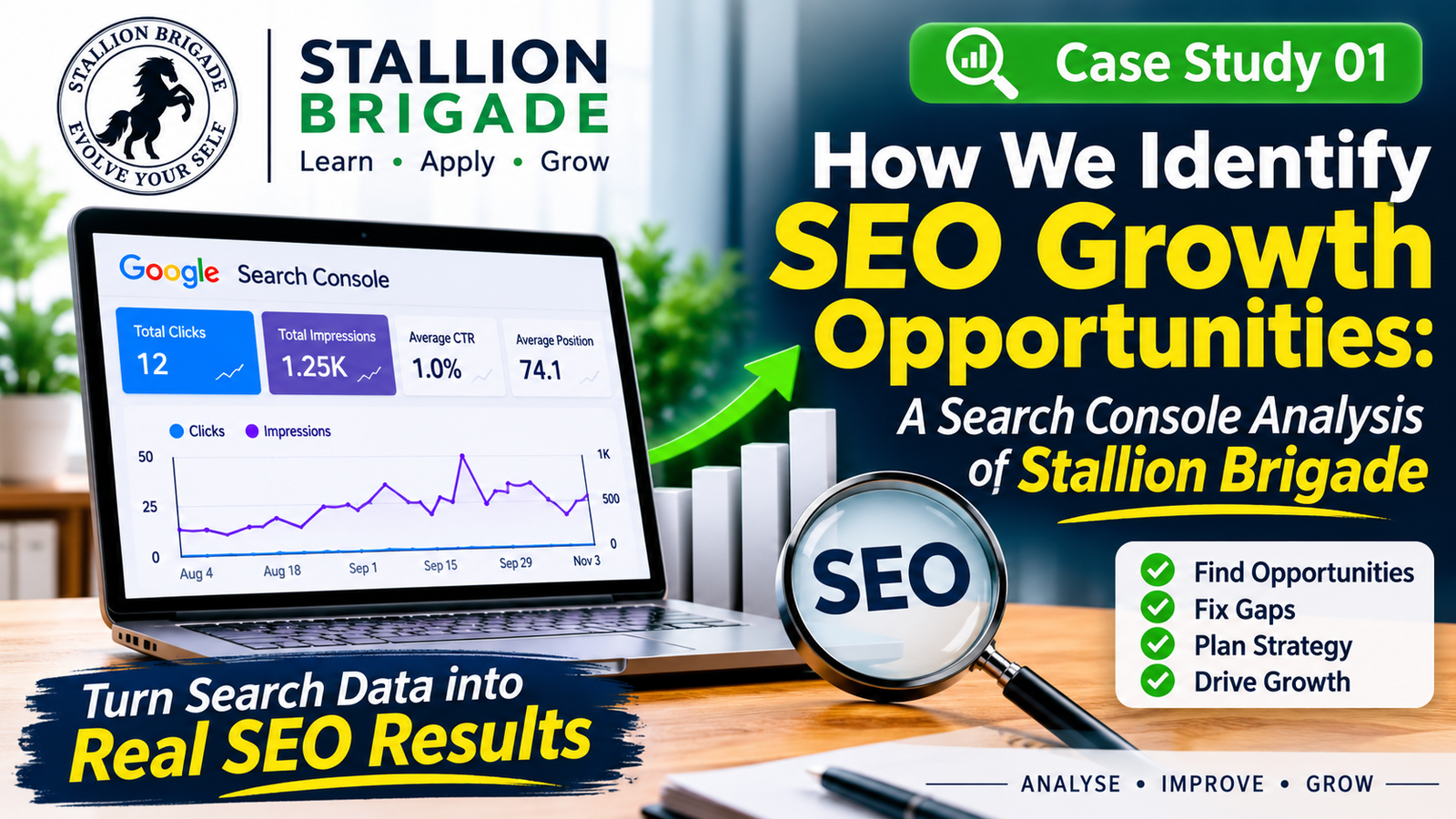
How We Identify SEO Growth Opportunities: A Search Console Analysis of Stallion Brigade
How Google Search Console Reveals SEO Opportunities for an AI-Era Marketing Website
Case study outline and working draft · Data period: August 4–November 3, 2026
How We Identify SEO Growth Opportunities: A Search Console Analysis of Stallion Brigade
An independent, data-led website analysis
Website: https://stallionbrigade.com/
Data source: Google Search Console
Analysis period: August 4–November 3, 2026
Status: Initial baseline analysis — implementation and results tracking pending.
1. Executive Summary
A website can publish useful content and still struggle to attract meaningful organic traffic.
The challenge is not always a lack of content. Sometimes the website is targeting the wrong search opportunities, has weak visibility for valuable queries, or fails to turn search impressions into clicks and business enquiries.
We analysed Stallion Brigade’s Google Search Console data to understand where the website currently stands and identify opportunities to improve its organic search performance.
The analysis revealed an important opportunity: Google is already associating the website with Claude SEO, Claude SEO tools and related search topics. However, visibility for several of these queries remains low in search results.
This gives us a starting point for a focused SEO and content strategy.
2. The Baseline: What the Data Shows
According to the Search Console chart export:
| Metric | Recorded result |
| Reporting period | August 4–November 3, 2026 |
| Total clicks | 12 |
| Total impressions | 1,250 |
Important page-level observations
The homepage recorded:
- 1,013 impressions
- 3 clicks
- 0.30% click-through rate
- Average position of 74.06
Some individual articles showed more promising average positions, including:
- Best Claude SEO Tools: A Complete Comparison Guide 2026 — average position 3.87, with 30 impressions.
- AI Search: The Complete Beginner to Expert Guide — average position 4.93, with 14 impressions.
- The Human-in-the-Loop Guide to SEO, AI Search 2026 and Beyond — average position 3.80, with 5 impressions.
These are small impression samples. They are encouraging signals, not proof of stable rankings or business results.
3. What Google Appears to Associate with the Website
The Queries report contains 94 search-query rows.
Some of the prominent queries include:
| Search query | Impressions | Average position |
| claude seo | 246 | 71.72 |
| claude seo agency | 86 | 62.76 |
| claude seo tracking software | 65 | 76.86 |
| claude seo tools | 60 | 73.05 |
| claude seo tracking tool | 52 | 89.40 |
| claude seo tracker | 46 | 91.74 |
Our interpretation
Google is showing the website for a cluster of searches related to Claude and SEO.
This suggests an existing topical association that deserves further investigation.
However, we should not assume that every query represents the website’s ideal audience. For example, someone searching for a Claude SEO tracking tool may want software, while someone searching for a Claude SEO workflow may want a tutorial.
Our next task is to separate search intent and identify which opportunities are relevant to the website’s audience and commercial goals.
4. The Main Problems We Want to Investigate
These are research questions, not yet confirmed technical findings.
Problem A: High impressions, limited clicks
The homepage received 1,013 impressions but only 3 clicks.
We need to investigate:
- Which queries generate those impressions?
- Is the homepage appearing for relevant searches?
- Does its title and description match search intent?
- Is the homepage clearly communicating the website’s main subject?
- Does it guide visitors towards useful resources?
Problem B: Search visibility is concentrated around a narrow topic
Many visible queries relate to Claude SEO tools and tracking.
We need to determine whether the website has enough depth and clear internal connections across:
- Claude for SEO
- AI-assisted SEO workflows
- AI Search and GEO
- AEO and answer-engine visibility
- Practical SEO problem-solving
Problem C: Some promising articles have very little search exposure
A few articles have average positions near the top of search results but only a small number of impressions.
We should investigate:
- Whether the keywords have sufficient search demand
- Whether the pages target specific search intent
- Whether related content supports these pages
- Whether internal links help visitors and search engines discover them
5. Our Recommended Strategy
We recommend a three-part approach.
Part 1: Improve existing search opportunities
- Review the homepage’s search intent and messaging.
- Identify pages with promising rankings but limited impressions.
- Improve titles, descriptions and content where the evidence supports changes.
- Strengthen internal links between related articles.
- Review overlapping topics and possible keyword cannibalisation.
Part 2: Build connected topic clusters
Organise the content around meaningful user problems rather than publishing unrelated articles.
Suggested clusters:
AI Search and GEO
- How businesses can improve visibility in AI search
- How to measure AI search visibility
- Google AI Overviews and AI Mode
- How AI search changes content strategy
Claude for SEO
- Claude SEO workflows
- Claude for keyword and topic research
- Claude and Google Search Console
- Comparing AI-assisted SEO tools
Business-focused SEO
- Why websites receive impressions but few clicks
- Why competitors outrank your website
- How to identify content gaps
- How to turn organic traffic into enquiries
Part 3: Connect content with business outcomes
Every important educational article should have a relevant next step.
Examples:
- Download an SEO audit checklist.
- Request a website content review.
- Get a search opportunity analysis.
- Discuss an AI Search visibility strategy.
The objective is not simply to increase traffic. It is to attract the right visitors and create opportunities for business enquiries.
6. The 90-Day Action Plan
Days 1–30: Diagnose and prioritise
- Review the homepage and important landing pages.
- Export query-level and page-level Search Console data.
- Group queries by search intent.
- Identify pages with the strongest improvement opportunities.
- Review internal links and content overlap.
- Establish baseline conversion tracking.
Expected deliverable: SEO opportunity report and prioritised action list.
Days 31–60: Implement improvements
- Improve selected existing articles.
- Refine homepage positioning and navigation.
- Build or improve relevant topic-cluster pages.
- Add contextual internal links.
- Publish two or three research-led, problem-solving articles.
- Add relevant calls to action.
Expected deliverable: Improved website structure and a focused content programme.
Days 61–90: Measure and refine
- Compare Search Console performance against the baseline.
- Monitor clicks, impressions, CTR and average position.
- Review which pages attract relevant visitors.
- Measure enquiry and lead activity.
- Identify the next set of content opportunities.
Expected deliverable: 90-day performance review and next-quarter growth roadmap.
7. How We Will Measure Success
We will track:
| Area | Measurement |
| Search visibility | Impressions and query coverage |
| Organic traffic | Search clicks and relevant landing-page visits |
| Search performance | CTR and average position |
| Content performance | Engagement with priority pages |
| Lead generation | Enquiry submissions and qualified leads |
| Business impact | Leads attributable to organic search |
We will not promise a particular ranking or traffic increase before implementation. The results will be reported against the actual baseline.
8. What This Analysis Demonstrates
This exercise demonstrates our approach to SEO strategy:
- Start with real search data.
- Understand what people are searching for.
- Identify the gap between current visibility and business goals.
- Prioritise improvements based on evidence.
- Build a practical implementation roadmap.
- Measure the impact instead of relying on assumptions.
We believe effective SEO is not simply about publishing more articles. It is about connecting search intent, useful content, website experience and business objectives.
9. Want Us to Investigate Your Website?
Your website may already have search opportunities that you are not fully using.
We can help identify:
- Search queries where your website has visibility but limited clicks.
- Content gaps between your website and competitors.
- Opportunities to improve topical authority.
- Ways to make your website more useful for Google and AI-powered search.
- Content opportunities that can attract potential customers.
Request an independent SEO and content opportunity review.
Research note: This is an independent analysis of Stallion Brigade using the available Google Search Console export. It is not a client success story. Recommendations are hypotheses to investigate and validate. No traffic growth, ranking improvement or lead increase is claimed until implementation results are measured.
What I would do next
Before publishing, we should strengthen this with three additional pieces of evidence:
- Google Analytics 4: Which pages attract visitors, and whether those visitors take action.
- Competitor comparison: Which topics and search opportunities competing websites cover that Stallion Brigade does not.
- Website review: Homepage messaging, navigation, internal links and important landing pages.
One important distinction: the Search Console export shows search visibility, not actual business leads. We should add enquiry tracking before claiming that SEO improvements increased leads.
This first study can become the template for the Dubai agency analyses. The strongest lead magnet will be a concise, evidence-based report that shows a business owner exactly where opportunities may exist and what to do about them.