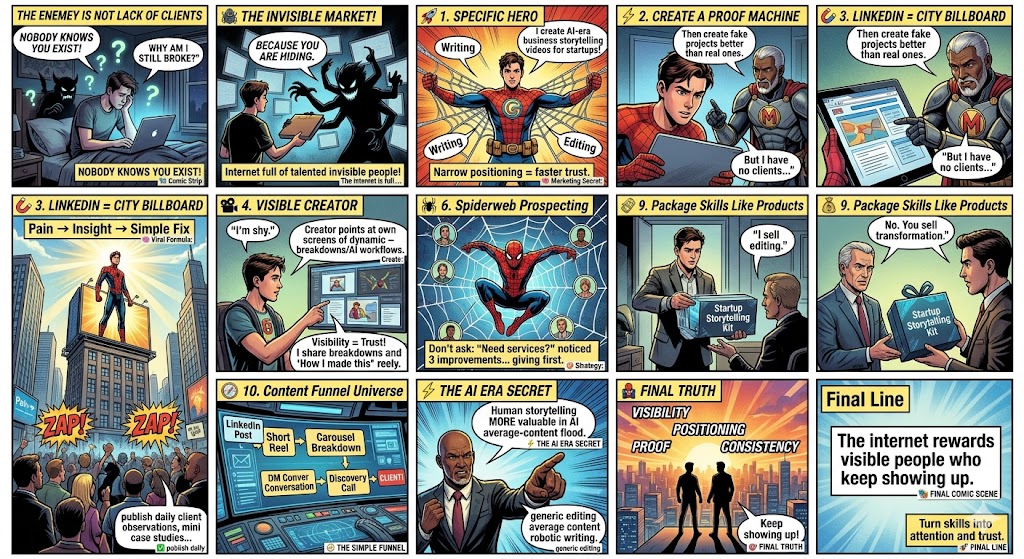
How to Win Clients for Writing & Video Production When the Competition Is Brutal
A research-backed guide to self-marketing, niche positioning, AI leverage, and client psychology.
| 1.57B Freelancers Worldwide | $9.91B Platform Market 2026 | 58% Say Finding Clients Is #1 Challenge | 329% Growth in AI Video Editing Demand |
10-minute read • Writing & Video Production • Sales & Marketing
01 – The Real Competition
You Are Not Competing on Skill. You Are Competing on Visibility.
There are 1.57 billion freelancers in the world. By 2027, projections suggest that 86.5 million Americans alone will be freelancing – more than half the entire U.S. workforce. And yet, if you ask most freelancers what keeps them up at night, the answer is almost never the quality of their work. It is the work of finding work.
A 2025 freelancer market study found that 58% of freelancers identify finding new projects as their single greatest challenge – ranking it above poor pay, difficult clients, and isolation combined. The market is booming. The competition is ferocious. And the uncomfortable truth is that talent alone is not a distribution strategy.
This article draws on market data from Upwork, Fiverr, LinkedIn, and independent research to show how the freelancers winning in 2026 – in writing, video production, and content creation – are actually getting and keeping clients. It draws on the hard-won patterns of freelancers who cracked the code without expensive courses, celebrity followings, or paid advertising.
| “The internet is full of talented invisible people. Meanwhile, average creators who understand attention, storytelling, and client psychology are winning.” |
02 – The Niche Paradox
Why Going Narrower Gets You More Clients, Not Fewer
The instinct to stay broad is understandable. More services mean more potential clients, right? In practice, the data says the opposite. Analysis across thousands of freelance businesses consistently shows that specialists outperform generalists by 300–500% in both revenue and client satisfaction. And AI-specialised freelancers now command 25–60% higher hourly rates than their general-practice peers in the same field, according to Upwork research.
The reason is psychological as much as it is economic. When a startup founder needs a video for investors, they do not search for “video editor.” They search for “startup pitch video specialists.” If your positioning matches their language, you appear. If it does not, you are invisible – no matter how skilled you are.
| 300–500%Revenue Advantage | Specialists outperform generalists by 300–500% in both revenue and client satisfaction (KRESERA analysis of thousands of freelance businesses). AI-specialised freelancers command 25–60% higher hourly rates than peers in the same field. The narrower your positioning, the faster clients trust you. |
For writers and video producers, the logic applies directly. A conversion copywriter specialising in SaaS onboarding emails earns multiples more than one who ‘writes anything.’ A short-form video editor specialising in founder story reels for LinkedIn gets inbound inquiries. A content writer focused on fintech for Southeast Asian markets is nearly impossible to replace.
| ❌ Invisible Positioning“I do writing and editing.””Freelance videographer available.””Content creator for hire.” | ✅ Magnetic Positioning “I turn founder expertise into viral LinkedIn content for SaaS companies.””I produce investor pitch videos for early-stage startups in under 72 hours.””I help D2C brands grow watch time through data-informed video storytelling.” |
| CASE STUDY – Niche + Productised = 6 FiguresA Shopify performance specialist (documented in a Jobbers.io analysis of 100 six-figure freelancers) built his entire business around one intersection: making existing Shopify stores load faster and convert better. He became one of fewer than 50 people globally doing exactly this work for exactly this client type – 7-figure fashion brands. The result: he could name his rates without competition.The lesson: Specificity is not a limitation. It is a moat. |
| Implementation Tactic Audit your Upwork or Fiverr profile right now. If your headline could apply to 10,000 other people, it is not a positioning statement. Rewrite it to include: your specific skill + your specific outcome + your specific client type. Test it for 30 days and track profile views. |
03 – Building Proof Without Clients
The Portfolio Problem – And How to Solve It Without Waiting
New freelancers face a paralyzing catch-22: clients want proof of results, but you need clients to generate proof. The solution, used by thousands of successful freelancers globally, is to manufacture proof rather than wait for it.
A rewritten landing page for a real company that did not hire you, posted publicly as a ‘concept redesign,’ demonstrates your thinking, your eye, and your craft. A before-and-after reel edit of a real brand’s weak content shows your skill more clearly than any resume.
| CASE STUDY – The ‘Concept’ Portfolio ApproachA SaaS product designer (documented by Damongo.com) created a signature ‘30-Day Conversion Audit’ package and documented three speculative projects that increased trial-to-paid conversion rates by 18–35%, using real brands as inspiration. She raised her rates before she had testimonials. Within 18 months, she was speaking at two industry conferences and fully booked on retainer.The lesson: The portfolio that gets you hired does not need to show past work. It needs to show future value. |
For video producers, this means creating a 60-second mock brand reel for a company you admire, using their public assets, and posting it: “Here is how I would reframe this brand’s story for LinkedIn.” For writers, it means rewriting the homepage of a startup whose messaging is weak, publishing the before and after, and explaining your reasoning. Clients hire on evidence of thinking, not just evidence of output.
04 – LinkedIn as Your Distribution Machine
The Platform That Most Freelancers Scroll But Never Work
LinkedIn has over 1 billion members. 40% visit the platform daily. And yet the overwhelming majority of freelancers use it passively, while a small minority publish consistently and accumulate enormous inbound advantage as a result.
Research cited by Linkmate found that professionals with active personal brands receive 47% more inbound opportunities than those with dormant profiles. When a prospect discovers you through content, the sales conversation begins with trust already established. Price objections drop. The entire dynamic shifts from persuasion to confirmation.
| 80/20Engagement Rule | Spend 80% of your LinkedIn time engaging, not broadcasting. Thoughtful comments on prospects’ posts – adding genuine insight rather than ‘great post!’ – make you familiar before you ever send a DM. By the time you reach out, they already recognise your name. |
Freelance content marketer Dominic Kent built his consultancy visibility by writing a book on freelancing, then systematically tagging contributors in his LinkedIn posts. Each tagged person shared the content with their network, multiplying his reach without a single paid promotion. The strategy generated both book sales and new consulting retainers simultaneously.
What works on LinkedIn in 2026: Content that follows the Pain → Insight → Simple Fix structure consistently outperforms promotional content. “Most startup founders make this one mistake in their investor pitch videos – here’s the fix” will reach more decision-makers than ‘I’m available for video work this month.’
Post three to four times per week. One authority piece (a deep breakdown or contrarian take). Two value posts (quick, actionable observations from your niche). One story post (something personal that connects to your professional lens). Consistency matters more than perfection.
| The Comment-First StrategyBefore sending any outreach DM, spend two weeks commenting on the target’s posts. A fintech content marketer described her approach: she identifies when a company is actively hiring – a signal they have a content gap – and reaches out only after several weeks of visible, intelligent engagement. Her response rate consistently runs above industry average because she is not a stranger by the time she asks for anything. |
05 – The Client Acquisition Funnel
How Strangers Become Paying Clients: The System Behind It
Most freelancers have no system. They post when inspired, pitch when desperate, and network when panicked. The freelancers who maintain full pipelines treat client acquisition as a system with predictable inputs and outputs.
THE CLIENT ACQUISITION FUNNEL
For Writers & Video Producers
| CONTENT & VISIBILITY – LinkedIn posts • Short reels • Authority articles Reach: 1,000s |
| ENGAGEMENT & RECOGNITION – Comments • Replies • Profile visits spike Aware: ~200 |
| VALUE-FIRST OUTREACH – DM with insight, not pitch • Warm lead, not cold Warm: ~40 |
| DISCOVERY CALL – Listen first • Diagnose the problem • Present outcome Calls: ~10 |
| PROPOSAL & CLOSE – Fixed-price package • Clear scope • Easy yes Proposals: ~4 |
| SIGNED CLIENT 1–2 clients |
The most important insight this funnel reveals is where the work actually happens. Most of the conversion occurs long before the DM. By the time a well-positioned freelancer sends an outreach message to a warm prospect, the selling is largely done. The content did the trust-building. The outreach is simply the formal handshake.
Average cold email response rates have fallen to just 3.43% in 2026, down from 8.5% in 2019. LinkedIn DMs perform better – 7% to 15% average reply rates – but only when the sender is not a stranger. Personalised LinkedIn DM campaigns from people who have already engaged with the prospect’s content push response rates well above 25%, according to Sopro data.
| The Timing Signal Strategy If a startup posts a job for a ‘Content Marketing Manager,’ reach out immediately. Your message: “I noticed you’re building your content team – while that search is underway, I help companies like yours maintain publishing velocity without a full-time hire. Here’s what that could look like for you in the next 30 days.” This positions you as a solution to a real, present pain. |
06 – Outreach That Actually Works
The Shift From Selling Services to Diagnosing Problems
The single biggest mistake in freelance outreach is leading with what you offer rather than what the client needs. Clients do not wake up thinking ‘I need a video editor.’ They wake up thinking ‘my content is getting no engagement’ or ‘my pitch deck is not converting.’ Your outreach must enter the conversation already happening in their head.
| WHAT NOT TO SAY vs. WHAT WORKS Ineffective: “Hi [Name], I’m a freelance video editor with 5 years of experience. I’d love to work with your company. Please let me know if you need any help.” Effective: “Hi [Name], I’ve been following your LinkedIn content – your insights on [specific topic] are genuinely useful. I noticed your last three videos don’t have subtitles or a strong opening hook, which typically cuts watch time by 40–60% on mobile. I put together a quick 60-second example of how your last video could have been restructured. Want to take a look?” The lesson: The second message shows research, delivers immediate value, references a specific problem, and makes the ask incredibly low-friction. It is not a pitch. It is a diagnosis. |
Voice notes and short video DMs on LinkedIn – 30–45 second Loom videos referencing a specific post or content gap – are among the highest-converting outreach formats available to freelancers right now, as they feel human in an inbox full of templated text.
For follow-up, Tuesday through Thursday between 8–11 AM in the recipient’s local time zone consistently generates the strongest engagement (Reachoutly 2026 data). Following up two to three times is professional – provided each follow-up adds a new piece of value.
07 – Packaging
Stop Selling Hours. Start Selling Outcomes.
Hourly billing is the default for new freelancers. It feels fair and transparent. In practice, it is a trap. It caps your income at your available hours, invites clients to micromanage your time, and frames you as a cost rather than an investment.
Productised services – fixed-price, fixed-scope packages with a defined deliverable and outcome – fundamentally change the economics and psychology of the relationship. MixBloom, a white-label social media content agency, built their entire model on fixed monthly packages from $199 to $549 per client. Instead of hunting for individual clients, they close agencies managing multiple clients at once. The Match Artist, a photography service that productised dating app photography specifically, grew to documented $896,000 per year in revenue by going radically narrow.
| $50KValue-Based Fee | One pricing formula used by high-earning specialists: Client’s expected revenue increase ÷ 10% = your project fee. Example: If your video content strategy generates $500,000 in annual revenue for a client, a $50,000 project fee represents a 10x ROI. The same 40 hours of work, priced at $1,250 per effective hour. This is only accessible to freelancers who articulate business outcomes, not deliverables. |
| The Product Mindset Shift Write three packages – starter, core, premium – at price points that reflect outcomes, not hours. Name each one after the result, not the service. ‘The Visibility System’ rather than ‘Social Media Package.’ ‘The Launch Reel’ rather than ‘Video Editing.’ When clients buy a named outcome, they feel less like they are hiring a vendor and more like they are investing in a solution. |
08 – The AI Multiplier
Why the AI Era Is the Best Time in History to Be a Human Storyteller
The narrative around AI and freelancing falls into two camps: either AI will replace all creative work, or AI is irrelevant. The data supports neither.
Writing jobs on freelance platforms did fall roughly 33% following the widespread adoption of AI writing tools. But in the same period, Upwork reported that demand for AI-related freelance skills grew 109% year-over-year based on actual marketplace earnings from 2025. AI video generation and editing specifically grew 329%. AI integration grew 178%. The market is not shrinking – it is bifurcating.
Clients are not replacing human freelancers with AI. They are replacing generic human freelancers with AI, and simultaneously paying more for the ones who combine human judgment with AI efficiency. According to Upwork data, freelancers who use AI tools earn approximately 40% more per hour than those who do not, and AI-enabled workers complete comparable tasks 25–35% faster.
| CASE STUDY – The AI-Augmented Freelancer Advantage An A.Team survey of elite independent professionals ( them more inclined to remain independent. One video editor described it: AI handles subtitling, rough colour grading, B-roll suggestions, and rough cut sequencing. He handles pacing, story arc, music selection, and client communication. His output per week tripled. His rates doubled. Upwork’s research director Dr. Gabby Burlacu: “Professionals who can direct and refine AI outputs to enhance their work will stand out and find success.” |
For writers, AI handles first drafts, headline variations, and SEO research. You provide the angle, the voice, and the judgment of what actually resonates. For video producers, AI handles assembly edits, captions, and platform resizing. You handle the story, the emotion, and the strategic intent behind every frame. The freelancers anxious about AI are the ones selling generic output. The freelancers thriving are the ones who weaponized it.
09 – Authority Content Strategy
One Deep Post Per Week Can Change How an Entire Market Sees You
There is a category of content that works differently from regular posts. Not because it goes viral, but because of what it signals. When you publish a 1,200-word breakdown of why most startup video ads fail emotionally, you are not just showing knowledge. You are demonstrating that you see the game at a level most people do not.
| 47%More Inbound | More inbound opportunities flow to professionals with active, consistent personal brands versus dormant profiles (LinkedIn 2025 Workplace Report). A single well-written authority article published weekly, promoted through your network, compounds over six to twelve months into a pipeline that fills itself. |
Authority content formats that convert:
1. A deep breakdown of a famous brand’s content failure and what they should have done differently
2. A contrarian take on a widely accepted piece of advice in your industry
3. An annotated case study showing not just the output but the thinking behind each decision
4. A trend analysis showing you are paying attention to where the market is going, not just where it is
The cadence that works is one per week – not every day. Authority content requires depth. Produced weekly with genuine craft, it becomes the asset that generates client inquiries for months after it is published.
10 – The Daily System
What Consistency Actually Looks Like in Practice
Every strategy in this article requires consistency to pay off. Not obsession – consistency. The freelancers who build reliable pipelines are not the ones who sprint for two weeks and burn out. They are the ones who do small, deliberate things every single working day.
The baseline daily system used by top-performing creative freelancers: one piece of content published, five intelligent comments on relevant posts, five value-led outreach messages sent, one portfolio asset improved or created, one new thing learned about their niche or their clients’ businesses. That is roughly 90 minutes of business development, done alongside actual client work.
The results are not linear. The first 60 days rarely produce visible results. Days 60 to 90 produce the first signs of traction. Month four to six is when the compounding begins. By month nine to twelve, the freelancers who stayed consistent are turning away work.
| The 90-Day Rule Commit not to measure results before day 60. Not impressions, not followers, not client inquiries. Just execute the daily system. At day 60, do your first review. Judge the inputs – are you publishing consistently? Are your DMs specific and value-led? – before judging the outputs. The outputs will follow if the inputs are right. |
The Final Truth: You Do Not Need Permission
You do not need an expensive course, a famous client list, or a massive following to build a thriving freelance business in writing or video production. You need clarity on who you serve, visibility in the places they spend attention, proof that you can solve their specific problem, and the patience to show up consistently long enough for trust to accumulate.
The market is growing. The freelance platform market alone will reach $20.12 billion by 2030. Employers are actively increasing their use of freelancers – 99% of major employers plan to continue or expand freelance hiring through 2026. The opportunity is real and it is large. The only question is whether you will be visible enough to claim your share of it.
Start with one thing: rewrite your positioning statement today. Make it specific, outcome-focused, and written for the exact client you want. Then publish one piece of content this week that shows you understand their world. And do it again next week.
Sources: Upwork 2025–2026 Marketplace Data • Fiverr Business Trends • LinkedIn 2025 Workplace Report • Sopro Cold Outreach Statistics 2026 • Reachoutly Cold Email Benchmarks 2026 • Jobbers.io Freelance Statistics 2026 • KRESERA Freelance Business Analysis • Damongo.com • A.Team Elite Freelancer Survey • DemandSage Freelance Statistics 2026