Updated October 2026. Sources are linked inline and listed at the end.
Summary
In brief
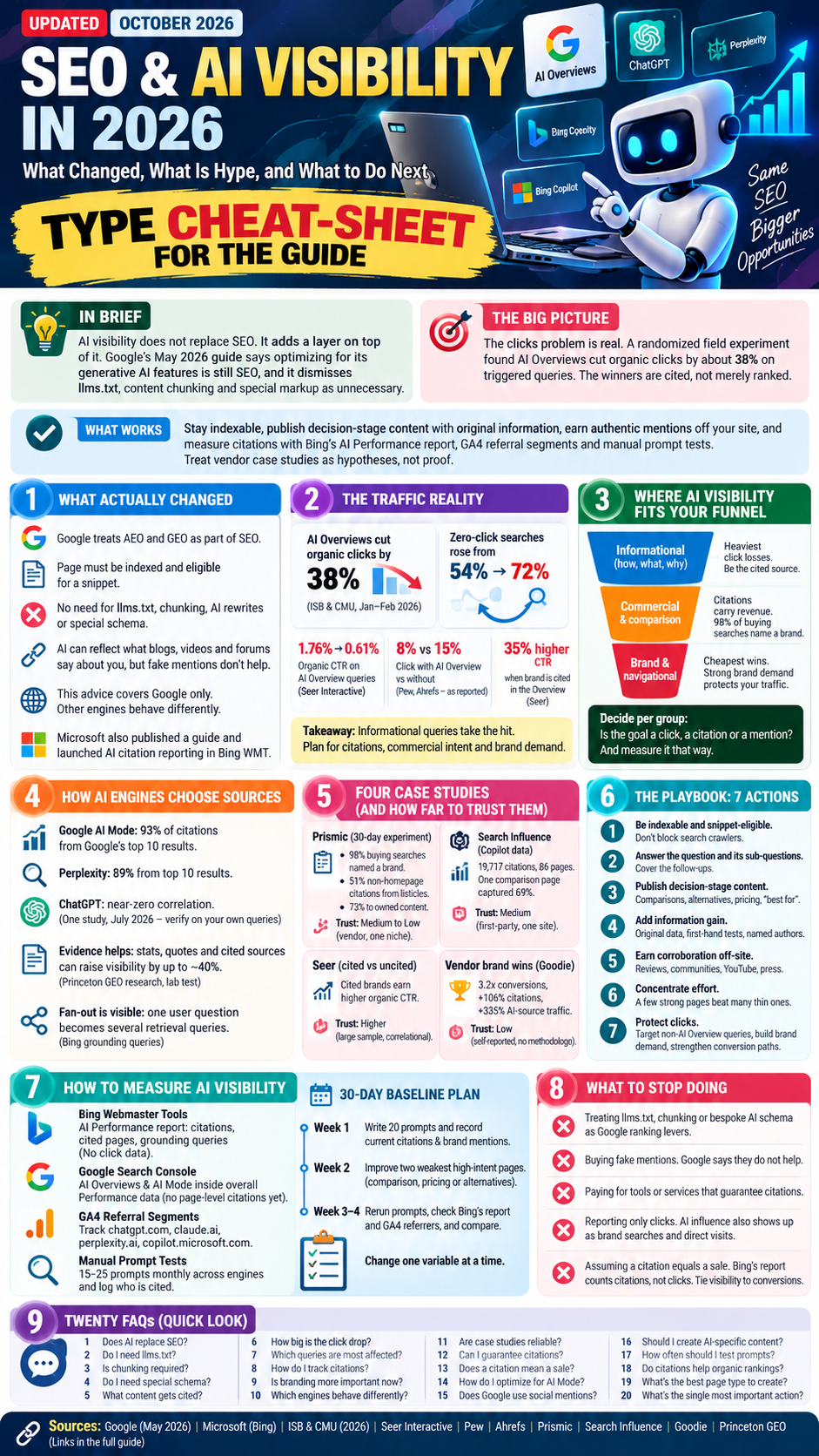
AI visibility does not replace SEO. It adds a layer on top of it. Google’s May 2026 guide says optimizing for its generative AI features is still SEO, and it dismisses llms.txt, content chunking and special markup as unnecessary.
The clicks problem is real, though. A randomized field experiment found AI Overviews cut organic clicks by about 38% on triggered queries. The winners are cited, not merely ranked.
What the evidence supports: stay indexable, publish decision-stage content with original information, earn authentic mentions off your site, and measure citations with Bing’s AI Performance report, GA4 referral segments and manual prompt tests. Treat vendor case studies as hypotheses, not proof.
Contents
- What actually changed
- The traffic reality
- Where AI visibility fits your funnel
- How AI engines choose sources
- Four case studies, and how far to trust them
- The playbook: seven actions
- How to measure AI visibility
- What to stop doing
Main Article
- What actually changed
On May 15, 2026, Google published its first official guide to optimizing for generative AI features. Coverage of the guide highlights five points:
• Google treats AEO and GEO as part of SEO.
• A page must be indexed and eligible for a snippet to appear in AI Overviews or AI Mode.
• You do not need llms.txt, content chunking, AI-specific rewrites or special schema for Google’s AI features.
• Manufactured mentions do not help, but AI features can reflect what blogs, videos and forums say about you.
• The advice covers Google only. Other engines behave differently.
• Microsoft moved in the same direction: it published its own guide to AEO and GEO and then launched citation reporting in Bing Webmaster Tools (see section 7).
Read together, the message from both search giants is consistent: the fundamentals still decide who gets retrieved. What changed is the surface where the answer appears, and how rarely the click follows. - The traffic reality
• Field experiment: a working paper from ISB and Carnegie Mellon (January to February 2026) found AI Overviews cut organic clicks by 38% on queries where they appeared. Zero-click searches rose from 54% to 72%. It is not yet peer reviewed.
• Seer Interactive: organic CTR on AI Overview queries fell from 1.76% to 0.61%, but a follow-up study saw an 85% rebound in early 2026 and warned against extrapolating from 2025.
• Pew and Ahrefs (as reported in the same coverage): 8% of users click with an AI Overview versus 15% without, and top-ranking pages lose about 58% of CTR. Ahrefs’ figure is correlational.
• Cited brands fare better: Seer reported 35% higher organic CTR when a brand is cited inside the Overview.
The takeaway: informational queries take the hit. Plan for citations, commercial intent and brand demand, not just rankings. - Where AI visibility fits your funnel
Not every query is worth the same fight. Sort your query portfolio into three groups before you spend any budget:
• Informational (how, what, why): the heaviest click losses. Aim to be the cited source and win the brand impression, and do not expect the old traffic. In the field experiment, people sent to AI Mode clicked out less and reported lower satisfaction than the other groups.
• Commercial and comparison: where citations carry revenue. Prismic found 98% of buying searches named a brand, so this is where being named decides the shortlist.
• Brand and navigational: the cheapest wins. Strong brand demand protects you when an answer replaces the click, because people search for you by name.
Then decide, per group, whether the goal is a click, a citation or a mention, and measure it that way. - How AI engines choose sources
• Each engine is different. One July 2026 study of 320 queries, reported in a newsletter, found Google AI Mode took 93% of citations from Google’s top 10 results and Perplexity 89%, while ChatGPT showed near-zero correlation. Single study, second-hand: verify on your own queries.
• Evidence helps. Princeton’s GEO research found that adding statistics, quotations and cited sources raised visibility by up to roughly 40% in a benchmark. That is a lab test, not a live engine.
• Fan-out is visible. Bing’s grounding queries read like machine-written keyword searches, which means one user question becomes several retrieval queries. - Four case studies, and how far to trust them
• Prismic’s 30-day experiment (report). 98% of buying searches named a brand versus 34% of informational ones. Comparison listicles earned 51% of non-homepage citations, and 73% of citations went to owned content. Human-edited, AI-assisted pages were cited within 14 days and also improved organic rankings. Lesson: decision-stage comparison content on your own site. Trust: medium to low. Vendor-published, one niche (ABM landing pages).
• Search Influence’s Copilot data (analysis). Over 91 days: 19,717 citations across 86 pages and 400+ grounding queries. One structured comparison page captured 69% of them. Lesson: citations concentrate on a few definitive assets. Trust: medium. First-party data, but one site and Copilot only.
• Seer’s cited versus uncited analysis. Cited brands earned higher organic CTR on the same query type. Lesson: a citation protects clicks. Trust: higher (large sample), but correlational.
• Vendor-reported brand wins (Goodie): SteelSeries 3.2x AI-search conversions in six months, Rathbones +106% AI citations, NoGood +335% AI-source traffic. Lesson: gains are possible. Trust: low. Self-reported by a tool vendor, no methodology shown. - The playbook: seven actions
- Be indexable and snippet-eligible. Do not block search crawlers. Decide on AI training crawlers separately from search crawlers.
- Answer the question and its sub-questions. Cover the follow-ups a retrieval system will fan out to.
- Publish decision-stage content: comparisons, alternatives, pricing and honest “best for” criteria.
- Add information gain: original data, first-hand tests, named authors, cited sources.
- Earn corroboration off-site: reviews, communities, YouTube, press. Authentic only.
- Concentrate effort. A few strong, regularly updated pages beat many thin ones.
- Protect clicks: target queries without AI Overviews, build brand demand, and strengthen conversion paths.
- How to measure AI visibility
• Bing Webmaster Tools: the AI Performance report shows citations, cited pages and grounding queries for Copilot and Bing summaries. It has no click data.
• Google Search Console: AI Overviews and AI Mode sit inside overall Performance data, without page-level citation counts, per trade coverage. Check your account for newer reports.
• GA4: create referral segments for chatgpt.com, claude.ai, perplexity.ai and copilot.microsoft.com.
• Manual tests: run a fixed set of 15 to 25 buying and how-to prompts monthly across engines, in fresh chats, and log who is cited.
A simple 30-day baseline:
• Week 1: write 20 prompts across your three query groups, and record today’s citations and brand mentions in each engine.
• Week 2: improve your two weakest high-intent pages (comparison, pricing or alternatives) and refresh their dates and sources.
• Weeks 3 and 4: rerun the same prompts, check Bing’s report and your GA4 referrers, and compare. Change one variable at a time, or you will not know what worked. - What to stop doing
• Treating llms.txt, chunking or bespoke AI schema as Google ranking levers.
• Buying fake mentions. Google says they do not help.
• Paying for tools or services that guarantee citations.
• Reporting only clicks. AI influence often shows up as brand searches and direct visits.
• Assuming a citation equals a sale. Bing’s report counts citations but not clicks, so tie visibility to conversions in your own analytics. - Twenty FAQs
- Is SEO still relevant for AI visibility?
Yes. Google says optimizing for its generative AI features is still SEO. Pages must be indexed and snippet-eligible, and the features draw on the same index. - What is the difference between SEO, GEO, AEO and AIO?
They are overlapping labels for visibility in search and answer engines. Google folds GEO and AEO into SEO. Define your terms once, then measure outcomes: citations, clicks and conversions. - Do I need an llms.txt file?
Not for Google, which says AI-specific files are unnecessary. One reported 90-day log study found only about 0.1% of AI crawler requests touched the file. Treat it as optional. - Should I chunk my content for AI?
Google says no. Write for people: descriptive headings, a direct answer first, then depth. - Does schema markup get me into AI Overviews?
Google says no special markup unlocks eligibility. Use structured data for its normal purposes, not as an AI trick. - How much do AI Overviews reduce clicks?
Estimates vary: about 38% in the randomized experiment, about 58% for top pages in Ahrefs data, and a 61% CTR fall in Seer’s data before a reported early-2026 rebound. Informational queries suffer most. - Do queries without AI Overviews still lose clicks?
Evidence is mixed. Seer reported declines even without Overviews in late 2025, then later saw informational no-Overview CTR improve. Do not assume those queries are safe. - Is being cited in an AI Overview worth the effort?
Probably. Seer found cited brands earned about 35% higher organic CTR. The finding is correlational, so test it on your own data. - Do Google rankings affect ChatGPT citations?
It depends on the engine. One July 2026 study found AI Mode and Perplexity leaned heavily on top-10 Google results, while ChatGPT showed almost no correlation. Verify on your queries. - What content gets cited most?
In Prismic’s single-niche experiment, comparison listicles earned 51% of non-homepage citations, and buying queries named brands far more than informational ones. Treat it as a hypothesis to test. - Is AI-written content OK?
Prismic’s human-edited, AI-assisted pages were cited within 14 days. But low-value scaled content risks spam treatment. Add original information and fact-check everything. - How fast can new content get cited?
Reports range from about 3 to 5 days (a vendor report) to 14 days (Prismic). There is no guarantee, and results vary by niche and competition. - How do I track AI citations?
Use Bing’s AI Performance report, a monthly manual prompt set, GA4 referral segments, and, if budget allows, a third-party tracker. No single source is complete. - Does Search Console report AI Overviews and AI Mode?
Per trade coverage, they are folded into overall Performance data without page-level citation counts. A newer AI report may be rolling out, so check your account. - Which AI referrers should I segment in GA4?
Start with chatgpt.com, claude.ai, perplexity.ai and copilot.microsoft.com, and add others as they appear in your referral report. - Does Bing matter now?
Yes, for Copilot visibility and because it is the only major platform offering first-party citation reporting. Importing your sites from Search Console takes minutes. - Do brand mentions matter?
Google says AI features can reflect what blogs, videos and forums say about you. Authentic mentions help. Manufactured ones do not, and may violate spam policies. - Should I block AI crawlers?
Decide deliberately. Training crawlers and search or retrieval crawlers are often separate user agents. Blocking retrieval bots can remove you from those engines’ answers. - Can small sites compete?
Possibly. Prismic reported that format and intent mattered more than volume or authority, and Copilot citations concentrated on a few pages. The evidence is limited, so test small. - How do I judge AI visibility case studies?
Check who published it, the sample size, the time window, whether clicks or revenue were measured, and what else changed (PR, paid, seasonality). Most are vendor-published and unaudited.
Sources
• Google Search Central: Guide to optimizing for generative AI features
• Search Engine Journal: Google’s AI search guide calls AEO and GEO still SEO
• Search Engine Journal: AI Overviews cut organic clicks 38%, field study finds
• Seer Interactive: 2026 CTR research and cited-brand CTR finding
• Prismic: AI search visibility report 2026
• Search Influence: Bing AI Performance and Copilot citations
• Search Engine Land: Bing Webmaster Tools AI Performance report
• Aggarwal et al.: GEO: Generative Engine Optimization (arXiv)
• Goodie: AI visibility case studies (vendor-reported)
- Is SEO still relevant for AI visibility?
- What actually changed