Washington / New York, 2 May, 2026:
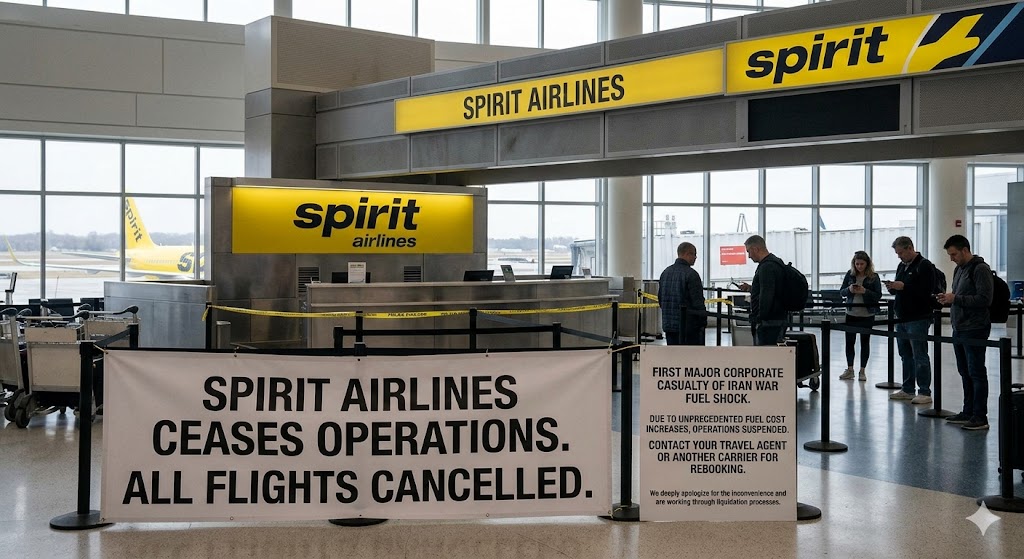
Budget carrier Spirit Airlines has begun an immediate shutdown of its operations after failing to secure a $500 million bailout from the administration of Donald Trump, marking what analysts describe as one of the first significant corporate casualties linked to the widening economic fallout of the Iran conflict.
The airline confirmed on Saturday that it had initiated “an orderly wind-down” of its business, cancelling all upcoming flights with immediate effect. Customer services have also been suspended, and passengers holding tickets are unlikely to receive direct refunds, though they may pursue claims through their credit card providers.
Fuel shock pushes struggling airline over the edge
Spirit had already been navigating financial instability, including a second bankruptcy process in recent years. However, the sharp rise in global energy prices following the escalation of the Iran US Israel conflict 2026 appears to have accelerated its collapse.
Jet fuel costs—typically accounting for up to 40% of airline expenses—have reportedly surged since late February, when US and Israeli strikes triggered wider regional instability. The resulting price shock placed additional strain on airlines operating on thin margins.
Savanthi Syth, an airline analyst at Raymond James, told the BBC that soaring fuel prices were “the final nail in the coffin” for Spirit, which had already been attempting to restructure its operations.
Bailout talks collapse amid political resistance
The airline had been in discussions with US officials over a potential rescue package, with earlier proposals reportedly involving significant government control. However, the plan faced opposition from lawmakers and financial stakeholders.
US Transportation Secretary Sean Duffy was quoted as saying that supporting the airline would amount to investing “good money after bad.”
Despite earlier optimism from Spirit in April that a deal was imminent, negotiations ultimately broke down. President Trump later indicated that a final proposal had been presented, but no agreement was reached.
Wider industry impact emerging
Spirit’s collapse highlights the broader vulnerability of the aviation sector to geopolitical shocks. Airlines across the United States and Europe have already begun reducing flight schedules and increasing fares to offset rising operational costs.
Meanwhile, the International Energy Agency has warned that parts of Europe could face jet fuel shortages within weeks if supply disruptions continue.
Uncertain outlook for passengers and industry
With operations now halted, thousands of passengers are left stranded, while uncertainty looms over potential job losses and ripple effects across the low-cost airline market.
Industry observers suggest that Spirit’s shutdown could signal the beginning of a wider consolidation phase in aviation, particularly if energy prices remain elevated amid ongoing geopolitical tensions.
Analysis:
While Spirit’s financial challenges predated the conflict, the current crisis underscores how rapidly external shocks—particularly energy volatility—can destabilize already fragile business models.