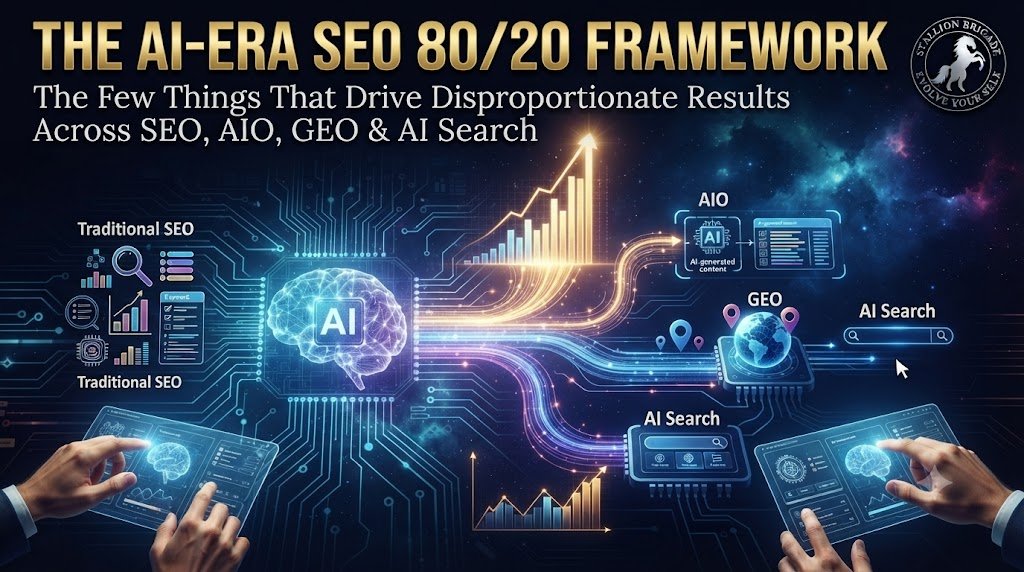
The AI-Era SEO 80/20 Framework: What Actually Drives Search Visibility in 2026
If you’re handed an SEO campaign in 2026, I would not start with 100 keywords, hundreds of backlinks, or publishing 50 AI-generated articles.
The 20% that tends to create the majority of the outcome is much more concentrated:
Make the right pages discoverable → make them genuinely useful → build topical/entity authority → make the information easy for search engines and AI systems to understand, extract, cite and trust → measure what actually produces visibility and business results.
Google itself still emphasizes crawlability, indexing, helpful people-first content, links, and making content understandable.
The 80/20 SEO + AIO + GEO + AI Search Framework
Think of the campaign as 8 high-leverage jobs.
| Priority | What to do | Why it matters |
| 1 | Fix crawl/indexation | If search engines can’t reliably discover/index the page, everything else is wasted |
| 2 | Find the money topics | Concentrate effort where search demand + business value overlap |
| 3 | Build topic/entity authority | Become the obvious source for a subject, not another page targeting a keyword |
| 4 | Create answer-first content | Make important questions easy for humans and machines to extract |
| 5 | Build internal-link architecture | Connect related concepts and distribute authority |
| 6 | Establish external authority | Earn mentions, links, citations and corroborating evidence |
| 7 | Optimize for AI retrieval/citation | Make your content easy for AI/search systems to understand and reference |
| 8 | Measure visibility, not just rankings | Track Google + AI search + business outcomes |
Let’s break down the 20%.
1. Fix the technical foundation first
Don’t spend weeks doing technical SEO theatre.
Find the few technical problems that can actually suppress visibility.
Your first audit should answer:
Can search engines:
- discover the important URLs?
- crawl them?
- render the important content?
- index the correct canonical URLs?
- understand what each page is about?
- follow the internal links?
- access important text?
- understand structured data?
- find updated pages through the sitemap?
Google describes Search as a three-stage process: crawling → indexing → serving.
So your first priority is:
Remove anything preventing the right content from entering and being understood by the index.
The 80/20 technical checklist
Check:
- robots.txt
- noindex
- canonicals
- XML sitemap
- 404/5xx errors
- redirect chains
- orphan pages
- duplicate URLs
- JavaScript-rendered content
- mobile usability
- Core Web Vitals where relevant
- important page templates
- internal links
- structured data
Don’t obsess over 200 technical issues if only 5 affect your revenue-generating pages.
2. Find the 10: 20 topics that actually matter
This is probably the highest-leverage strategic activity.
Don’t ask:
“What keywords can we rank for?”
Ask:
“What topics does this business need to be known for?”
Then map:
Business → audience → problems → questions → topics → entities → pages → conversions
For example, suppose you’re doing SEO for an online travel company.
Instead of targeting:
cheap flights
Build an ecosystem around:
Cheap flights
→ Delhi to Dubai flights
→ Delhi Dubai flight prices
→ cheapest month to fly
→ baggage allowance
→ direct vs connecting flights
→ airline comparison
→ Dubai airport information
→ visa requirements
→ travel tips
→ cancellation/refund policies
→ best time to visit
→ FAQs
You’re no longer creating isolated keyword pages.
You’re creating a knowledge ecosystem.
3. Build topical authority, not keyword volume
This is where traditional SEO and AI search increasingly converge.
An AI system doesn’t only need to see:
“Best CRM software”
It needs to understand that your site has meaningful coverage of:
- CRM
- CRM implementation
- CRM features
- CRM integrations
- CRM pricing
- CRM use cases
- CRM alternatives
- CRM workflows
- CRM automation
- CRM for different industries
- CRM problems
- CRM evaluation
The model:
Pillar → Cluster → Supporting answers → Evidence → Internal links
For every important commercial topic, ask:
“If an AI system had to determine whether this company understands this subject deeply, what evidence would it find?”
That’s a much better question than:
“How many articles should we publish?”
4. Make every important page “answer extractable”
This is one of the biggest opportunities for AIO/GEO/AI search.
Your page should contain information that can be easily extracted without the AI needing to interpret 2,000 words of fluff.
For important questions:
Answer first.
Example:
What is GEO?
Generative Engine Optimization (GEO) is the practice of improving how a brand’s information is discovered, understood, retrieved and represented by generative AI systems.
Then explain.
Don’t bury the answer after:
- 500-word introduction
- generic history
- three paragraphs about why the topic matters
- five stock-image sections
- finally the answer
Structure important content around:
Question → direct answer → explanation → evidence → examples → implications
This works for:
- Google Search
- AI Overviews
- ChatGPT search
- Gemini
- Perplexity
- other answer engines
You’re essentially making the content machine-readable at the semantic level, not merely technically crawlable.
5. Create “citation-worthy” content
This is where GEO/AI search becomes different from traditional SEO.
Ranking isn’t the only objective anymore.
You want other systems to have a reason to mention your site as a source.
That means producing things other websites and AI systems can reference.
High-value assets include:
- original research
- statistics
- surveys
- proprietary datasets
- benchmarks
- experiments
- industry frameworks
- detailed comparisons
- first-hand case studies
- expert interviews
- original examples
- calculators
- methodologies
- unique definitions
- documented processes
Compare:
“10 SEO tips”
with:
“We analyzed 12,000 pages across 40 SaaS websites and identified six patterns associated with AI-search visibility.”
The second creates something potentially citable.
That’s a major GEO asset.
6. Internal linking is an underrated superpower
This is one of the simplest high-ROI activities.
Google explicitly says links help it discover pages and understand relationships between pages.
Don’t just add:
Related Articles
at the bottom.
Build contextual semantic relationships.
Example:
GEO guide
links to:
→ AI search optimization
→ entity SEO
→ semantic SEO
→ structured data
→ LLM visibility
→ citation optimization
→ content architecture
And those pages link back appropriately.
You’re effectively creating a knowledge graph through your website.
One powerful audit:
Take your 20 most commercially important pages.
Ask:
Does every important page have relevant internal links coming into it?
Google specifically recommends ensuring pages you care about are linked from other pages.
7. Build authority outside your website
Publishing more isn’t necessarily the answer.
Your site needs external corroboration.
Look for:
- authoritative backlinks
- expert mentions
- industry publications
- digital PR
- podcasts
- interviews
- research citations
- partner websites
- relevant communities
- professional organizations
- reputable directories where appropriate
- original research references
Think:
“Where else does the web confirm that this company/person/entity knows this subject?”
That’s increasingly important in an AI-mediated search environment.
8. Build an Entity + Trust Layer
This is the piece many SEO campaigns still overlook.
AI systems need to understand:
Who are you?
What do you know?
Why should your information be trusted?
What entity does your website represent?
Create consistency around:
Organization
- company name
- official website
- about page
- contact information
- location
- social profiles
- organization schema
People
- authors
- credentials
- expertise
- author pages
- publications
- professional profiles
Topics
- definitions
- entities
- relationships
- terminology
- expertise
Evidence
- sources
- references
- original research
- case studies
- data
This creates a stronger entity footprint.
The AI Search Layer
Now add something important:
Don’t treat “AI SEO” as a separate website.
That’s a mistake.
Think of it as:
SEO foundation
↓
Semantic/content architecture
↓
Entity authority
↓
External corroboration
↓
AI retrieval & citation readiness
In other words:
Good SEO creates the infrastructure. Good content creates the information. Authority creates trust. AI optimization improves how that information can be retrieved and represented.
The 20% I would actually spend my time on
If I had 100 hours for an SEO + AI Search campaign, I’d roughly allocate it like this:
20 hours — Technical & indexation
Find and fix the issues blocking important pages.
20 hours — Topic/entity strategy
Identify the 10: 20 commercially important topics and map the content ecosystem.
25 hours — Content improvement
Upgrade existing high-potential pages before creating hundreds of new ones.
15 hours — Internal architecture
Build pillar/cluster relationships and contextual internal links.
10 hours — Authority
Digital PR, expert mentions, links, citations, partnerships.
10 hours — Measurement & experimentation
Track:
- organic clicks
- impressions
- rankings
- CTR
- conversions
- branded search
- AI citations
- AI mentions
- referral traffic
- visibility by topic
- visibility by entity
- assisted conversions
The BIG shift: Stop measuring only rankings
Traditional SEO:
“Where do we rank?”
Modern search:
“Can people and machines discover, understand, trust, retrieve and act on our information?”
So your dashboard should have four layers.
Layer 1 — SEO
- indexed pages
- impressions
- clicks
- rankings
- CTR
- organic conversions
Layer 2 — Content
- topic coverage
- content quality
- cannibalization
- internal links
- freshness
- content decay
Layer 3 — AI Search
- AI mentions
- citations
- cited URLs
- brand/entity mentions
- prompt visibility
- competitor visibility
- source selection
Layer 4 — Business
- qualified traffic
- leads
- revenue
- assisted conversions
- customer acquisition
- pipeline
Your 80/20 Campaign Workflow
If you give me a new website tomorrow, this is the sequence I’d use:
STEP 1
Business + audience + revenue analysis
↓
STEP 2
Technical/indexation audit
↓
STEP 3
Search Console + analytics + existing rankings
↓
STEP 4
Competitor/content-gap analysis
↓
STEP 5
Identify 10: 20 priority topics
↓
STEP 6
Map entities + questions + search journeys
↓
STEP 7
Build pillar/cluster architecture
↓
STEP 8
Upgrade existing high-potential pages
↓
STEP 9
Create genuinely differentiated content
↓
STEP 10
Add structured data where appropriate
Google notes that structured data provides explicit clues about page meaning and can make pages eligible for richer search features.
↓
STEP 11
Strengthen internal links
↓
STEP 12
Build external authority/citations
↓
STEP 13
Test AI-search visibility
↓
STEP 14
Measure business outcomes
↓
STEP 15
Double down on what works.
And here’s the real 80/20
If you remember only five things, remember these:
1. Fix discoverability
If Google/AI systems can’t access and understand the content, optimization is irrelevant.
2. Own fewer topics more deeply
10 authoritative topic ecosystems can be more valuable than 1,000 disconnected keywords.
3. Answer questions directly
Make important information easy for both humans and machines to extract.
4. Create information worth citing
Original data, research, expertise, experience, frameworks and evidence are powerful assets.
5. Build a connected authority graph
Your pages + internal links + authors + entities + external mentions + citations should collectively tell the same story.
The new mental model
I would replace the old SEO funnel:
Keywords → Content → Rankings → Traffic
with:
Intent → Topics → Entities → Content → Evidence → Authority → Retrieval → Citation → Visibility → Conversion
That is the SEO → AIO → GEO → AI Search evolution in one framework.
And importantly, these aren’t four completely separate disciplines. A large part of the work overlaps. Google’s own guidance continues to emphasize the fundamentals: helpful people-first content, crawlable links, understandable page structure, and technically accessible content.
If you’re positioning yourself as an AI-Era Content & Search Strategist, this is also the framework I’d build your consulting methodology around: Search Foundation → Topic Authority → Entity Authority → Answer Architecture → Citation Authority → AI Visibility → Business Impact.