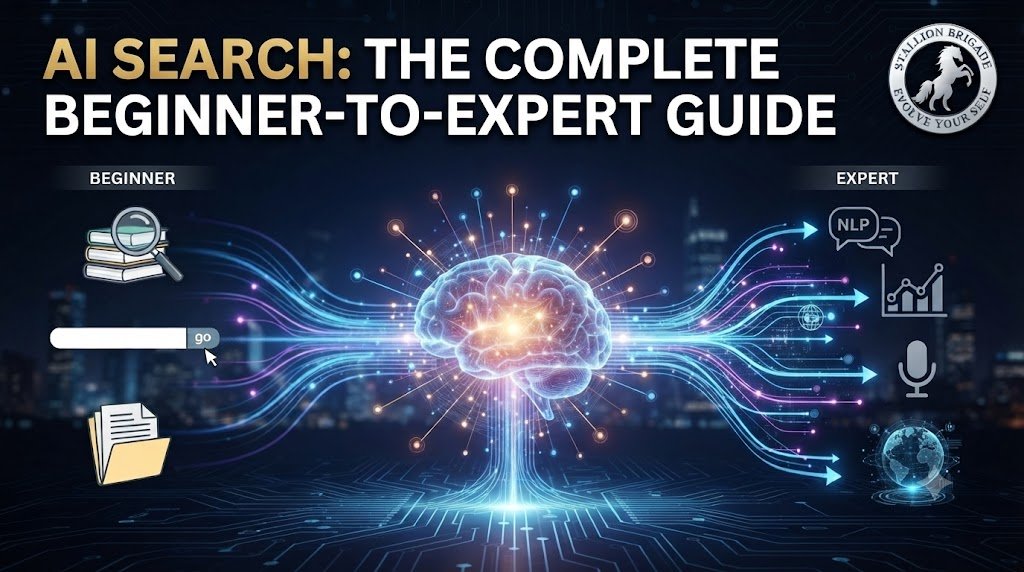
AI Search: The Complete Guide to Search in the AI Era
AI Search Cluster
The AI Search cluster is Stallion Brigade’s comprehensive knowledge hub for understanding how search is evolving in the age of artificial intelligence. It takes readers from the fundamental definition of AI Search through its underlying mechanics, Google’s AI-powered search experiences, query fan-out, optimization strategies, visibility measurement and the broader implications for SEO. Together, these pages form a structured learning path – from understanding AI Search, to understanding how it works, to learning how to optimize for it and measure its impact on modern search visibility.
AI Search SEO — The Implications of AI Search for SEO: https://stallionbrigade.com/ai-search/ai-search-seo/
AI Search — Main Hub: https://stallionbrigade.com/ai-search/
What Is AI Search? — Definition & Concept: https://stallionbrigade.com/ai-search/what-is-ai-search/
AI Search Guide — Complete Beginner-to-Expert Guide: https://stallionbrigade.com/ai-search/ai-search-guide/
How AI Search Works — Mechanics & Process: https://stallionbrigade.com/ai-search/how-ai-search-works/
Google AI Overviews — Google’s AI-Generated Search Experience: https://stallionbrigade.com/ai-search/google-ai-overviews/
Google AI Mode — Google’s Conversational AI Search Experience: https://stallionbrigade.com/ai-search/google-ai-mode/
Query Fan-Out — How AI Search Expands Complex Queries: https://stallionbrigade.com/ai-search/query-fan-out/
AI Search Optimization — Optimizing Websites & Content for AI Search: https://stallionbrigade.com/ai-search/ai-search-optimization/
AI Search Visibility — Measuring Visibility in AI-Powered Search: https://stallionbrigade.com/ai-search/ai-search-visibility/
AI Search:
The way people search is changing. Learn how AI is transforming discovery, answers, SEO and the future of the web.
Search has always been about one fundamental human need:
“Help me find the information I need.”
For decades, search engines largely answered that need by retrieving and ranking webpages. You entered a query, Google returned a set of results, and you decided which pages to open, read and compare.
AI Search is changing that journey.
Instead of simply returning documents, modern search systems can increasingly understand complex questions, investigate related topics, retrieve information from multiple sources, synthesize what they find and present an answer within a conversational interface.
Google’s AI Mode, for example, can break a complex question into subtopics, search for those subtopics simultaneously and bring the results together into an AI-powered response. It can also accept text, voice, images and files and support follow-up questions.
This doesn’t mean traditional SEO is dead.
It means search visibility is becoming broader than rankings alone.
Welcome to AI Search.
What Is AI Search?
AI Search is the evolution of search in which artificial intelligence participates more deeply in understanding queries, retrieving information, interpreting sources, generating answers and supporting conversational exploration.
Traditional search can be simplified as:
Query → Retrieval → Ranking → Results → User research
AI Search increasingly looks like:
Question → Understanding → Research → Retrieval → Synthesis → Answer → Sources → Follow-up
The distinction is important.
AI Search does not simply mean “searching with ChatGPT.” It describes a broader ecosystem that includes Google’s AI-powered Search experiences, ChatGPT Search, Perplexity and other systems that combine information retrieval with generative AI.
Google’s current AI Search documentation describes AI features as being built on its existing Search infrastructure and information systems rather than operating as completely separate systems.
For marketers, publishers and SEO professionals, this creates a new strategic question:
How do you make your information discoverable, understandable, useful and authoritative when an AI system is helping the user conduct the search?
That question sits at the centre of this entire AI Search cluster.
The AI Search Knowledge Hub
This section is the roadmap for understanding the subject from fundamentals to advanced AI-era SEO.
1. What Is AI Search?
Definition, concepts and the fundamental shift
Start here if you are new to AI Search.
This guide explains what AI Search means, how it differs from traditional search and why the search journey is moving from simply finding documents toward understanding questions and synthesizing information.
Read: /ai-search/what-is-ai-search/
You will learn:
- What AI Search means
- How AI-powered search differs from traditional search
- Why conversational search matters
- The role of AI-generated answers
- How AI Search affects SEO
- The emerging AI-search ecosystem
Core idea: Search is evolving from document retrieval toward information discovery and synthesis.
2. How AI Search Works
The mechanics behind AI-powered discovery
Once you understand what AI Search is, the next question is:
How does it actually work?
AI Search can involve several interconnected stages:
Query understanding → Intent interpretation → Query expansion → Retrieval → Source evaluation → Synthesis → Answer → Citations → Follow-up
One of the most important concepts is query fan-out—the ability to break a complex question into related searches and investigate several subtopics.
This article takes you inside that process and explains what happens between the moment a user asks a question and the moment an AI-powered search system produces an answer.
Read: /ai-search/how-ai-search-works/
Google AI Search
Google remains one of the most important environments in which AI Search is transforming the traditional search experience.
Two concepts deserve particular attention:
3. Google AI Overviews
AI-generated answers within Google Search
Google AI Overviews add an AI-generated layer to the Search experience.
Instead of presenting only conventional search results, Google can provide an AI-generated overview for appropriate queries, accompanied by links that allow users to explore supporting web content.
This creates an important change for publishers:
Your page may no longer need to be the first thing a user sees to become part of the user’s search journey.
Your content can potentially become a source within the AI-generated answer.
Google says its generative AI Search features remain grounded in its broader Search systems and web information, making traditional SEO fundamentals relevant to AI Search as well.
Read: /ai-search/google-ai-overviews/
Explore:
- What AI Overviews are
- How they work
- AI Overviews vs traditional results
- AI Overviews vs AI Mode
- Source and citation visibility
- Implications for SEO
- Content strategy for AI Search
4. Google AI Mode
From searching for information to conducting research
AI Mode takes the conversational Search experience further.
Google describes AI Mode as its most powerful AI Search experience, allowing users to ask complex questions, explore topics through follow-up questions and investigate information from multiple sources. It uses query fan-out to divide questions into subtopics and search for them simultaneously.
Users can interact with AI Mode through:
- Text
- Voice
- Images
- Files
- Follow-up questions
- Webpage or URL-based questions
This creates a fundamentally different search journey:
Search → Read
can become:
Ask → Investigate → Compare → Clarify → Explore → Act
Read: /ai-search/google-ai-mode/
The Technology Behind AI Search
5. Query Fan-Out
How one question can become many searches
Imagine asking:
“How should a SaaS company prepare for AI Search?”
That single question could require research into:
- Technical SEO
- Content architecture
- AI Search
- Google AI Mode
- Query intent
- Entity understanding
- Content quality
- Citations
- AI visibility
- Measurement
Instead of treating the user’s question as one isolated keyword, an AI Search system can investigate multiple related subtopics.
Google calls this process query fan-out.
Its AI Mode documentation explains that the system can divide a question into subtopics and search for each simultaneously across multiple data sources.
This concept is important because it changes how SEO professionals should think about content.
The objective isn’t to create a separate article for every conceivable keyword variation.
It is to build strong topical coverage around genuine information needs.
Read: /ai-search/query-fan-out/
Optimizing for AI Search
Understanding AI Search is only the beginning.
The next question is:
How should websites and content strategies adapt?
6. AI Search Optimization
AI Search Optimization is the practical discipline of making your website and content easier for modern search systems to discover, understand, retrieve and use.
It begins with the fundamentals.
Technical accessibility
Search engines need to be able to access your content.
Indexability
Important pages need to be eligible for Search.
Information architecture
Your pages should have clear relationships.
Semantic relevance
Content should genuinely address the subject and user intent.
Content quality
Pages should provide meaningful value rather than simply repeating information already available elsewhere.
Originality
Firsthand experience, research, experiments, analysis and unique perspectives can make content more valuable.
Entity clarity
Search systems need to understand the relationships between authors, organizations, topics, products and other entities.
Internal linking
Related information should be connected logically.
AI Search optimization should therefore not be treated as a collection of hacks.
Google’s documentation explicitly says that its existing SEO fundamentals remain relevant to generative AI Search and warns against creating content primarily to target every possible AI-generated query or using supposed AI-search tricks.
Read: /ai-search/ai-search-optimization/
Measuring AI Search Visibility
Traditional SEO measurement has generally focused on:
- Rankings
- Impressions
- Clicks
- CTR
- Conversions
AI Search introduces another dimension:
How often is my content appearing within AI-powered search experiences?
7. AI Search Visibility
AI Search visibility is broader than ranking.
A website can participate in an AI-search journey by being:
- Retrieved as a source
- Linked within an AI response
- Referenced during a research journey
- Discovered through AI-generated answers
- Associated with a topic or entity
- Visited after an AI-assisted search
Google is also expanding measurement for generative AI Search. Its current Search documentation provides a Generative AI performance report covering AI Overviews and AI Mode, allowing site owners to analyze relevant impressions and other dimensions.
This creates a new measurement model:
Traditional Search
Query → Ranking → Impression → Click
AI Search
Question → Retrieval → AI response → Source visibility → Exploration → Click
The metrics are evolving, but the strategic principle is already clear:
SEO measurement must increasingly account for visibility inside AI-mediated search journeys, not only positions on conventional result pages.
Read: /ai-search/ai-search-visibility/
AI Search and SEO
8. AI Search SEO
AI Search does not eliminate SEO.
It expands what SEO needs to accomplish.
Traditional SEO often asks:
How can I rank this page for this keyword?
AI-era SEO asks:
How can I make this information discoverable, relevant, understandable, trustworthy and retrievable for the questions my audience asks?
That requires a broader framework.
Technical SEO
Can search systems access your website?
Information architecture
Can they understand how your content is organized?
Search intent
Does your content solve the underlying problem?
Topical authority
Does your website demonstrate meaningful depth around a subject?
Entity authority
Is the relationship between your author, organization and subject clear?
Original research
Do you contribute information that isn’t simply copied or rephrased?
Content architecture
Are individual pages connected into a coherent knowledge system?
Brand authority
Does your organization become recognizable as a useful source on the subject?
This is why the future of SEO is not necessarily SEO versus AI Search.
It is:
SEO evolving for an AI-mediated search environment.
Read: /ai-search/ai-search-seo/
The AI Search Visibility Stack
The entire cluster can be understood through one framework:
1. Technical Accessibility
Can search systems reach your information?
↓
2. Crawlability & Indexability
Can your pages participate in Search?
↓
3. Information Architecture
Can relationships between pages and topics be understood?
↓
4. Semantic Relevance
Does the content answer the user’s information need?
↓
5. Content Quality
Does it genuinely help?
↓
6. Originality & Evidence
Does it contribute something meaningful?
↓
7. Authority & Reputation
Is the source credible?
↓
8. Entity Understanding
Can search systems understand the people, organizations and concepts involved?
↓
9. Retrieval Visibility
Can the information be found for relevant questions?
↓
10. AI Search Visibility
Can the content become part of an AI-generated answer or research journey?
↓
11. Brand Visibility
Does the search experience introduce the user to your expertise?
↓
12. Business Outcome
Does visibility eventually contribute to meaningful action?
This is the broader framework that connects every page in this cluster.
AI Search Is Bigger Than Google
Google AI Overviews and AI Mode are extremely important, but AI Search is not synonymous with Google.
The broader ecosystem includes conversational and AI-assisted discovery experiences from multiple platforms.
That means a long-term AI Search strategy should avoid becoming dependent on:
- one search engine
- one AI model
- one ranking feature
- one optimization technique
- one measurement system
The more durable strategy is to create information assets that remain valuable across search environments.
That means building:
- authoritative content
- original research
- useful frameworks
- strong entities
- coherent content architecture
- clear authorship
- trustworthy sources
- meaningful brand recognition
The interface may change.
The underlying principle remains:
Create information worth discovering.
What AI Search Means for Content Creators
The emergence of AI Search changes the role of content.
For years, much of SEO content production revolved around:
Keyword → Article → Ranking → Traffic
The AI-search environment encourages a broader model:
Audience question → Information need → Research → Original insight → Content asset → Distribution → AI/search visibility → Human engagement
This is particularly important as AI makes commodity content easier to produce.
If everyone can generate a 1,500-word article about a topic in seconds, simply producing another 1,500-word article is unlikely to create a meaningful competitive advantage.
The advantage increasingly comes from:
- original experience
- data
- experiments
- analysis
- expertise
- frameworks
- first-party research
- strong information architecture
- distinctive points of view
In other words:
AI makes content production cheaper. It makes meaningful information more valuable.
What AI Search Does Not Mean
AI Search has generated considerable speculation, but several misconceptions are worth avoiding.
AI Search does not mean SEO is dead.
Traditional Search infrastructure remains fundamental to many AI Search experiences.
AI Search does not mean every page should be written by AI.
AI can assist research and production, but usefulness, accuracy, originality and human value remain critical.
AI Search does not mean keywords are irrelevant.
Keywords remain useful signals of language and information needs. But modern search increasingly interprets topics, intent, entities and context.
AI Search does not mean there is one universal ranking formula.
Google AI Mode, AI Overviews and other AI Search systems may operate differently.
AI Search does not mean you need an AI-search “hack.”
There is no reliable shortcut that substitutes for strong technical SEO, useful content and authority.
AI Search does not mean websites disappear.
AI Search continues to connect users with web sources, links and original content. Google specifically describes AI Mode as providing links to explore further and emphasizes the role of high-quality web content in supporting responses.
Where Should You Start?
If you are new to AI Search, follow this sequence.
Beginner
1. What Is AI Search?
Understand the concept and why search is changing.
2. How AI Search Works
Understand the retrieval, synthesis and conversational process.
Intermediate
3. Google AI Overviews
Understand Google’s AI-generated answer layer.
4. Google AI Mode
Understand deeper conversational and multimodal Search.
5. Query Fan-Out
Understand how complex questions can become multiple searches.
Advanced
6. AI Search Optimization
Learn how to adapt websites and content.
7. AI Search Visibility
Learn how to measure participation in AI-powered search.
8. AI Search SEO
Connect AI Search with the broader discipline of modern SEO.
This creates a progression from:
Understanding → Mechanics → Platforms → Retrieval → Optimization → Measurement → Strategy
The Future of Search Is Not “AI Instead of Search”
It is AI inside Search.
The search experience is becoming increasingly capable of understanding questions rather than merely matching queries.
It can investigate multiple sources rather than simply return a list.
It can synthesize information rather than requiring the user to perform all the synthesis.
It can continue a conversation rather than requiring a completely new query.
And increasingly, it can move from:
finding information
toward:
understanding information
and eventually:
helping users act on information.
Google’s current AI Mode experience already supports follow-up questions, multimodal inputs and deeper exploration across web sources, while newer connected-app capabilities show how Search can increasingly connect an AI response to actions in external services.
That makes AI Search one of the most important developments in the evolution of digital discovery.
The Stallion Brigade AI Search Framework
This entire section of Stallion Brigade is designed around one simple idea:
Understand how AI Search works before trying to optimize for it.
The cluster therefore follows a deliberate progression:
AI Search
The complete ecosystem
↓
What Is AI Search?
Definition & concept
↓
How AI Search Works
Mechanics & process
↓
Google AI Overviews
AI-generated Search answers
↓
Google AI Mode
Conversational and deeper AI Search
↓
Query Fan-Out
How complex questions become multiple searches
↓
AI Search Optimization
How to prepare websites and content
↓
AI Search Visibility
How to measure participation in AI Search
↓
AI Search SEO
How AI changes the broader SEO discipline
Together, these pages form a knowledge architecture, rather than a collection of disconnected blog posts.
And that distinction matters.
The objective isn’t simply to publish more articles about AI.
The objective is to build a coherent body of knowledge about how search is evolving in the AI era.
Explore the AI Search Knowledge Hub
What Is AI Search?
Understand the definition, evolution and fundamental principles of AI-powered search.
How AI Search Works
Explore query understanding, retrieval, synthesis, citations, conversational search and the AI Search process.
Google AI Overviews
Learn how Google’s AI-generated overview experience changes the traditional Search journey.
Google AI Mode
Understand Google’s deeper conversational, multimodal and research-oriented AI Search experience.
Query Fan-Out
Learn how AI Search systems can break complex questions into related searches and investigate multiple subtopics.
AI Search Optimization
Discover practical strategies for making websites and content more accessible, useful and discoverable in AI-powered Search.
AI Search Visibility
Learn how to think about, measure and improve visibility across AI-mediated search experiences.
AI Search SEO
Understand how traditional SEO evolves when search becomes increasingly conversational, generative and AI-mediated.
The AI Search Principle
The most important lesson is perhaps the simplest:
Don’t create content merely because AI might find it.
Create content because people need the information.
Make it:
- accessible
- accurate
- useful
- original
- well researched
- clearly structured
- connected to related knowledge
- authored by identifiable experts
- supported by evidence
- continuously improved
Then build the technical and semantic infrastructure that allows search systems to discover it.
The future of SEO isn’t simply about getting a webpage to rank.
It is about becoming a trusted source within the information systems that increasingly mediate how people discover, understand and act on information.
That is the opportunity of AI Search.
And that is what this Stallion Brigade knowledge hub is designed to help you understand.
Start Your AI Search Journey
New to AI Search?
Start with What Is AI Search?.
Want to understand the technology?
Continue to How AI Search Works.
Want to understand Google’s implementation?
Explore Google AI Overviews and Google AI Mode.
Ready for the SEO implications?
Move through AI Search Optimization, AI Search Visibility and AI Search SEO.
This is your starting point for understanding search in the AI era.
A structural recommendation for the actual WordPress page
I would not make this page another 2,000-word conventional article with ten FAQs. Its strategic role is different from the child pages you have already created.
I recommend treating /ai-search/ as a hub/landing cornerstone, with:
- a strong hero introduction;
- a short definition of AI Search;
- the 8-page cluster map;
- a visual “AI Search Visibility Stack”;
- short descriptions linking to every child page;
- a “Start Here” learning path;
- a concise future-of-search section;
- and strong internal links between the cluster pages.
That gives Google a very clear hierarchy:
AI Search (hub)
→ What Is AI Search?
→ How AI Search Works
→ Google AI Overviews
→ Google AI Mode
→ Query Fan-Out
→ AI Search Optimization
→ AI Search Visibility
→ AI Search SEO
The important architectural distinction is that this page explains the whole territory, while each child page owns one specific subtopic. That minimizes cannibalization and gives the cluster a much stronger semantic structure.
I would also keep GEO, AEO, LLM Visibility, Retrieval/RAG, Multimodal Search and Agentic Search as the next layer of the AI Search architecture rather than adding them to this first-wave cluster immediately. That gives you room to expand the knowledge graph without making the hub feel overloaded.