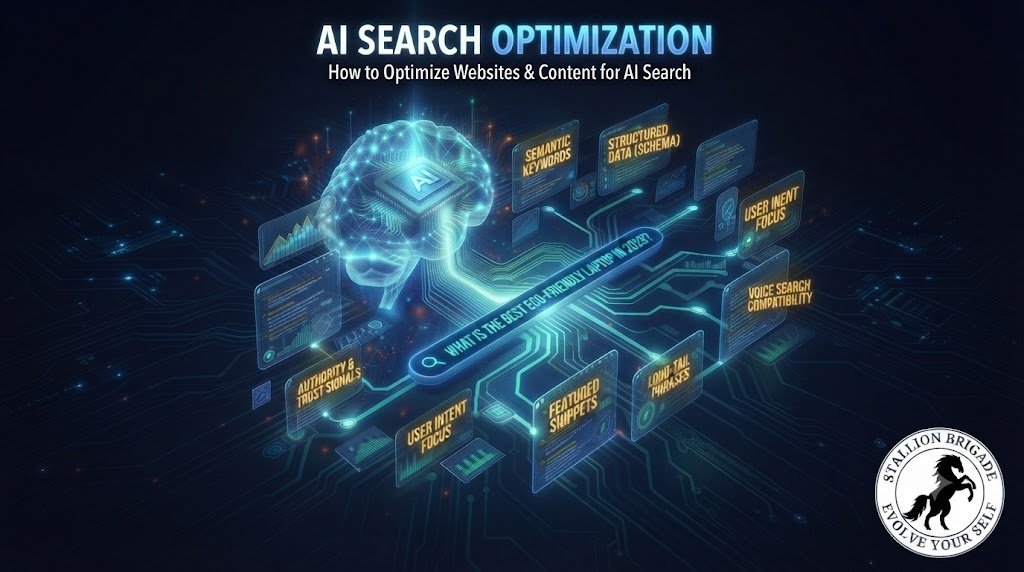
AI Search Optimization: How to Optimize Websites & Content for AI Search
Article Summary
AI Search Optimization is the process of improving a website so its content can be discovered, understood, retrieved, cited, recommended, and acted upon by AI-powered search systems. It builds on traditional SEO rather than replacing it.
As search evolves through Google AI Overviews and AI Mode, Microsoft Copilot, conversational search and multimodal experiences, visibility is becoming broader than ranking for keywords. Websites increasingly need technically accessible pages, clear answers, strong topic coverage, identifiable entities, original evidence, useful media, logical internal linking, and content that satisfies the different questions behind a user’s intent.
This cornerstone guide explains how AI Search Optimization works, what to optimize, what has changed from traditional SEO, which popular GEO tactics are unnecessary, and how to build a practical optimization framework for the AI-search era.
Contents
- What Is AI Search Optimization?
- Why AI Search Changes Website Optimization
- SEO vs. AI Search Optimization
- The AI Search Visibility Journey
- Technical Foundations for AI Search
- Optimize for Intent, Not Just Keywords
- Answer Questions Clearly and Early
- Build Topic Depth and Content Architecture
- Optimize for Query Fan-Out
- Make Content Easy to Understand and Retrieve
- Strengthen Entities and Authority
- Create Original, Citable Information
- Optimize for Comparisons and Recommendations
- Images, Video and Multimodal Search
- Structured Data and AI Search
- Freshness and Content Maintenance
- What Not to Do for AI Search
- Measuring AI Search Visibility
- The Stallion Brigade AI Search Optimization Framework
- AI Search Optimization Checklist
- FAQs
AI Search Optimization – Optimizing Websites & Content for AI Search
The search result is no longer always a list of links.
For decades, website optimization followed a familiar logic:
Find keywords → create pages → earn links → improve rankings → attract clicks.
That model still matters.
But search is becoming more complex.
A user can now ask:
“I run a small SaaS company with a limited budget. Should I focus on SEO, paid search or content marketing first?”
An AI-powered search system can interpret the question, explore related subtopics, retrieve information from multiple sources, compare alternatives and synthesize an answer.
The user’s journey may begin inside the generated answer rather than on your website.
That creates a new optimization challenge.
Your page doesn’t merely need to rank.
Ideally, your information should be:
Crawlable → Indexable → Understandable → Retrievable → Useful → Citable → Recommendable
That is the essence of AI Search Optimization.
1. What Is AI Search Optimization?
AI Search Optimization is the practice of improving websites, content and digital information so they can be effectively discovered, understood, retrieved and surfaced within AI-powered search experiences.
It includes traditional SEO fundamentals but expands the objective.
Traditional SEO commonly asks:
“How can this page rank for this search?”
AI Search Optimization also asks:
“How can this information become a useful source when an AI system is constructing an answer?”
That distinction is important.
AI-generated answers may combine information from multiple sources. A website therefore does not necessarily need to provide the entire answer to contribute useful information to the response.
Microsoft describes this emerging environment in terms of grounding: connecting AI-generated answers to fresh, verifiable web evidence. Bing Blogs
2. Why AI Search Changes Website Optimization
Traditional searches were often relatively short:
SEO agency
best CRM
content marketing tools
AI search encourages much richer questions:
“Which CRM would be best for a 15-person B2B consulting company that needs email automation but doesn’t have a dedicated technical team?”
That one prompt contains:
- product category;
- company size;
- industry;
- use case;
- required feature;
- technical constraint;
- comparison intent;
- recommendation intent.
AI systems can therefore work across topics, entities, context and intent, rather than relying on an exact keyword-page relationship.
Microsoft’s latest AI visibility reporting reflects this shift: Bing Webmaster Tools now groups AI citation activity by intent and topic, alongside individual grounding queries. Bing Blogs
For publishers, this suggests an important change:
Stop treating every search as an isolated keyword. Start treating it as an information need.
3. SEO vs. AI Search Optimization
AI Search Optimization does not mean abandoning SEO.
Google’s 2026 guidance explicitly reinforces that existing SEO fundamentals continue to matter for its generative AI search features. Google for Developers
Think of the relationship this way:
| Traditional SEO | AI Search Optimization |
| Keywords | Questions, prompts and intent |
| Rankings | Rankings + retrieval + citations |
| Individual queries | Topics and related information needs |
| Page optimization | Page + site knowledge architecture |
| Search snippets | Search snippets + generated answers |
| Backlinks/authority | Authority + evidence + identifiable sources |
| Text search | Text + image + video + multimodal |
| Click measurement | Clicks + citations + AI visibility |
| Searcher visits pages | AI may synthesize information before the visit |
The two disciplines overlap heavily.
Strong AI Search Optimization usually starts with strong SEO.
4. The AI Search Visibility Journey
A useful way to understand optimization is as a sequence.
Crawl
Can search systems access the page?
↓
Index
Can the page enter the search index?
↓
Understand
Is its subject, structure and meaning clear?
↓
Retrieve
Is it relevant enough to be retrieved for the information need?
↓
Extract
Can useful facts or passages be identified?
↓
Cite
Is the information useful and trustworthy enough to support an answer?
↓
Recommend
When appropriate, is the entity or solution suitable for recommendation?
↓
Click or Action
Does the user visit, investigate, subscribe, enquire or buy?
A weakness early in this chain can affect everything after it.
This is why chasing “AI citations” while ignoring indexation or content quality is backwards.
5. Start With the Technical Foundations
Before thinking about GEO tricks, make sure search systems can reliably access your website.
Check:
- robots.txt;
- accidental noindex directives;
- canonical URLs;
- XML sitemaps;
- internal links;
- redirects;
- duplicate pages;
- HTTP status codes;
- mobile usability;
- page performance;
- JavaScript accessibility where relevant.
Bing similarly emphasizes crawlability, indexing, freshness and sitemaps as foundations for content discovery in AI-powered search. Bing Blogs
The principle is simple:
AI cannot reliably surface information it cannot discover or access.
Technical SEO therefore remains the foundation of AI Search Optimization.
6. Optimize for Intent, Not Just Keywords
Suppose your target keyword is:
AI Search Optimization
Traditional keyword research may give you:
- AI search optimization;
- optimize for AI search;
- AI SEO;
- AI search SEO;
- GEO optimization.
Useful-but incomplete.
Now think about what the person actually wants to know:
- What is AI Search Optimization?
- How does it work?
- Is it different from SEO?
- What is GEO?
- How do I get cited by AI?
- Does schema help?
- Do backlinks still matter?
- How do I optimize existing articles?
- How do I measure AI visibility?
- How do I know whether ChatGPT or Copilot mentions my company?
That is an intent map, not merely a keyword list.
And it provides a much stronger basis for content.
7. Answer the Main Question Clearly and Early
Don’t force readers-or retrieval systems-to work unnecessarily hard to find your core answer.
If the heading asks:
What is AI Search Optimization?
follow it quickly with:
AI Search Optimization is the process of improving website content and structure so information can be discovered, understood, retrieved and surfaced by AI-powered search experiences.
Then expand.
A useful structure is:
Question → Direct answer → Explanation → Evidence → Example → Related question
This also improves the experience for human readers who want quick answers before deciding whether to continue.
8. Build Topic Depth, Not Random Content Volume
Publishing hundreds of loosely related AI articles does not automatically create authority.
Instead, build connected topic clusters.
For example:
AI Search
→ What Is AI Search?
→ Complete AI Search Guide
→ How AI Search Works
→ Google AI Overviews
→ Google AI Mode
→ Query Fan-Out
→ AI Search Optimization
→ AI Search Visibility
→ AI Search SEO
→ GEO
→ AEO
→ LLM Visibility
→ AI Citations
This architecture helps both people and search systems understand the relationship between concepts.
Google’s people-first content guidance continues to emphasize original information, substantial coverage and content created primarily to help people rather than manipulate rankings. Google for Developers
Depth is not the same as word count.
A 1,200-word page that answers the question completely can be stronger than a repetitive 5,000-word article.
9. Optimize for Query Fan-Out
Query fan-out is particularly important in AI search.
A complex prompt may lead an AI search system to investigate several related information needs.
For example:
“What is the best SEO strategy for a new SaaS startup?”
may require information about:
SaaS SEO
→ keyword strategy
→ technical SEO
→ content strategy
→ competitor analysis
→ backlinks
→ budget
→ expected timeline
→ AI Search
→ measurement
You don’t need a separate page for every imaginable variation.
Instead, determine:
What belongs on the main page?
Keep tightly related information together.
What deserves deeper treatment?
Create a supporting page.
How should those pages connect?
Use descriptive contextual internal links.
This creates a knowledge network instead of a collection of isolated posts.
10. Make Content Easy to Understand and Retrieve
Good AI-search content should also be good human-readable content.
Use:
- descriptive H2 and H3 headings;
- short, meaningful paragraphs;
- lists where lists genuinely help;
- comparison tables;
- definitions;
- examples;
- descriptive captions;
- logical sections;
- concise summaries.
Microsoft specifically recommends clear headings, tables and FAQs as ways to make key information easier to surface accurately, alongside strong evidence and clear subject focus. Bing Blogs
But don’t misunderstand this as:
“AI loves bullet points, therefore turn every article into bullet points.”
Structure should improve comprehension-not make the writing robotic.
11. Strengthen Entities and Authority
AI Search Optimization is also about who is saying what about whom.
Make important entities unambiguous.
For a professional website, clearly establish:
Person → expertise → organization → topics → published work
For a company:
Brand → products/services → customers → industries → locations → evidence
Useful signals can include:
- detailed About pages;
- author biographies;
- consistent author names;
- editorial policies where appropriate;
- organization information;
- contact information;
- credible external references;
- relevant structured data;
- original work demonstrating expertise.
Don’t manufacture authority.
Document real authority clearly.
12. Create Information Worth Citing
One of the strongest AI-search strategies is also one of the hardest to fake:
Publish information that adds something to the web.
Examples include:
- original research;
- experiments;
- surveys;
- benchmarks;
- proprietary data;
- case studies;
- expert observations;
- tested workflows;
- screenshots;
- original frameworks;
- calculations;
- first-hand experience.
Suppose 500 websites say:
“AI is changing SEO.”
Your 501st version adds little.
But suppose you publish:
“We tracked 500 prompts across three AI platforms for six months. Here is how citation visibility changed.”
Now you potentially possess source-worthy information.
Microsoft’s AI Performance guidance specifically encourages publishers to strengthen content with expertise, examples, evidence, data and credible sourcing. Bing Blogs
13. Optimize for Comparison and Recommendation Queries
Informational content is only one part of AI Search.
Users also ask:
What’s best?
Which should I choose?
What are the alternatives?
Is this worth buying?
Which option is suitable for my situation?
These prompts require different content.
Strong decision-stage pages may contain:
Option → Features → Price → Advantages → Limitations → Ideal user → Alternatives → Evidence
For example:
ChatGPT vs. Claude for SEO research
shouldn’t simply declare a winner.
Explain:
- research capabilities;
- workflow;
- context requirements;
- output differences;
- limitations;
- pricing where current;
- suitable use cases;
- methodology behind your comparison.
The objective is to help the user make the decision, not merely capture the query.
14. Optimize Beyond Text: Multimodal Search
AI Search is increasingly multimodal.
People can search using:
- text;
- images;
- cameras;
- combinations of images and language;
- video and other media.
Google has recently expanded Search Console reporting for web multimodal searches, including searches involving Lens, Circle to Search, uploaded images and image-based Chrome searches. Google for Developers
Therefore, don’t treat images as decoration.
Use useful:
- original screenshots;
- diagrams;
- charts;
- process illustrations;
- comparison graphics;
- demonstrations;
- videos.
Give images descriptive surrounding context and appropriate alt text.
The future of search optimization isn’t text optimization alone.
15. Use Structured Data Correctly
Structured data can help search engines understand specific information about a page and can make pages eligible for supported search features. Google for Developers
Depending on the page, appropriate markup might describe:
- articles;
- organizations;
- people;
- products;
- breadcrumbs;
- events;
- videos;
- local businesses.
But schema is not a magic AI-citation switch.
Structured data should accurately represent visible content.
Don’t add irrelevant markup merely because someone claims it will make an LLM cite you.
16. Keep Important Information Fresh
AI-generated answers often need current information.
Outdated:
- prices;
- statistics;
- product features;
- software screenshots;
- regulations;
- company information;
- recommendations;
can reduce usefulness.
Create an update process.
For important pages:
Review → Verify → Update → Republish appropriately → Monitor
Bing’s AI Performance guidance specifically recommends keeping cited information fresh and accurate. Bing Blogs
17. AI Search Optimization Myths to Avoid
AI Search has created a new industry of shortcuts.
Be skeptical.
“You need an llms.txt file to rank in Google AI.”
Not for Google Search.
Google clarified in June 2026 that llms.txt is not needed for Google Search and does not positively or negatively affect Google Search visibility or rankings, though other services may choose to use such files. Google for Developers
“Keywords are dead.”
No.
Queries, terminology and search demand still matter. What’s changing is that optimization increasingly needs to understand broader intent and context.
“Schema guarantees AI citations.”
No.
“Create thousands of AI-generated pages.”
That can create duplication, thin content and quality problems rather than authority.
“GEO replaces SEO.”
No.
A better model is:
SEO provides the foundation. AI Search Optimization expands the visibility objective.
18. Measure AI Search Visibility Differently
Rankings and organic clicks remain useful, but they don’t tell the entire story.
Track:
Traditional SEO metrics
- impressions;
- clicks;
- CTR;
- rankings;
- indexed pages;
- conversions.
AI visibility metrics
- brand mentions;
- cited URLs;
- citation frequency;
- relevant prompts/topics;
- competitor citations;
- citation share where available;
- referral traffic;
- conversions from AI platforms.
Measurement is becoming more practical. Bing Webmaster Tools introduced AI Performance reporting in 2026 for citations, cited pages and grounding queries, then expanded it with Intents, Topics, Citation Share and Compare. Bing Blogs
This points toward a more sophisticated visibility model:
Don’t measure only whether you rank. Measure whether your information participates in the answer.
19. The Stallion Brigade AI Search Optimization Framework
To simplify everything in this guide, use the R.E.A.C.H. framework:
R – Retrievable
Can search systems crawl, index and retrieve the information?
E – Explicit
Are the topic, entities, answers and relationships clear?
A – Authoritative
Does the content demonstrate real knowledge, evidence, experience and trustworthy sourcing?
C – Connected
Is the page connected to a meaningful topic architecture through contextual internal links?
H – Helpful
Does it genuinely help the person complete the information journey or make a decision?
This gives us a simple test:
Can AI retrieve it?
Can AI understand it?
Can the source support it?
Is it connected to the wider topic?
Does it actually help the user?
If the answer is yes across all five dimensions, you are building a much stronger foundation for AI Search visibility.
20. AI Search Optimization Checklist
Before publishing or updating an important page, ask:
- Can search engines crawl and index it?
- Does it have one clear primary purpose?
- Does it answer the core question early?
- Does it cover important related information?
- Are entities and terminology unambiguous?
- Does it add something beyond generic AI-generated summaries?
- Are factual claims supported?
- Does it contain first-hand evidence where possible?
- Is it connected to relevant parent and supporting pages?
- Are titles and headings descriptive?
- Are images and videos genuinely useful?
- Is appropriate structured data implemented accurately?
- Are outdated claims, prices and statistics reviewed?
- Does it satisfy informational and, where relevant, decision-stage intent?
- Can its performance be measured in traditional and AI-search systems?
If several answers are no, don’t rush to publish another article.
Improve the information asset you already have.
Conclusion: Optimize for Information Value, Not AI Tricks
AI Search Optimization can sound like a completely new discipline.
At its core, however, the principle is straightforward:
Make your website easy to discover, easy to understand, useful to retrieve and valuable enough to reference.
That requires:
Technical accessibility + clear answers + topic architecture + entity clarity + original evidence + authority + freshness + measurement.
Traditional SEO asked:
“How can my page rank?”
AI Search Optimization adds another question:
“Why should an AI system use information from my page when constructing its answer?”
That is the question publishers should increasingly learn to answer.
Because the future of search visibility may not belong simply to the website with the most content-or even the page containing the most keywords.
It will increasingly reward websites that provide clear, reliable and genuinely useful information at the moment an AI system needs evidence.
Frequently Asked Questions
1. What is AI Search Optimization?
AI Search Optimization is the process of improving website content, technical accessibility, information architecture and authority so that information can be discovered, understood, retrieved and potentially surfaced in AI-powered search experiences.
2. Is AI Search Optimization the same as SEO?
No, but they strongly overlap. SEO remains the technical and content foundation. AI Search Optimization expands the goal toward visibility in AI-generated answers, citations, recommendations and multimodal experiences.
3. What is the difference between AI Search Optimization and GEO?
GEO generally focuses on improving visibility within generative answers. AI Search Optimization can be treated as a broader discipline covering the full journey from crawling and indexing through retrieval, citation, recommendation and measurement.
4. How do I optimize content for AI Search?
Start with technical indexability, answer important questions clearly, organize content around user intent, develop connected topic clusters, establish entities, provide original evidence, use meaningful internal links, keep information current and monitor AI citations as well as traditional search performance.
5. Do keywords still matter in AI Search?
Yes. Keywords still reveal language, topics and demand. But AI Search Optimization should go beyond exact keyword matching to understand questions, context, entities, related intents and the broader information journey.
6. Does structured data improve AI visibility?
Structured data can help search engines understand specific information and make pages eligible for supported search features, but it does not guarantee inclusion or citation in an AI-generated answer. Google for Developers
7. Do I need llms.txt for Google AI Search?
No. Google clarified in 2026 that llms.txt is not required for Google Search and does not improve or harm Google Search rankings or visibility. Other systems may independently choose to support it. Google for Developers
8. How can I make my content more likely to be cited by AI?
There is no guaranteed citation formula. Improve your chances of being a useful source by publishing clear, accurate, distinctive and well-supported information, including original research, data, examples, comparisons and first-hand experience where appropriate.
9. How can AI Search visibility be measured?
Combine traditional metrics such as impressions, clicks and conversions with AI-specific observations such as cited URLs, citation frequency, brand mentions, grounding queries, topic visibility, competitor presence and AI referral traffic. Bing now provides first-party AI citation and visibility reporting through Bing Webmaster Tools. Bing Blogs
10. What is the most important principle of AI Search Optimization?
Don’t optimize for an AI system at the expense of the person asking the question.
The strongest long-term strategy is to create content that is technically accessible, clearly structured, demonstrably trustworthy and genuinely useful.
In other words:
Optimize for retrieval, but write for people.