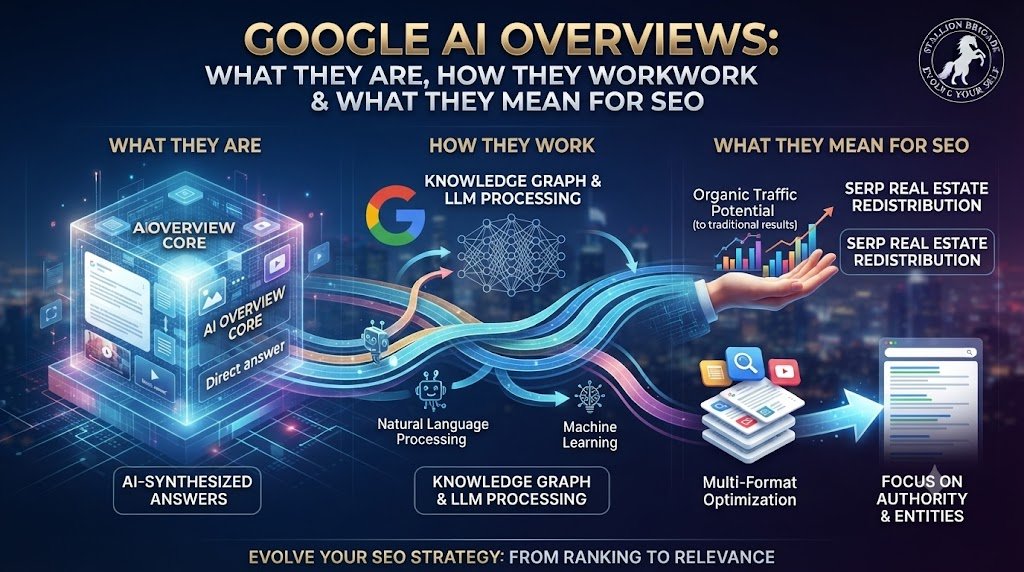
Google AI Overviews: What They Are, How They Work & What They Mean for SEO
Article Summary
Google AI Overviews are AI-generated summaries that can appear within Google Search when Google’s systems determine that an AI-generated explanation can help users understand a query. Rather than requiring users to open several webpages and synthesize the information themselves, an AI Overview can provide a concise explanation and links to supporting webpages.
But AI Overviews are more than a new search-result feature. They represent an important change in how Google combines AI, web retrieval, ranking systems, query understanding and content synthesis.
This guide explains what Google AI Overviews are, how they work, how they differ from traditional search results and AI Mode, how websites can become eligible to appear as supporting sources, what AI Overviews mean for SEO and traffic, and what content publishers should—and should not—do to prepare for Google’s AI-powered search experience.
Contents
- What Are Google AI Overviews?
- Why Did Google Introduce AI Overviews?
- How Do AI Overviews Work?
- The AI Overview Process: From Query to Answer
- What Is Query Fan-Out?
- How AI Overviews Select Supporting Sources
- AI Overviews vs Traditional Search Results
- AI Overviews vs Google AI Mode
- Do AI Overviews Replace Organic Search?
- How AI Overviews Affect SEO
- How to Optimize Your Website for AI Overviews
- Content Quality and Originality Matter
- Technical SEO Still Matters
- What About GEO, AEO and AI Optimization?
- What Google Says About AI-Search “Hacks”
- How to Measure AI Overview Visibility
- Common Mistakes to Avoid
- The Future of Google AI Overviews
- Frequently Asked Questions
Google AI Overviews: The New Layer of Google Search
The Powerful Hook
Imagine asking Google a complicated question and getting an explanation before you even click a search result.
You ask:
“How should a small business use AI to improve SEO without creating hundreds of low-quality AI-generated articles?”
Instead of simply receiving ten blue links, Google may provide an AI-generated overview that brings together relevant information and gives you links to websites where you can investigate further.
That changes an important part of the search journey.
For decades, the basic model of search was:
Question → Search results → Click → Read → Compare → Decide
AI Overviews introduce another layer:
Question → AI-generated overview → Supporting sources → Deeper exploration
Google describes AI Overviews as an AI-generated snapshot designed to help people understand information more quickly, with links that allow them to explore the subject further. (Google Help)
For SEO professionals and publishers, this raises an important question:
If Google can answer part of the user’s question directly, what happens to the websites that used to receive those clicks?
The answer is more nuanced than “AI is replacing organic search.”
Google’s own documentation says its generative AI features are rooted in its existing Search ranking and quality systems and use relevant pages from the Search index to help generate responses. (Google for Developers)
Understanding that relationship is the key to understanding AI-era SEO.
1. What Are Google AI Overviews?
Google AI Overviews are AI-generated summaries that can appear within Google Search for queries where Google’s systems determine that an AI-generated response can provide additional value.
They are designed particularly for questions that may benefit from synthesizing information from multiple sources.
For example, a user might search:
“How does query fan-out work in AI Search?”
An AI Overview could provide:
- a definition
- an explanation
- related concepts
- supporting links
- opportunities to explore the topic further
AI Overviews are therefore not simply another form of featured snippet.
A featured snippet generally extracts and displays information from a particular webpage.
An AI Overview can synthesize information and provide a broader explanation supported by multiple web sources.
Google explains that AI Overviews are integrated with its core Search systems and are designed to provide links to relevant webpages rather than functioning simply as an independent chatbot. (blog.google)
2. Why Did Google Introduce AI Overviews?
Some questions are easy to answer with a single search.
For example:
“What is the capital of France?”
Other questions require research:
“What are the advantages and disadvantages of remote work for a small technology company?”
The second question may involve:
- productivity
- communication
- recruitment
- management
- technology
- employee preferences
- cost
- company culture
Traditionally, users might conduct several searches and visit multiple websites.
Google’s stated purpose for AI Overviews is to help users get to the gist of more complicated questions faster while still providing links for deeper exploration. (Google for Developers)
This is an important distinction.
AI Overviews are intended to reduce the amount of work required to understand a question—not necessarily to eliminate the web pages that contain the underlying information.
3. How Do AI Overviews Work?
The exact internal workings of Google’s systems are proprietary and can change over time.
However, Google provides enough information to understand the broad architecture.
A simplified model is:
User query
↓
Query understanding
↓
Information retrieval
↓
Query fan-out where appropriate
↓
Relevant source identification
↓
Information synthesis
↓
AI-generated response
↓
Supporting links
Google’s current documentation says its generative AI features use retrieval-augmented generation (RAG)—also described as grounding—to retrieve relevant, up-to-date webpages from Google’s Search index and use information from those pages when generating responses. (Google for Developers)
This is particularly important for SEO.
The AI Overview isn’t simply asking a language model:
“What do you know about this topic?”
It is connected to Google’s broader Search ecosystem.
4. The AI Overview Process: From Query to Answer
Let’s break that process down.
Step 1: The user asks a question
The question might be:
“How can I improve my website’s visibility in AI Search?”
Google first needs to understand the question and determine what information might be useful.
Step 2: Google interprets the query
The system attempts to understand:
- the subject
- intent
- context
- relationships between concepts
- potentially relevant subtopics
This is why exact keyword matching is not enough to explain modern Google Search.
Google’s systems can understand that:
“How do I get my website mentioned by AI?”
and
“How can I improve my visibility in generative search?”
may represent closely related information needs even though their wording is different.
Step 3: Google retrieves information
Google can retrieve relevant pages from its Search index.
This makes a basic technical fact extremely important:
A page generally needs to be indexed and eligible to appear in Google Search to be eligible as a supporting link in AI Overviews or AI Mode. Google states that there are no additional technical requirements beyond the existing Search technical requirements for eligibility. (Google for Developers)
That means the fundamentals still matter:
- crawlability
- indexability
- accessible content
- appropriate technical configuration
- useful information
- compliance with Search policies
Step 4: Google may use query fan-out
A complex query can involve several related questions.
For example:
“How should an ecommerce company prepare for AI Search?”
Potential research dimensions could include:
- ecommerce SEO
- product information
- structured data
- AI Search
- product discovery
- Google Search
- shopping
- content quality
Google calls the technique of issuing multiple related searches across subtopics query fan-out. Its documentation says AI Overviews and AI Mode may use this technique to develop responses. (Google for Developers)
This is one of the most important concepts for understanding AI Search.
5. What Is Query Fan-Out?
Query fan-out means that the original question can be expanded into multiple related searches.
Consider:
“How do I start a content marketing strategy for a SaaS company?”
A traditional search might focus primarily on that phrase.
An AI-powered system may need information about:
- SaaS audiences
- buyer journeys
- content strategy
- SEO
- product-led growth
- customer research
- distribution
- measurement
These related searches allow the system to construct a broader response.
Why this matters for publishers
Your page doesn’t necessarily have to contain the exact wording of every possible query.
Google explicitly says its systems can understand the relevance of pages even when there is no exact match between the query and the page’s primary content. It also warns against creating separate pages for every possible query or fan-out variation simply to manipulate visibility. (Google for Developers)
This reinforces an important content principle:
Build comprehensive resources around genuine user needs—not thousands of pages targeting minor keyword variations.
6. How AI Overviews Select Supporting Sources
One of the most important questions for publishers is:
How does my website get into an AI Overview?
There is no public formula that guarantees inclusion.
Google says that its AI features use Search’s existing ranking and quality systems and retrieve relevant pages from its index. (Google for Developers)
That means there is no guaranteed:
- AI Overview hack
- special keyword density
- magic word count
- required article length
- special “AI citation” tag
- guaranteed GEO technique
Instead, Google’s guidance emphasizes the same fundamental principles that underpin good Search visibility.
Google’s current AI optimization documentation specifically emphasizes valuable, non-commodity content, unique perspectives, helpful and reliable information, technical accessibility and people-first content. (Google for Developers)
7. AI Overviews vs Traditional Search Results
Traditional Google Search generally provides a collection of results that users evaluate.
AI Overviews can provide an explanatory layer above or alongside those results.
Traditional search
Query
→ Search results
→ User chooses sources
→ User researches
→ User forms conclusion
AI Overview
Query
→ AI-generated explanation
→ Supporting links
→ User explores selected sources
The second model potentially changes how users interact with search results.
But it does not mean organic results cease to matter.
Google says AI Overviews and AI Mode continue to surface links to relevant websites and can provide opportunities for users to discover content they may not have encountered through a conventional search. (Google for Developers)
8. AI Overviews vs Google AI Mode
These two concepts should not be treated as identical.
AI Overviews
AI Overviews are integrated into the Search results page and are intended to provide a useful AI-generated snapshot for queries where Google determines that generative AI adds value.
They may not appear for every query. (Google for Developers)
AI Mode
AI Mode is designed for more extensive exploration, reasoning and complex comparisons.
Google describes it as particularly useful when a question might previously have required multiple searches or follow-up searches. AI Mode can also use query fan-out to investigate multiple subtopics. (Google for Developers)
A useful conceptual distinction is:
AI Overview = AI-assisted answer layer within Search
AI Mode = deeper conversational AI search experience
The two systems can use different models and techniques, so the responses and links shown can vary. (Google for Developers)
9. Do AI Overviews Replace Organic Search?
Not exactly.
They change the search results experience, but Google’s documentation continues to describe webpages and links as an important part of the system.
Google says that AI Overviews can help users explore a greater diversity of websites for complex questions. (Google for Developers)
The more useful question for SEO professionals is therefore not:
“Will organic search disappear?”
It is:
“How does organic visibility change when an AI-generated answer becomes part of the search journey?”
That leads to a broader definition of search visibility.
A website might now receive exposure through:
- traditional organic results
- featured snippets
- AI Overviews
- AI Mode
- Discover
- images
- video
- other Search surfaces
Search visibility is becoming increasingly multidimensional.
10. How AI Overviews Affect SEO
Google’s position is particularly clear:
SEO remains relevant to generative AI Search.
Google’s official guide states that its generative AI features are rooted in its core Search ranking and quality systems, so existing SEO best practices continue to matter. (Google for Developers)
That means you should not abandon:
Technical SEO
Make sure important pages can be crawled and indexed.
Information architecture
Create logical relationships between your pages.
Internal linking
Help users and search systems discover related information.
Search intent
Understand what the user is actually trying to accomplish.
Content quality
Create useful, reliable and sufficiently comprehensive resources.
Originality
Contribute information rather than simply rewriting what everyone else has published.
Authority
Clearly establish who is creating the content and why they are qualified to discuss the subject.
Google’s people-first guidance specifically encourages original information, research or analysis and recommends demonstrating expertise through appropriate sourcing, author information and evidence of experience. (Google for Developers)
11. How to Optimize Your Website for AI Overviews
There is an important distinction between optimizing for AI Overviews and trying to manipulate AI systems.
A sustainable strategy begins with conventional SEO fundamentals.
1. Make your content crawlable
Google’s generative AI systems use publicly accessible, crawlable content when retrieving information for responses. (Google for Developers)
Check:
- robots.txt
- indexing directives
- canonical URLs
- internal links
- sitemap
- JavaScript accessibility
2. Create genuinely useful content
Google’s guidance emphasizes content that is:
- unique
- compelling
- useful
- reliable
- people-first
- non-commodity
Google specifically says that unique viewpoints and firsthand experience can provide value that isn’t easily reproduced elsewhere. (Google for Developers)
3. Answer the primary question clearly
Don’t make users hunt for the definition.
If the page is:
What Are Google AI Overviews?
Answer that question near the beginning.
Then develop the subject progressively.
This benefits both users and search systems.
4. Cover meaningful subtopics
A strong cornerstone article should answer the major questions surrounding the topic.
For example, a Google AI Overviews guide can naturally cover:
- what they are
- how they work
- query fan-out
- citations
- SEO
- eligibility
- content strategy
- measurement
- limitations
That is much more useful than creating separate thin pages for every variation.
5. Add original value
This is increasingly important.
Instead of merely saying:
“AI Overviews are changing SEO.”
Add:
- original observations
- experiments
- screenshots
- Search Console data
- case studies
- first-hand analysis
- documented workflows
- comparisons
- original frameworks
Google’s current guidance explicitly recommends non-commodity content and unique points of view. (Google for Developers)
12. Content Quality and Originality Matter
One of the biggest mistakes in AI-era SEO is assuming that producing more AI-generated content automatically creates more visibility.
Google’s current guidance takes a different approach.
It emphasizes content created primarily to help people and warns against large-scale content production designed primarily to manipulate search rankings. (Google for Developers)
This creates a useful distinction:
Commodity content
“Everything everyone else has already said.”
versus
Original content
“What can this author or organization add that isn’t easily available elsewhere?”
For Stallion Brigade, this distinction is especially important.
A future AI Search Lab, for example, could publish:
- AI Search experiments
- citation studies
- visibility observations
- Google Search Console analysis
- prompt/query research
- before-and-after content changes
- documented SEO workflows
That type of material can create a stronger knowledge asset than another generic article titled “10 AI SEO Tips.”
13. Technical SEO Still Matters
AI Overviews do not remove the technical foundation of Search.
Google says that to be eligible as a supporting link in AI Overviews or AI Mode, a page needs to be indexed and eligible to appear in Google Search with a snippet. (Google for Developers)
Therefore, check:
Crawlability → Indexability → Canonicalization → Internal linking → Page accessibility → Content quality
A page with outstanding content but a noindex directive has a fundamental visibility problem.
Similarly, content blocked from crawling cannot easily become a retrieved source.
Google also recommends maintaining good page experience and addressing issues such as mobile usability, latency and Core Web Vitals as part of the broader Search experience. (Google for Developers)
14. What About GEO, AEO and AI Optimization?
The rise of AI Overviews has generated terms such as:
- GEO — Generative Engine Optimization
- AEO — Answer Engine Optimization
- AIO — AI Optimization
These terms can be useful frameworks for discussing changes in search.
But don’t treat them as completely separate from SEO.
Google’s official guidance explicitly says that, from Google’s perspective, optimizing for generative AI search is still SEO because these experiences are rooted in Google’s Search systems. (Google for Developers)
A useful model is:
SEO = foundation
AI Search = evolving search environment
GEO/AEO/AIO = frameworks for thinking about visibility in that environment
This is a more useful way to approach the terminology than creating increasingly complicated “optimization” checklists.
15. What Google Says About AI-Search “Hacks”
This is an area where publishers should be particularly careful.
Google’s current guidance says there is:
- no requirement to break content into tiny chunks for AI
- no need to rewrite content specifically for AI systems
- no special schema required specifically for generative AI Search
- no benefit in creating llms.txt specifically for Google Search
- no reason to create pages for every possible fan-out query
- no reason to manufacture inauthentic mentions across the web. (Google for Developers)
Google also states that llms.txt files neither help nor hurt visibility in Google Search, although publishers can maintain them for other systems that use them. (Google for Developers)
This is a useful warning against AI-search cargo cult SEO—the practice of adopting every new tactic simply because it is associated with AI.
16. How to Measure AI Overview Visibility
AI Search creates a measurement challenge.
Traditional SEO measurement often focuses on:
- impressions
- clicks
- CTR
- rankings
- conversions
AI Search adds another dimension:
Was my content surfaced within an AI-generated search experience?
Google has introduced reporting in Search Console for generative AI features, and its documentation says the Search Console performance report includes AI Overviews. Google clarified in September 2026 that AI Overviews are counted and logged in the Performance report using the established methodology for Search features. (Google for Developers)
This means your measurement framework should increasingly examine:
Traditional visibility
- organic impressions
- clicks
- CTR
- average position
AI-search visibility
- AI Overview exposure
- AI-feature impressions where available
- clicks associated with AI Search experiences
- queries producing AI features
- pages appearing in relevant AI-search journeys
Business visibility
- branded searches
- direct traffic
- assisted conversions
- qualified leads
- subscriptions
- sales
The ultimate goal isn’t simply to appear in an AI Overview.
The goal is useful visibility that contributes to a meaningful user journey.
17. Common Mistakes to Avoid
Mistake 1: Creating hundreds of AI-generated pages
More URLs do not automatically mean more authority.
Mistake 2: Writing only for AI
Google explicitly recommends creating content for people rather than search engines or AI systems. (Google for Developers)
Mistake 3: Obsessing over word count
Google says there is no ideal page length for generative AI Search. (Google for Developers)
Mistake 4: Creating a separate page for every fan-out query
Google specifically warns against this when done primarily to manipulate rankings or AI responses. (Google for Developers)
Mistake 5: Chasing artificial mentions
Inauthentic mentions across websites are not a sustainable strategy.
Mistake 6: Treating structured data as an AI citation hack
Structured data remains useful for Search, but Google says there is no special schema requirement for generative AI Search. (Google for Developers)
Mistake 7: Ignoring technical SEO
An excellent article that isn’t properly accessible or indexed has a fundamental discoverability problem.
18. The Future of Google AI Overviews
AI Overviews should be understood as part of a much larger transformation.
Search is gradually moving from:
“Here are some pages.”
toward:
“Here is an explanation, and here are the sources you can explore.”
That means the future of SEO is unlikely to be purely about ranking individual pages for individual keywords.
It will increasingly involve:
technical accessibility
→ information architecture
→ semantic relevance
→ content quality
→ original research
→ entity understanding
→ authority
→ retrieval
→ AI-generated answer visibility
→ brand discovery
Google’s current documentation reinforces this broader view: the same foundational SEO practices that support conventional Search remain relevant to generative AI features, while original, valuable, non-commodity content becomes increasingly important. (Google for Developers)
The strategic lesson is therefore simple:
Don’t try to manufacture content that an AI will cite. Build information that deserves to be discovered, understood and cited.
That is the more durable approach to AI-era SEO.
Frequently Asked Questions About Google AI Overviews
1. What are Google AI Overviews?
Google AI Overviews are AI-generated summaries that appear within Google Search when Google’s systems determine that generative AI can provide additional value for a query. They provide an overview of information and links that users can follow to explore the topic further. (Google Help)
2. Are AI Overviews the same as Google AI Mode?
No. AI Overviews are an AI-generated layer within Search, while AI Mode is designed for deeper conversational exploration, complex questions and comparisons. Google says the two can use different models and techniques. (Google for Developers)
3. How does Google create an AI Overview?
Google can retrieve relevant webpages from its Search index, use AI techniques such as retrieval-augmented generation and, for complex queries, query fan-out to investigate related subtopics before generating a response. (Google for Developers)
4. What is query fan-out?
Query fan-out is the process of generating multiple related searches across subtopics and information sources to help answer a complex original query. Google says both AI Overviews and AI Mode may use query fan-out. (Google for Developers)
5. Can any website appear in an AI Overview?
There is no guarantee. A page must be indexed and eligible to appear in Google Search with a snippet to be eligible as a supporting link. Google also says that satisfying technical and quality requirements does not guarantee that a page will be crawled, indexed or served. (Google for Developers)
6. Do I need special SEO techniques to rank in AI Overviews?
Google says there are no additional technical requirements or special optimizations specifically required for AI Overviews. Foundational SEO best practices remain relevant. (Google for Developers)
7. Does structured data help a page appear in AI Overviews?
Structured data remains useful as part of an overall SEO strategy, but Google says there is no special structured-data markup required specifically for generative AI Search. (Google for Developers)
8. Does AI-generated content appear in AI Overviews?
AI-generated content can be indexed and appear in Search, but Google evaluates content according to its Search policies and emphasizes helpful, reliable, people-first content. Using AI to produce large amounts of low-value content primarily to manipulate Search can violate Google’s spam policies. (Google for Developers)
9. Does AI Overview visibility replace traditional SEO?
No. Google’s documentation explicitly states that its generative AI features are rooted in core Search ranking and quality systems. Traditional SEO therefore remains part of the foundation for visibility in these experiences. (Google for Developers)
10. How should SEO professionals prepare for AI Overviews?
Focus on the fundamentals while expanding your definition of search visibility: maintain strong technical SEO, build clear content architecture, create original and useful information, demonstrate expertise, develop topical and entity clarity, conduct original research and measure visibility across both traditional Search and AI-powered Search experiences.