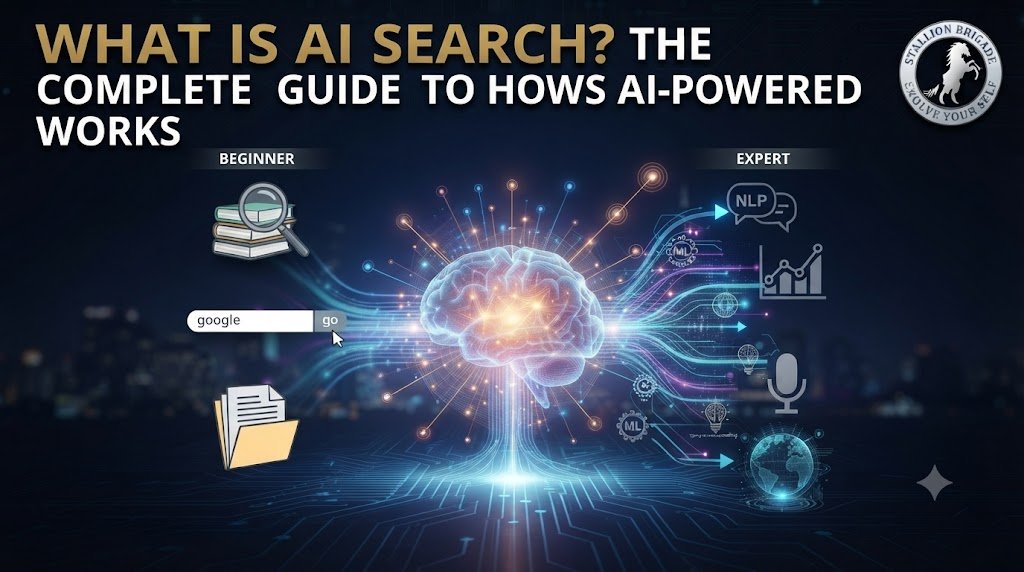
What Is AI Search? The Complete Guide to How AI-Powered Search Works
Article Summary
AI Search is changing how people discover information online. Instead of simply matching keywords with webpages and presenting a list of links, AI-powered search systems can interpret complex questions, retrieve information from multiple sources, synthesize what they find, and present a conversational answer with links for further exploration.
This guide explains what AI Search is, how it works, how it differs from traditional search, what Google AI Overviews and AI Mode mean for SEO, how ChatGPT Search and other AI search experiences fit into the ecosystem, and what website owners and SEO professionals need to understand about visibility in the AI-search era.
Contents
- What Is AI Search?
- How Is AI Search Different From Traditional Search?
- How Does AI Search Work?
- The AI Search Process: From Question to Answer
- What Is Query Fan-Out?
- AI Overviews vs AI Mode
- AI Search Beyond Google
- Why AI Search Matters for SEO
- AI Search, SEO, AEO, GEO and AIO
- What Makes Content Visible in AI Search?
- What AI Search Does Not Mean
- The Future of AI Search
- Frequently Asked Questions
What Is AI Search?
Search is no longer just about finding pages. It is increasingly about finding answers, understanding context and exploring a subject.
Imagine searching Google for:
“I run a small B2B SaaS company. What SEO strategy should I use if my potential customers increasingly discover software through AI tools rather than traditional Google results?”
Traditional search would largely return a collection of webpages related to the words and concepts in that query.
An AI-powered search experience can approach the same question differently. It may interpret the underlying intent, break the question into several related research tasks, retrieve information from multiple sources, compare the evidence, synthesize an answer and provide links to relevant webpages.
That is the fundamental idea behind AI Search.
AI Search is the broader evolution of search in which artificial intelligence is used to understand queries, retrieve and interpret information, generate or organize answers, and support conversational exploration.
Google describes AI Overviews and AI Mode as AI features within Search that can use techniques such as retrieval-augmented generation and query fan-out to identify relevant information and supporting webpages. (Google for Developers)
AI Search therefore does not simply mean “searching with ChatGPT.”
It encompasses an emerging search ecosystem that includes:
- Google AI Overviews
- Google AI Mode
- ChatGPT Search
- Perplexity
- Gemini-powered search experiences
- Microsoft Copilot and other AI-assisted discovery systems
- AI-powered search interfaces embedded into products and platforms
The interfaces differ, but the underlying shift is similar:
from retrieving documents to helping users understand information.
How Is AI Search Different From Traditional Search?
Traditional search engines have become remarkably sophisticated. Modern search already understands entities, context, intent, language, relationships and user needs far beyond simple keyword matching.
So it would be inaccurate to describe traditional search as merely:
keyword → webpage
However, AI Search adds another important layer.
Traditional search
A simplified model looks like:
Query → retrieval/ranking → search results → user chooses pages → user reads and synthesizes information
The user performs much of the final research work.
AI Search
A simplified model becomes:
Question → interpretation → research/retrieval → synthesis → answer → supporting sources → follow-up exploration
The search system performs more of the intermediate information-processing work.
This does not eliminate webpages.
In fact, Google’s current documentation explicitly says that its generative AI features rely on Search’s existing systems and surface links to relevant webpages. Google also states that traditional SEO best practices remain relevant because AI features are grounded in its core Search systems. (Google for Developers)
That distinction is extremely important for anyone working in SEO.
AI Search is not the death of search engines. It is the evolution of the search interface and information-retrieval process.
How Does AI Search Work?
AI Search is not one universal technology. Different platforms use different models, indexes, retrieval systems and ranking mechanisms.
Nevertheless, the process can be understood through several common stages.
1. The user asks a question
The input may be:
- a traditional keyword
- a natural-language question
- a long conversational prompt
- a comparison
- a follow-up question
- an image
- a voice query
- a combination of text, images and other context
The important change is that users don’t necessarily have to translate their problem into short search keywords.
They can describe the problem itself.
2. The system interprets the query
AI systems attempt to understand what the user actually wants.
Consider:
“Which laptop should I buy for video editing under ₹100,000?”
The system has more to understand than the individual words.
It may need to interpret:
- product category
- geographic context
- currency
- budget
- intended use
- technical requirements
- comparison intent
- potentially current product availability
This is where AI’s ability to interpret natural language and context becomes particularly valuable.
3. The system retrieves information
The system then needs relevant information.
Depending on the platform and query, that may involve:
- web search indexes
- webpages
- structured databases
- knowledge graphs
- product information
- maps or local information
- current news
- other data sources
Google describes its AI Search systems as using retrieval techniques to ground responses in relevant, current information from its Search index. (Google for Developers)
This is one reason crawlability, indexability and technical SEO remain fundamental.
If a useful webpage cannot be discovered, crawled or indexed, it becomes much harder for search systems to retrieve it.
The AI Search Process: From Question to Answer
A useful conceptual model is:
User question
↓
Query understanding
↓
Intent and context identification
↓
Query expansion / fan-out
↓
Information retrieval
↓
Source evaluation
↓
Content and entity understanding
↓
Evidence synthesis
↓
Generated answer
↓
Citations and links
↓
Follow-up conversation
Not every AI search system follows exactly this sequence, and the internal processes are generally proprietary.
But this model provides a useful way for SEOs and content strategists to understand the transition.
What Is Query Fan-Out?
Query fan-out is one of the most important concepts in modern AI Search.
Suppose you ask:
“How can I improve the SEO of my SaaS website for AI search?”
A conventional search might retrieve results around that primary query.
An AI search system may need to investigate several related dimensions:
- What is AI Search?
- How does Google AI Mode work?
- What does Google recommend for AI features?
- What technical SEO factors matter?
- How do AI systems retrieve content?
- What makes content useful and authoritative?
- How do citations work?
- What changes should SaaS websites make?
Google explicitly describes query fan-out as generating multiple related searches across subtopics and using those results to develop an answer. (blog.google)
This creates an important implication for content strategy:
You don’t necessarily need a separate article for every possible variation of a question.
Instead, a strong piece of content can comprehensively address the important subtopics surrounding a primary user need.
Google’s current guidance specifically cautions against creating large numbers of pages simply to target every possible query or fan-out variation. (Google for Developers)
AI Overviews vs AI Mode
Two Google concepts are particularly important to understand.
AI Overviews
AI Overviews are AI-generated responses that can appear within Google Search when Google’s systems determine that an AI-generated overview can provide additional value.
They are designed to help users understand complicated questions and then explore supporting webpages.
Google says AI Overviews may use query fan-out and can provide links to a wider range of relevant websites. (Google for Developers)
AI Mode
AI Mode goes further toward a conversational research experience.
It is designed for questions involving:
- deeper exploration
- complex comparisons
- multi-part questions
- follow-up questions
- multimodal inputs
Google has described AI Mode as using query fan-out to break questions into subtopics and issue multiple searches concurrently. (blog.google)
Google’s 2026 updates also show that Search is moving toward more agentic and AI-assisted experiences rather than simply displaying conventional results. (blog.google)
For SEOs, the important distinction is not simply “AI Overview vs AI Mode.”
The bigger shift is:
Search is becoming increasingly capable of performing research before presenting the user with an answer.
AI Search Beyond Google
Google is not the only company changing how people search.
ChatGPT Search
ChatGPT can search the web and provide current information with links to relevant sources. OpenAI describes its search experience as combining conversational interaction with web information and source links. (OpenAI)
This changes the traditional search journey.
Instead of:
Search → open five pages → compare → ask another question
the user can potentially:
Ask → receive answer → ask follow-up → refine the research
Perplexity and other AI search systems
Other platforms similarly combine conversational interfaces with web retrieval and source attribution.
The specific technology differs between platforms, so it is a mistake to assume that “optimizing for AI” means optimizing for one universal AI algorithm.
There is no single AI Search ranking system.
There is an ecosystem of systems.
That is why a sustainable strategy should focus on fundamentals such as:
discoverability + relevance + usefulness + evidence + authority + entity clarity + strong content architecture.
Why AI Search Matters for SEO
For years, SEO has largely focused on questions such as:
How do I get my webpage to rank?
AI Search introduces another question:
How do I make my information useful enough, accessible enough and trustworthy enough to be retrieved, understood and potentially cited when an AI system answers a user’s question?
This is a broader visibility problem.
Google’s official guidance is particularly important here: it says that the foundational SEO practices that help pages appear in conventional Search also remain relevant to generative AI features. (Google for Developers)
That means SEO professionals should not abandon:
- technical SEO
- crawlability
- indexability
- internal linking
- information architecture
- search intent
- useful content
- structured data where appropriate
- page experience
- authority
- original research
- clear authorship
Instead, they need to understand how those foundations operate in an AI-mediated search environment.
AI Search, SEO, AEO, GEO and AIO
The emergence of AI Search has produced a growing vocabulary:
SEO — Search Engine Optimization
The broad discipline of improving a website’s visibility and usefulness within search systems.
AEO — Answer Engine Optimization
A term commonly used for strategies intended to improve the likelihood that content will be surfaced in answer-oriented search experiences.
GEO — Generative Engine Optimization
A term used to describe efforts to improve visibility within generative AI systems.
AIO — AI Optimization
A broader term sometimes used for optimizing content, workflows or digital assets for AI-mediated discovery.
These terms are useful, but they can also create unnecessary confusion.
Google’s own 2026 guidance says that from its perspective, optimizing for generative AI search is still fundamentally SEO, and specifically cautions against relying on supposed AEO/GEO “hacks.” (Google for Developers)
A practical way to think about the relationship is:
SEO = foundation
AI Search = evolving search environment
AEO/GEO/AIO = specialized frameworks for thinking about visibility within that environment
The terminology matters less than understanding the underlying systems.
What Makes Content Visible in AI Search?
There is no guaranteed formula for appearing in an AI-generated answer.
Google explicitly says that meeting requirements and following best practices does not guarantee crawling, indexing or serving. (Google for Developers)
Nevertheless, several principles are strategically important.
1. Make your content discoverable
AI systems need access to information.
Your pages should therefore be:
- crawlable
- indexable
- internally linked
- technically accessible
- free from unnecessary indexing barriers
2. Answer real questions
Create content around genuine user problems rather than manufacturing pages around every imaginable keyword variation.
3. Go beyond commodity information
Google’s current guidance emphasizes unique, valuable and non-commodity content. (Google for Developers)
That means adding something that cannot be easily reproduced by thousands of websites.
For example:
- original research
- firsthand experience
- proprietary data
- experiments
- case studies
- expert analysis
- original frameworks
- useful comparisons
- documented processes
4. Establish topical and entity clarity
Search systems increasingly need to understand:
- who created the content
- what the website is about
- what subjects the author understands
- how pages relate to one another
- which concepts and entities the website consistently covers
This makes content architecture increasingly important.
5. Structure information clearly
Use:
- descriptive headings
- concise explanations
- logical sections
- examples
- definitions
- tables where appropriate
- relevant internal links
- supporting media
But don’t confuse structure with manipulation.
Google specifically says there is no requirement to adopt special “AI-friendly” formatting tricks such as artificial chunking. (Google for Developers)
What AI Search Does Not Mean
Several misconceptions have appeared around AI Search.
AI Search does not mean SEO is dead.
Google explicitly says SEO remains relevant for its generative AI search experiences. (Google for Developers)
AI Search does not mean every article should be written by AI.
Google allows generative AI to assist content creation, but emphasizes accuracy, quality, relevance and compliance with its spam policies. Large-scale automated content without meaningful added value can violate those policies. (Google for Developers)
AI Search does not mean keyword research is irrelevant.
Understanding what people want remains important.
The difference is that search strategy increasingly needs to understand topics, entities, intent, context and information journeys, rather than treating individual keywords as isolated targets.
AI Search does not mean citations are guaranteed.
A page can be indexed and useful without being selected as a supporting source for every relevant AI response.
Visibility is contextual.
AI Search does not mean there is one magic optimization technique.
There is no reliable shortcut such as:
“Add this file and every AI system will cite your website.”
Google’s current guidance specifically pushes back against several such tactics, including unnecessary AI text files such as llms.txt as an optimization requirement. (Google for Developers)
The Future of AI Search
The most important development may not be the appearance of AI-generated summaries.
It is the gradual transformation of search from a retrieval interface into an information and action interface.
Search is increasingly becoming:
Ask → research → understand → compare → decide → act
rather than simply:
Search → click → read
Google’s 2026 Search announcements point toward increasingly agentic experiences, while its AI Mode developments show a continuing emphasis on complex queries, multimodality, follow-up questions and deeper exploration. (blog.google)
For content creators and SEO professionals, this means the strategic question is changing.
The goal is no longer simply:
“How can I rank this page?”
A more future-facing question is:
“How can I build information that search systems can discover, understand, trust, retrieve and connect to the questions my audience is asking?”
That is the heart of AI-era search strategy.
The AI Search Mindset
The transition to AI Search does not require abandoning everything learned from traditional SEO.
It requires expanding the model.
Think of search visibility as a stack:
Technical accessibility
↓
Crawlability & indexability
↓
Information architecture
↓
Semantic relevance
↓
Content usefulness
↓
Originality & evidence
↓
Authority & reputation
↓
Entity understanding
↓
Retrieval visibility
↓
AI-answer visibility
↓
Brand visibility
↓
Conversion
The strongest AI Search strategy therefore isn’t about finding a loophole in an AI system.
It is about becoming a valuable source of information within the information ecosystem.
And that brings us to one of the most important principles for the future of SEO:
Don’t create content merely to be found by AI. Create information worth finding.
That is the difference between chasing AI-search tactics and building genuine AI-era search authority.
Frequently Asked Questions About AI Search
1. What is AI Search in simple words?
AI Search is a form of search that uses artificial intelligence to understand questions, retrieve information, synthesize findings and provide more direct, contextual or conversational answers instead of simply displaying a list of webpages.
2. Is AI Search replacing Google?
AI Search is changing Google rather than simply replacing it. Google is incorporating AI capabilities such as AI Overviews and AI Mode directly into Search. (blog.google)
3. Is ChatGPT Search the same as Google AI Search?
No. They are separate search experiences operated by different companies and based on different systems. They share some characteristics, including conversational queries, web retrieval and source links, but their underlying systems are not identical. (OpenAI)
4. What is Google AI Mode?
Google AI Mode is an AI-powered Search experience designed particularly for complex questions, deeper exploration, multimodal queries and conversational follow-ups. It can use query fan-out to investigate multiple related subtopics. (blog.google)
5. What is a query fan-out?
Query fan-out is a technique in which an AI search system generates multiple related searches or subqueries from a user’s original question, retrieves information across those areas and uses the results to construct a more comprehensive response. (Google for Developers)
6. Is SEO still important for AI Search?
Yes. Google explicitly states that its existing SEO best practices remain relevant to AI features such as AI Overviews and AI Mode. Pages still need to be discoverable, indexable and eligible for Search. (Google for Developers)
7. What is GEO?
GEO commonly means Generative Engine Optimization. It refers to strategies intended to improve visibility within generative AI search experiences. Google, however, frames optimization for its generative AI features as part of SEO rather than requiring a separate optimization discipline. (Google for Developers)
8. Does AI-generated content rank in Google?
AI-assisted content can appear in Google Search, but Google emphasizes that content should be accurate, useful, relevant and compliant with its Search policies. Generating large volumes of low-value pages without meaningful added value can fall under scaled content abuse. (Google for Developers)
9. How can I optimize my website for AI Search?
Start with the fundamentals: make your site crawlable and indexable, develop clear information architecture, create genuinely useful and original content, demonstrate expertise and evidence, use appropriate structured data, strengthen internal linking and continually improve content based on real user needs. Google recommends essentially this foundation for its AI Search features. (Google for Developers)
10. Will AI Search make traditional search results disappear?
There is no basis for assuming that traditional search results will simply disappear. Google’s current AI Search experiences continue to use and link to webpages, while AI Overviews and AI Mode are being developed as additional ways to explore information. The more useful way to think about the transition is that search is becoming multimodal, conversational and increasingly AI-mediated. (Google for Developers)
Suggested positioning for this Stallion Brigade cornerstone page
For /ai-search/what-is-ai-search/, I would position this as the definition and conceptual foundation page of your AI Search cluster—not as another giant “how to optimize for AI Search” guide.
Its role in your architecture should be:
AI Search Hub
→ What Is AI Search? ← this page
→ How AI Search Works
→ Google AI Overviews
→ Google AI Mode
→ Query Fan-Out
→ AI Search Optimization
→ AI Search Visibility
→ AI Search SEO
→ GEO
→ AEO
→ LLM Visibility
That gives Google and AI systems a much clearer semantic relationship between your pages and makes this URL a natural definition-level entity page for the broader AI Search topic.