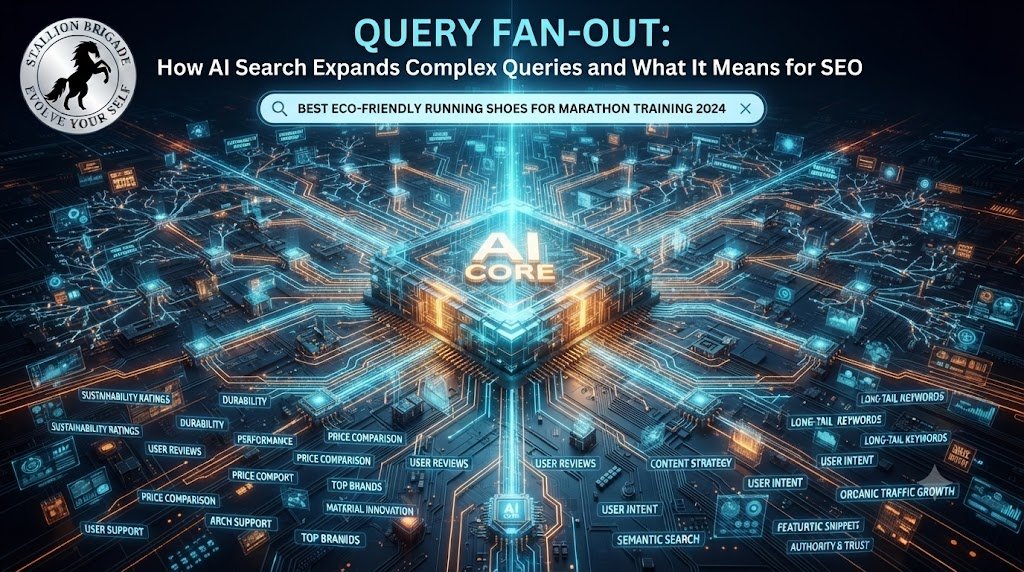
Query Fan-Out – How AI Search Expands Complex Queries
Article Summary
Query fan-out is one of the most important mechanisms behind modern AI search. Instead of treating a user’s question as a single search query, AI-powered search experiences can generate multiple related searches across different subtopics and sources before producing an answer. This guide explains how query fan-out works, why it matters for SEO and GEO, how to identify the underlying questions behind a query, and how to build content that can satisfy an entire information journey-not just one keyword.
Contents
- What Is Query Fan-Out?
- Why AI Search Needs Query Fan-Out
- How Query Fan-Out Works
- A Practical Example
- Query Fan-Out vs. Traditional Search
- Why Query Fan-Out Matters for SEO
- Query Fan-Out and GEO
- How to Optimize Content for Fan-Out
- Building a Fan-Out Content Map
- What Not to Do
- How to Research Your Own Fan-Out Opportunities
- Measuring the Impact
- The Future of Query Fan-Out
- FAQs
Query Fan-Out – How AI Search Expands Complex Queries
A single question can become an entire search journey.
Imagine someone asks Google AI Mode:
“I’m starting a small SaaS company with a limited marketing budget. Should I invest in SEO, paid advertising, or content marketing, and what should I do first?”
A traditional search engine could treat that as one query.
An AI search system has a much bigger problem to solve.
It needs to understand:
- what the person is trying to achieve;
- what “limited budget” means in context;
- whether the user needs immediate or long-term results;
- how SEO compares with paid advertising;
- whether content marketing should be part of the strategy;
- what works for SaaS;
- what the likely costs are;
- what should be done first;
- and what evidence supports the recommendation.
This is where query fan-out becomes important.
Instead of relying exclusively on the original wording, an AI search system can generate multiple related searches to investigate different aspects of the user’s question.
Google officially describes query fan-out as a set of concurrent, related queries generated by the model to obtain additional information and search results needed to answer the user’s question. Google says both AI Overviews and AI Mode may use this technique. Google for Developers
That seemingly small change has major implications for SEO.
Because the question is no longer:
“Does my page rank for the user’s keyword?”
It becomes:
“Does my content contain useful information for the different questions an AI system may investigate while answering the user’s request?”
1. What Is Query Fan-Out?
Query fan-out is an AI-search retrieval technique in which a complex user query can lead to multiple related searches or sub-queries that explore different aspects of the user’s information need.
Think of it visually:
One user question
↓
AI interprets the intent
↓
Question expands into related searches
↓
Multiple sources are retrieved
↓
Relevant information is evaluated
↓
Findings are synthesized
↓
AI-generated answer + supporting sources
The important point is that the user normally sees one answer, while the underlying retrieval process can involve multiple related searches.
Google’s documentation gives a straightforward example. A question such as “how to fix a lawn that’s full of weeds” can generate related searches around herbicides, non-chemical weed removal and weed prevention. Google for Developers
So the system isn’t merely looking for a page containing the exact sentence the user typed.
It is exploring the information space surrounding the question.
2. Why Does AI Search Need Query Fan-Out?
Human questions are rarely as simple as keywords suggest.
Consider:
“What’s the best CRM for a 20-person consulting company?”
There are several hidden questions inside that request:
- Which CRM products are suitable for small teams?
- Which work well for consulting businesses?
- What features matter?
- What does each option cost?
- Which has good integrations?
- Which is easiest to implement?
- What are the limitations?
- What do customers say?
- Which option provides the best value?
The user’s sentence contains one visible query but many information requirements.
AI search can investigate those requirements separately and then bring the findings together.
That is one reason Google describes AI Mode as particularly useful for complex questions and comparisons that might previously have required multiple searches. Google for Developers
The important SEO lesson
The user’s prompt is not necessarily the complete information need.
The prompt is the starting point.
The underlying questions are where the opportunity lies.
3. How Query Fan-Out Works
There isn’t one universal fan-out architecture used by every AI search system. Different platforms use different models, retrieval systems and ranking processes.
So think of the following as a simplified conceptual model, not a claim about the exact internal architecture of every AI engine.
Stage 1: Understand the question
The system identifies:
- the main subject;
- user intent;
- entities;
- constraints;
- context;
- relationships;
- and potentially implied follow-up questions.
For example:
“Best project management software for a remote marketing team under $500 per month”
contains:
Topic: project management software
Audience: remote marketing team
Constraint: $500/month
Intent: recommendation/comparison
Decision: which product to choose
Stage 2: Expand the information need
The system can then explore related questions such as:
- best project management tools;
- project management software for marketing teams;
- remote collaboration features;
- pricing;
- integrations;
- reporting;
- team size;
- alternatives;
- limitations.
These are the fan-out queries.
They don’t necessarily correspond to questions anyone explicitly typed into a search box.
Stage 3: Retrieve information
The system searches relevant indexes, websites and potentially other information sources.
This is where your website enters the picture.
If your content provides a useful answer to one of the underlying questions, it may become a candidate source for that part of the response.
Google says pages appearing in its generative AI search experiences still need to satisfy normal technical Search requirements, including being indexed and eligible to appear with a snippet. Google for Developers
Stage 4: Evaluate and combine information
The system may retrieve information from different sources for different parts of the question.
One website might provide pricing.
Another might explain technical features.
Another might provide original research.
Another might offer a comparison.
The AI can then synthesize relevant findings into one response.
Stage 5: Generate the answer
The user receives a synthesized response rather than a list of every search performed behind the scenes.
Supporting links or citations may then provide pathways to the underlying sources.
This creates a new visibility opportunity:
Fan-out query → retrieval → citation → website visit
4. A Practical Query Fan-Out Example
Let’s take a more commercially important example:
“What is the best SEO tool for a small business in 2026?”
The system could potentially need information about:
Product discovery
Which SEO tools are available?
Suitability
Which ones are appropriate for small businesses?
Features
What does each tool actually do?
Pricing
What does each option cost?
Ease of use
Can a small business use it without an SEO specialist?
Alternatives
Are there cheaper or simpler alternatives?
Use cases
Which tool is better for keyword research, technical SEO or content?
Limitations
What can’t each tool do?
Current relevance
Are the products and pricing information still current?
The original prompt is only one sentence.
The information requirement is much larger.
This is why modern content strategy increasingly needs to think beyond a single keyword.
5. Query Fan-Out vs. Traditional Search
The distinction is important, but it should not be exaggerated.
| Traditional Search | AI Search with Fan-Out |
| User enters a query | User may enter a complex question |
| Search retrieves results for the query | System may generate related searches |
| User examines multiple pages | AI may synthesize information |
| User performs follow-up searches | Some follow-up research can happen within the experience |
| Ranking is a major visibility metric | Retrieval, citation and recommendation can also matter |
| Keyword/query is central | Intent, context and related information needs become more important |
But AI Search has not made traditional SEO irrelevant.
Google explicitly says that its generative AI search experiences continue to rely on its existing Search systems and that fundamental SEO best practices remain relevant. Google for Developers
This distinction matters because some GEO discussions incorrectly suggest that websites should abandon conventional SEO.
They shouldn’t.
AI Search expands the SEO problem; it doesn’t erase the foundations.
6. Why Query Fan-Out Matters for SEO
Query fan-out changes the way we should think about content coverage.
The old model was often:
Keyword → Page
A more useful AI-era model is:
Information need → Questions → Subtopics → Entities → Evidence → Content
Suppose you publish:
“What Is AI Search?”
That’s useful.
But a person learning AI Search may immediately need to know:
- How does AI Search work?
- What is query fan-out?
- What are AI Overviews?
- What is Google AI Mode?
- How is AI Search different from SEO?
- How do I optimize for AI Search?
- How can I measure AI Search visibility?
- What is GEO?
- What is AEO?
- What is LLM visibility?
Those questions form an information ecosystem.
A strong site architecture connects them.
That’s why query fan-out reinforces the importance of topic clusters and content architecture.
7. Query Fan-Out and GEO
Generative Engine Optimization-or GEO-is often described as optimizing content for visibility in AI-generated answers.
Query fan-out helps explain one part of the retrieval challenge.
A user may ask:
“How can my SaaS company increase visibility in AI search?”
Possible underlying research questions might include:
- What is AI Search?
- What is GEO?
- How do AI systems retrieve websites?
- What makes content citable?
- How important are entities?
- Does technical SEO still matter?
- How should SaaS companies structure content?
- How can AI visibility be measured?
A website that addresses several of these connected information needs has more opportunities to provide useful evidence.
But there’s an important warning here.
Don’t turn every possible fan-out query into a separate article.
Google’s current guidance specifically warns against creating separate content for every possible query variation or fan-out query merely to manipulate rankings or generative AI responses. Google says its systems can understand relevance even when there isn’t an exact query-to-page match. Google for Developers
That is one of the most important practical lessons about query fan-out.
8. How to Optimize Content for Query Fan-Out
You don’t optimize for query fan-out with a magic tag or a special piece of schema.
Instead, improve the information usefulness of your content.
1. Answer the primary question clearly
Don’t bury the answer under 800 words of introduction.
State what the page is about and provide a useful answer early.
2. Cover important related questions
Ask:
“What would a reader naturally ask next?”
Those questions can become useful sections, not necessarily separate pages.
3. Explain entities clearly
If you mention:
- products;
- people;
- companies;
- technologies;
- concepts;
- standards;
make their relationships clear.
4. Provide evidence
Use:
- original data;
- research;
- examples;
- experiments;
- case studies;
- first-hand experience;
- credible references.
5. Add meaningful comparisons
Where users are likely to make decisions, explain:
A vs. B → differences → use cases → limitations → recommendation criteria.
6. Build internal links
If a related question deserves its own detailed page, link to it.
This is where your AI Search content cluster becomes valuable.
9. Build a Fan-Out Content Map
For every important cornerstone topic, create a simple map.
For example:
Core question
How can a website become visible in AI Search?
Related questions
Understanding
→ What is AI Search?
→ How does AI Search work?
Mechanisms
→ What is query fan-out?
→ How does retrieval work?
→ How does AI select sources?
Optimization
→ What is GEO?
→ What is AEO?
→ How do you optimize content for AI Search?
Visibility
→ What is AI citation visibility?
→ How do you measure AI visibility?
Authority
→ How do entities influence AI Search?
→ What makes a source trustworthy?
Now you have something more powerful than a keyword list.
You have an information architecture.
That is the real strategic value of understanding query fan-out.
10. How to Research Your Own Fan-Out Opportunities
You cannot normally see every internal query an AI system generates.
Therefore, don’t pretend that a tool can reveal the exact hidden fan-out for every search.
Instead, approximate the information journey.
Start with your important customer questions.
Then ask an AI assistant:
“If someone asked this question, what additional questions would they need answered before they could make an informed decision?”
Then categorize the responses into:
- definitions;
- causes;
- processes;
- comparisons;
- alternatives;
- costs;
- examples;
- use cases;
- risks;
- implementation;
- measurement.
Next, compare that map against your existing website.
You will usually discover one of three situations:
Covered
You already have a strong page answering the question.
Partially covered
The information exists but is buried in another article.
Missing
Your site has no useful answer.
That’s where your genuine content opportunities are.
11. Don’t Confuse Fan-Out Queries With a New Keyword List
This deserves emphasis.
Query fan-out should not become:
“AI generated 15 subqueries, therefore I need 15 articles.”
That would recreate the same keyword-first thinking under a new name.
Instead:
Use fan-out to understand the information requirement.
Then decide whether each requirement belongs:
- on the cornerstone page;
- in a supporting article;
- in a comparison;
- in a FAQ;
- in a case study;
- in a resource;
- or nowhere because it isn’t genuinely useful.
Google’s current guidance strongly favors useful, unique, people-first content and explicitly warns against creating large quantities of pages merely to target possible fan-out variations. Google for Developers
12. Query Fan-Out and Content Architecture
This is where the concept becomes particularly important for Stallion Brigade.
Your AI Search hub should not attempt to answer every question in depth.
Instead:
AI Search Hub
↓
What Is AI Search?
↓
How AI Search Works
↓
Query Fan-Out
↓
AI Search Optimization
↓
AI Search Visibility
↓
AI Search SEO
Each page handles a distinct information need.
Then individual articles can connect to one another through contextual internal links.
The result is a site that doesn’t merely contain isolated articles.
It creates an interconnected knowledge system.
That is much closer to how users-and increasingly AI search systems-need information to be organized.
13. How to Measure Query Fan-Out Opportunities
There isn’t a universal Google Search Console report showing every hidden fan-out query behind AI-generated answers.
So measurement needs to be indirect.
Watch for:
Traditional Search visibility
Are your pages ranking for related queries?
Impressions
Are Google impressions expanding across the topic?
Clicks
Are those impressions generating visits?
AI citations
Is your site appearing as a cited source in AI search experiences?
Brand mentions
Is your brand being mentioned when people ask relevant questions?
Competitor visibility
Which competitors repeatedly appear instead of you?
Content gaps
Which related questions consistently produce other sources but not yours?
The objective isn’t to prove that one particular hidden query generated one particular citation.
The objective is to understand whether your information coverage and retrieval visibility are improving.
14. The Future of Query Fan-Out
Search is moving from:
“Find me a page.”
toward:
“Help me investigate this.”
That distinction matters.
A complex question can require research across:
- definitions;
- facts;
- opinions;
- products;
- prices;
- comparisons;
- current events;
- locations;
- images;
- videos;
- primary sources.
AI search can increasingly coordinate that research into a conversational experience.
Google says AI Mode and AI Overviews can use query fan-out to search across related subtopics and data sources, and that the systems may surface a wider and more diverse range of supporting links as the response is developed. Google for Developers
For publishers, that creates an interesting opportunity.
You don’t necessarily have to be the answer to the entire question.
You need to have valuable information that deserves to be part of the answer.
The Big SEO Lesson From Query Fan-Out
Query fan-out doesn’t mean that keywords are dead.
It means that keywords are no longer a sufficient representation of the user’s information needs.
The smarter approach is:
Keyword
→ Intent
→ Question
→ Related questions
→ Entities
→ Evidence
→ Content
→ Internal relationships
→ Retrieval
→ Citation
The websites most prepared for AI Search will therefore not necessarily be those that publish the most pages.
They will be the ones that build the most useful information systems around the problems their audiences are trying to solve.
And that’s the real significance of query fan-out.
AI Search is not simply expanding the query.
It is expanding our definition of what a search query represents.
Frequently Asked Questions About Query Fan-Out
1. What is query fan-out in AI Search?
Query fan-out is a retrieval technique in which an AI search system can turn one complex user question into multiple related searches or sub-queries. The results from those searches can then be combined to help produce a more comprehensive answer.
2. Does Google officially use the term query fan-out?
Yes. Google Search Central explicitly uses “query fan-out” to describe a set of concurrent, related queries generated to retrieve additional information for a user’s question. Google says both AI Overviews and AI Mode may use this technique. Google for Developers
3. Does every AI search engine use query fan-out in exactly the same way?
No. Different AI search products use different models, retrieval systems and architectures. Query fan-out is best understood as a useful description of a retrieval behavior rather than assuming every platform implements it identically.
4. How does query fan-out affect SEO?
It expands the potential information requirements behind a search. Instead of optimizing only for the exact wording of a query, publishers should create useful content that addresses the underlying questions, entities, relationships and evidence associated with important topics.
5. Does query fan-out mean I need a separate page for every sub-query?
No. That is one of the biggest mistakes to avoid. Google specifically cautions against creating separate content for every possible fan-out variation simply to manipulate AI search visibility. Consolidate related information when that produces a better resource. Google for Developers
6. Is query fan-out the same as keyword expansion?
Not exactly. Keyword expansion generally focuses on discovering variations of a search term. Query fan-out is broader: it can involve different questions, subtopics, entities, comparisons and information requirements needed to answer a complex request.
7. How can I optimize a page for query fan-out?
Start with the main user problem, answer it clearly, identify important related questions, provide evidence and examples, explain relevant entities, use clear information architecture, and connect deeper subjects through useful internal links.
8. Can I see Google’s exact fan-out queries in Google Search Console?
Generally, you should not assume that Search Console will expose the complete set of internal fan-out queries used to construct an AI response. Use Search Console’s available query and page data together with manual AI-search testing and content-gap analysis to understand likely information needs.
9. Does query fan-out replace traditional SEO?
No. Google’s current guidance says that the foundational SEO practices used for traditional Search remain relevant to its generative AI search experiences. Crawlability, indexability, useful content, technical accessibility and overall quality continue to matter. Google for Developers
10. What is the biggest lesson from query fan-out for content creators?
Stop thinking only in terms of “What keyword should this page rank for?”
Instead ask:
“What information does a person-and therefore an AI search system-need in order to answer this problem properly?”
That shift takes you from keyword optimization to information optimization.
And that is one of the most important transitions in SEO for the AI Search era.