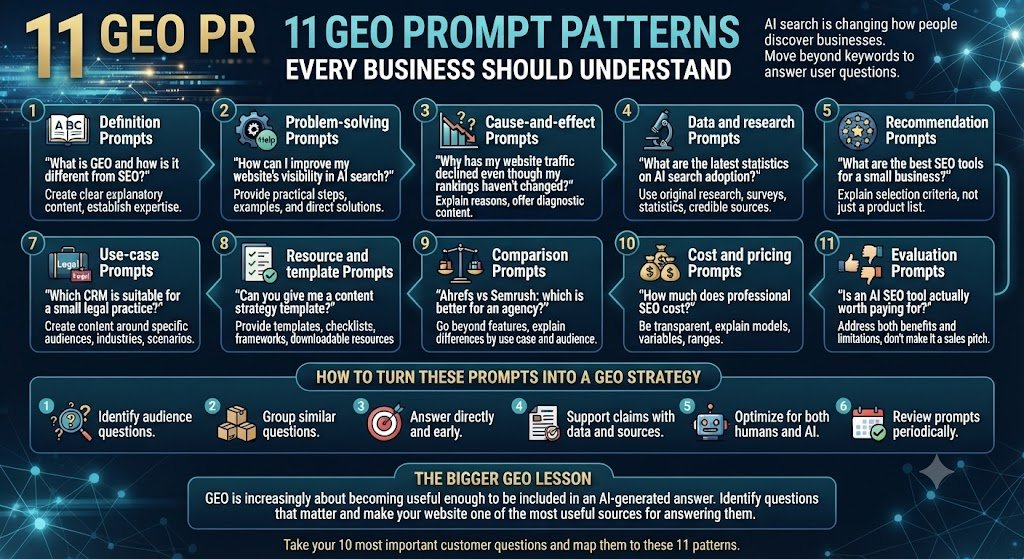
Miss one of the these, and an AI assistant may recommend your competitor instead of you.
AI search is changing how people discover businesses.
In traditional SEO, we often think in terms of keywords:
“SEO agency”
“CRM software”
“content marketing”
But AI users increasingly express their intent through questions and conversations.
They ask what something means, how to solve a problem, which options to consider, how products compare, what something costs, and whether a solution is worth buying.
For GEO, your content should be prepared for these different search intents.
Here are 11 prompt patterns worth covering.
1. Definition prompts
“What is GEO and how is it different from SEO?”
Create clear explanatory content that establishes your expertise around a subject.
2. Problem-solving prompts
“How can I improve my website’s visibility in AI search?”
Answer the problem directly and provide practical steps, examples, and solutions.
3. Cause-and-effect prompts
“Why has my website traffic declined even though my rankings haven’t changed?”
These prompts require explanation rather than just definitions. Diagnostic content can be particularly valuable here.
4. Data and research prompts
“What are the latest statistics on AI search adoption?”
Original research, surveys, statistics, benchmarks, and credible sources can make your content more useful as a reference.
5. Recommendation prompts
“What are the best SEO tools for a small business?”
This is where your content needs to explain selection criteria, not simply list products.
6. Alternative prompts
“What are some alternatives to Semrush?”
Create content that explains different options, their strengths, limitations, pricing, and appropriate use cases.
7. Use-case prompts
“Which CRM is suitable for a small legal practice?”
The more specific the user’s situation, the more important contextual information becomes.
Create content around audiences, industries, problems, and scenarios you actually serve.
8. Resource and template prompts
“Can you give me a content strategy template?”
Templates, checklists, frameworks, calculators, examples, and downloadable resources can give AI systems useful material to reference.
9. Comparison prompts
“Ahrefs vs Semrush: which is better for an agency?”
Comparison content should go beyond feature lists. Explain differences by use case, audience, workflow, cost, and limitations.
10. Cost and pricing prompts
“How much does professional SEO cost?”
Be transparent where possible. Explain pricing models, variables, ranges, deliverables, and what affects the final cost.
11. Evaluation prompts
“Is an AI SEO tool actually worth paying for?”
These are decision-stage questions. Address both the benefits and limitations instead of turning the page into a sales pitch.
How to Turn These Prompts Into a GEO Strategy
You don’t necessarily need 11 completely separate articles.
Instead:
1. Identify the questions your audience actually asks.
2. Group similar questions around one strong topic.
3. Create content that answers the question directly and early.
4. Support your claims with original examples, evidence, data, experience, and credible sources.
5. Make important facts easy for both humans and AI systems to understand and retrieve.
6. Review your important prompts periodically across multiple AI search platforms.
And don’t measure GEO visibility only by:
“Did AI mention my brand?”
Also look at:
- Was your website cited?
- Was the information accurate?
- How did the AI describe your business?
- Which competitors appeared?
- What sources were cited instead of yours?
- Were you mentioned for the right use case?
The bigger GEO lesson
SEO helps you become discoverable. GEO is increasingly about becoming useful enough to be included in an AI-generated answer.
The opportunity isn’t simply to create more content.
It’s to identify the questions that matter to your audience and make your website one of the most useful sources for answering them.
Take your 10 most important customer questions today. How many of these 11 prompt patterns can you find in them?