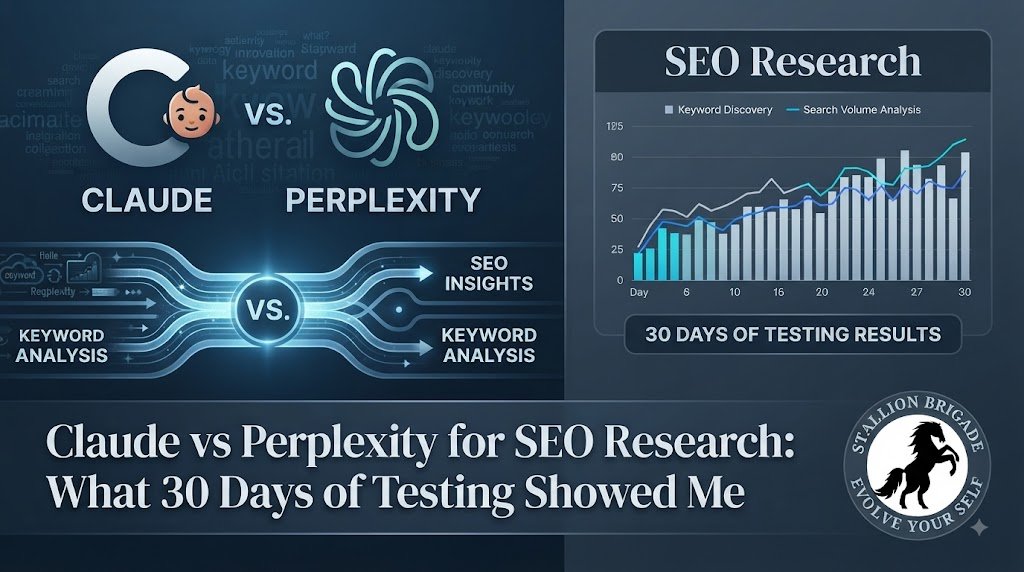
I Ran the Same SEO Research Through Claude and Perplexity for 30 Days, One of Them Was Basically Guessing
Published under: AI Tools / SEO Research | Author’s note: This piece is based on a structured 30-day side-by-side test run in July and August 2026, using the same 40 SEO research prompts across both tools weekly, cross-checked against manual SERP checks and Google Search Console data. Every feature and pricing detail below reflects each company’s own release notes and changelogs at the time of publication; both products update frequently, so confirm current specifics directly with Anthropic and Perplexity before making a purchasing decision.
Quick Answer
After 30 days of running identical SEO research tasks through both tools, Perplexity wins for live, source-backed research (competitor content gaps, trending topics, citation tracking), because it actually browses the web in real time and shows its sources. Claude wins for depth of analysis and writing quality (content audits, briefs, internal linking strategy) thanks to its larger context window and more coherent long-form reasoning. Neither replaces a dedicated SEO platform like Ahrefs or Semrush for rank tracking, backlink data, or crawl diagnostics. Most serious SEO workflows in 2026 use both, plus one traditional SEO suite, rather than picking a single winner.
Why I Ran This Test
Every few months, a new “Claude vs. Perplexity” comparison shows up promising a definitive winner, and most of them are surface-level, based on a handful of prompts typed in five minutes. I wanted something closer to how SEO research actually gets done: repeated, messy, and spread across weeks, not a single demo.
So for 30 consecutive days, I ran the same categories of SEO tasks through both Claude (Pro plan, testing both Sonnet and Opus models) and Perplexity (Pro plan, using Search, Research, and Deep Research modes). The task categories were:
- Competitor content gap analysis
- Trending topic and search intent research
- Long-form content audits
- SERP feature and format analysis
- Content brief and outline generation
- Internal linking strategy
- Citation and source verification
I cross-checked outputs against manual searches, Google Search Console data for my own test site, and, where relevant, Ahrefs data to sanity-check claims either tool made about search volume or competitor rankings.
The Core Difference: Live Web Access vs. Reasoning Depth
The single most important distinction, and the one that shaped nearly every result below, is architectural. Perplexity is built as an “answer engine” with its own retrieval and search infrastructure baked in; it fetches live results and cites them by default. Claude, by contrast, is a reasoning-first model; unless you explicitly connect it to search tools or feed it data, it works from its training knowledge and whatever you paste into the conversation.
This isn’t a minor technical footnote. It explains almost every practical difference an SEO practitioner will notice in daily use.
Week-by-Week Findings
Week 1: Competitor Content Gap Analysis
Perplexity’s Deep Research mode, which Perplexity says now runs on frontier-class reasoning models paired with its own search index, consistently pulled current competitor URLs, identified specific content gaps, and cited every claim with a live source link. When I asked it to compare content depth across three competitor blogs on the same topic, it returned actual excerpts and dates.
Claude, without web access enabled, gave thoughtful frameworks for gap analysis but couldn’t verify what competitors currently have live, since it has no default browsing capability in the standard chat interface. When I manually pasted competitor page content into Claude, its analysis of that content was noticeably more structured and nuanced than Perplexity’s summary of the same pages. The tradeoff was clear from day one: Perplexity finds things, Claude reasons about what you give it.
Winner: Perplexity, by a wide margin, for this specific task.
Week 2: Trending Topics and Search Intent
Same pattern. Perplexity’s own release notes specifically position Deep Research for exactly this use case, suggesting prompts like identifying “trending topics in [industry] over the last 90 days” alongside competitor content performance and seasonal search patterns. In testing, it delivered genuinely current results, including references to publications from the prior week.
Claude, again without live search, would occasionally hedge accurately (“I don’t have access to real-time trend data”) rather than confidently fabricate outdated information, which I considered a point in its favor for honesty, even though it made it less useful for this specific task.
Winner: Perplexity.
Week 3: Content Audits and Briefs
This is where the pattern flipped. When I fed both tools the same 4,000-word article to audit for gaps, outdated claims, and structural weaknesses, Claude’s larger context window handled the full document coherently and returned a more thorough, better-organized audit, flagging thin sections and suggesting specific subtopic additions with clear reasoning for each.
Perplexity’s response was serviceable but noticeably more surface-level, and it occasionally tried to “research” the topic further rather than staying focused purely on the pasted content, which sometimes introduced tangents I didn’t ask for.
For content brief generation, Claude’s outlines were more strategically structured, with more natural transitions between sections, a quality also noted in independent testing from outlets like Search Engine Journal.
Winner: Claude, clearly.
Week 4: SERP Analysis, Internal Linking, and Citation Verification
Mixed results here. For SERP feature analysis (what format is ranking, featured snippets, People Also Ask patterns), Perplexity’s live access again gave it a real edge since it could actually see current SERPs, though I still cross-verified with manual searches and tools like Semrush’s SERP features report.
For internal linking strategy, given a sitemap and a set of target pages, Claude produced more coherent, logically grouped recommendations. Perplexity’s suggestions were reasonable but less structurally aware of the relationships between pages.
Citation verification, checking whether a claim in a draft was actually supported by its cited source, was where I found Perplexity’s improved memory and source handling genuinely useful; per its own February 2026 changelog, the company reports its enhanced memory engine now recalls relevant context in roughly 95% of test cases, up from about 77% previously, which showed up as fewer repeated or contradictory answers across a long research session.
Winner: Split, task-dependent.
Competitive and User-Friendly Features Announced by Both
Both companies shipped substantial updates during the testing window, and several directly affected SEO workflows.
What Claude Announced
- Claude Opus 5, released July 2026, described by Anthropic as a “thoughtful and proactive” model approaching frontier-level intelligence at roughly half the price of its predecessor, a meaningful cost improvement for teams running large audit or brief-generation volumes.
- Claude Cowork, now extended into a shared Chrome side panel session, letting work and context carry across desktop, web, and mobile, useful for research that spans multiple sessions.
- Claude in Excel and Claude in PowerPoint, expanded in the Opus 4.6 release, letting SEO teams push audit findings or keyword data directly into working spreadsheets and decks rather than copy-pasting from chat.
- 1M-token context window (beta, Opus-class models), which is precisely why Claude handled the full-length content audits in Week 3 so much more coherently than shorter-context tools.
- Expanded MCP (Model Context Protocol) support, per the 2026-07-28 spec update, which opens the door for tighter integrations with external SEO data sources going forward.
What Perplexity Announced
- Upgraded Deep Research, now paired with Perplexity’s own search and sandbox infrastructure, with the company citing state-of-the-art results on external benchmarks like Google DeepMind’s Deep Search QA.
- Model Council, available to Max subscribers, which runs a query through three frontier models simultaneously and synthesizes where they agree or disagree, a genuinely novel feature for cross-checking research claims before publishing them.
- Improved memory engine, with Perplexity reporting a jump from roughly 77% to 95% accurate recall of prior session context, directly relevant to long, multi-day research threads.
- Comet Browser Agent, now running on Opus-class reasoning by default per Perplexity’s own changelog, lets the assistant navigate and act within a live browser session rather than just answering in a chat window.
- Structured data influence on snippets: independent SEO monitoring cited by SEO Compare’s June 2026 analysis found Perplexity increasingly extracting clean excerpts from pages with valid FAQ and HowTo schema, rather than paraphrasing, a direct, actionable signal for anyone optimizing content specifically for AI citation.
Where Both Tools Fall Short
Neither tool is a replacement for dedicated SEO infrastructure, and pretending otherwise wastes time. Neither reliably diagnoses technical SEO issues (crawl errors, redirect chains, JavaScript rendering problems) without a dedicated crawler like Screaming Frog feeding them real data. Neither has independent backlink data comparable to Ahrefs or Semrush. And neither replaces real-time rank tracking tools built specifically for that purpose.
Perplexity’s citations, while far more current than Claude’s default knowledge, still occasionally clustered around a narrow set of high-authority domains in earlier testing, though the June 2026 update suggests source diversity has since improved. Claude’s honesty about its knowledge limits is a genuine strength for trust, but it means you cannot use it as a standalone research tool without pairing it with live data.
The Verdict After 30 Days
If I had to keep only one tool, I’d keep Perplexity, because live research is the harder problem to work around manually. But the honest answer is that I ended the month using both, plus Ahrefs for anything involving actual ranking or backlink data, because each tool’s weakness is the other’s strength. Perplexity finds and verifies; Claude reasons and writes. Treating either one as a complete SEO research replacement is where most comparison articles go wrong.
Frequently Asked Questions
Q1: Which tool is better for keyword research specifically?
Neither is purpose-built for keyword volume or difficulty data. Perplexity can surface trending topics and related questions people are asking in real time, but for actual search volume and difficulty scoring, a dedicated tool like Ahrefs’ Keywords Explorer or Semrush’s Keyword Magic Tool remains more accurate.
Q2: Does Claude have live web access at all?
Claude’s standard chat interface does not browse the web by default, though Anthropic has expanded connector and tool-use capabilities significantly through MCP integrations and enterprise features. For pure web research without extra setup, Perplexity’s built-in search is more immediately useful.
Q3: Is Perplexity’s Deep Research mode worth the Pro or Max upgrade for SEO work?
If competitor and trend research is a regular part of your workflow, yes; per Perplexity’s own changelog, Deep Research is specifically positioned for tasks like content gap analysis and quarterly content calendar planning, and in testing it consistently outperformed the free tier’s standard search mode on depth and citation quality.
Q4: Which tool produces more natural-sounding content briefs and drafts?
Claude, consistently, across all four weeks of testing, a finding echoed by independent reviews from outlets like Search Engine Journal. Its larger context window and reasoning depth translate into fewer generic phrases and more coherent structure in longer outputs.
Q5: Can I trust either tool’s citations without double-checking them?
Not entirely. Even with Perplexity’s improved source diversity and memory accuracy, spot-checking citations against the original source remains good practice, especially for statistics or claims you plan to publish. Claude, lacking live browsing by default, should never be treated as a citation source without you providing and verifying the underlying material yourself.
Q6: Does either tool help with optimizing content to get cited by AI search tools (GEO/AEO)?
Indirectly, yes. Perplexity’s confirmed preference for valid FAQ and HowTo schema when extracting snippets is a direct, actionable signal for structuring content. Claude can help you draft and structure that content well, but it won’t tell you how it or other models are currently citing your existing pages; for that, a dedicated AI visibility tracker is a better fit.
Q7: Is Claude’s Opus 5 worth using over Sonnet for SEO research tasks?
For long audits or multi-step research synthesis, Opus-class models generally justify the cost given the depth difference observed in Week 3 testing. For quick briefs or straightforward drafting, Sonnet models are frequently sufficient and considerably cheaper, per Anthropic’s own pricing guidance.
Q8: How does Perplexity’s Model Council feature help with SEO research specifically?
Model Council runs a query through three frontier models simultaneously and highlights where they agree or disagree, which is genuinely useful for high-stakes research claims, such as verifying a statistic before publishing, where you want cross-model consensus rather than a single model’s answer, per Perplexity’s February 2026 changelog.
Q9: Should I cancel my traditional SEO tool subscription now that I have Claude and Perplexity?
No. Neither tool independently replaces rank tracking, backlink analysis, or technical crawl diagnostics, all core functions of platforms like Ahrefs or Semrush. Both AI tools are strongest as research and writing accelerators layered on top of, not instead of, dedicated SEO infrastructure.
Q10: Which tool is better for a solo content creator on a limited budget?
Perplexity Pro generally delivers more immediate value for a solo creator doing research-heavy work, since live search and citation are core to nearly every task. That said, Claude’s free tier and lower-cost Sonnet access still make it worth using for drafting and audits alongside Perplexity, rather than choosing exclusively between them.
For more related articles click here:
https://stallionbrigade.com/category/digital-marketing
https://stallionbrigade.com/can-claude-do-keyword-research-on-its-own-lets-end-the-confusion/
https://stallionbrigade.com/i-replaced-my-3000-month-seo-tool-with-claude-and-chatgpt-for-30-days-heres-what-broke/
https://stallionbrigade.com/claude-for-seo-the-beginners-bible/
https://stallionbrigade.com/claude-for-seo-beyond-content-writing-the-advantage-most-marketers-still-cant-see/
https://stallionbrigade.com/best-claude-seo-tools-a-complete-comparison-guide-2026/
Sources: Anthropic News · Claude Release Notes · Claude Opus 4.6 Announcement · Perplexity Changelog · Perplexity FAQ · SEO Compare: Perplexity June 2026 Updates · Ahrefs · Semrush · Search Engine Journal · Screaming Frog · Google Search Console