93% of Marketers Say Blogging Still Works. Here’s Why Yours Probably Isn’t.
Published under: Content Marketing / SEO Strategy |
Author’s note: This piece draws on primary survey data from HubSpot’s 2025 State of Blogging Report, HubSpot’s lead generation benchmarking study of 13,500+ companies, and Orbit Media’s annual blogging survey, cross-checked against current 2026 marketing data. Figures and platform features are cited directly where possible; confirm current numbers on the original source before using them in a board deck or client report.
Quick Answer
Blogging still works in 2026, but only when it’s run as a managed acquisition channel, not a publishing habit. HubSpot’s own data shows 93% of marketers at blog-maintaining companies call it important or very important, and 50% saw better ROI in 2024 than the year before, real numbers, not nostalgia.
The catch is competitive density: with roughly 600 million blogs and millions of posts published daily, generic content gets buried.
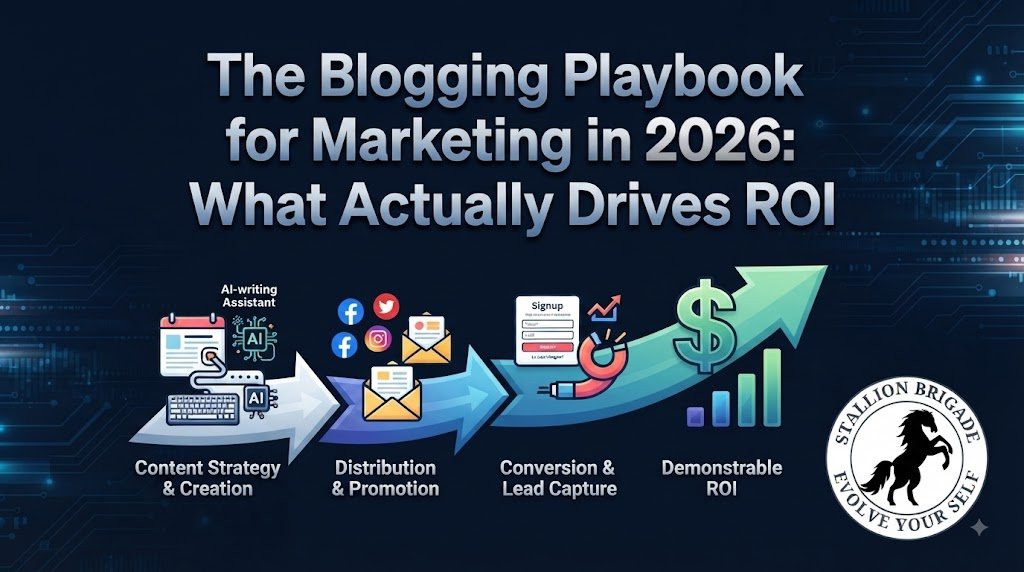
Winning programs pick topics around real audience “jobs” (not just keyword volume), build a repeatable editorial workflow, optimize for both traditional search and AI answer engines, distribute through owned channels rather than relying on social reach, and measure pipeline impact instead of pageviews.
A 90-day plan, built in three phases, is enough to prove the channel deserves ongoing budget.
Why Blogging Still Matters for Marketing in 2026
The headline finding from HubSpot’s 2025 survey isn’t that blogging survived, it’s that it’s being actively managed as a budget line. Sixty-five percent of marketers work at companies that maintain blogs, 93% of those marketers rate it important or very important, and 50% reported higher ROI in 2024 than the prior year.
Nearly three-quarters of respondents put more than 10% of their marketing spend into blogging, and 45% planned to invest even more in 2025. That’s not a channel coasting on habit, that’s a channel being funded because it produces results.
The catch is that the bar for standing out has risen sharply. Estimates put the global blog count around 600 million, with several million posts published daily. Visibility now comes from sharper topic selection, stronger internal linking, and content built to hold attention past the first scroll, not from sheer output.
What the Numbers Mean Operationally
The strongest teams have stopped asking whether to blog and started asking what the blog needs to do inside the broader acquisition mix. For B2B, that typically means capturing search demand around problems, comparisons, and use cases. For ecommerce, it often means category education and post-purchase retention content.
A useful operating rule: if a post can’t point to a next step, it’s being managed as a traffic asset, not a marketing asset. HubSpot’s data backs this framing directly, brand awareness (66%), customer engagement (53%), and lead generation (49%) are the top three reasons companies blog at all, meaning most teams already expect the blog to do more than just attract eyeballs.
The Competitive Bar Is Higher Than “Publish More”
Frequency still correlates with results, HubSpot’s benchmarking of over 13,500 companies found that businesses publishing 16+ posts per month saw roughly 3.5x more traffic and 4.5x more leads than those publishing four or fewer. But volume without structure just adds noise to an already saturated market. Programs that choose topics around genuine customer questions, build content into clusters, and revisit older posts before they decay consistently outperform high-output feeds that never convert.
Building a Strategy Around Search Intent and Audience Jobs
Most underperforming blogs fail before the first draft is written. A team picks a keyword, writes to it, and hopes traffic follows, but search behavior rarely rewards that approach anymore.
Start With the Job, Then the Keyword
A genuinely useful topic isn’t just a phrase with search volume attached, it’s a problem, comparison, or decision the reader is already in the middle of. Finding it means looking past volume into demand shifts, seasonality, and geographic concentration using tools like Google Trends or Ahrefs’ Keywords Explorer.
A practical research sequence:
- Map intent to funnel stage: informational, evaluative, or purchase-supportive.
- Group related entities and questions instead of chasing single phrases.
- Build a pillar-and-cluster structure so individual posts support a larger topic.
- Define the conversion path before drafting, even if the CTA is soft.
Test the SERP Before You Commit
Live search results tell you what the market already rewards. If page one is dominated by definitional explainers, a deep how-to may be the wrong format. If it’s already full of comparison pages and FAQs, a basic summary won’t clear the bar. Ask directly: can this post add evidence, first-hand nuance, or a clearer decision framework than what’s currently ranking? If not, the topic needs reframing, not just better writing.
Editorial Planning and the Content Ops Workflow
A blog becomes operational the moment the process stops living in one person’s head. The useful model is a repeatable pipeline: topic sourcing, brief creation, drafting, review, optimization, publish, and post-publish update.
Assign Ownership Before Production Starts
A finished brief should specify:
- The audience and search intent
- The target entity set, to keep the draft topically focused
- The conversion goal, even if it’s just a newsletter signup
- Required proof points, internal links, and brand voice notes
- An update trigger, so the post gets revisited once performance data comes in
Keep the Workflow Visible
The most common breakdown isn’t writing quality, it’s unclear status. A shared Kanban board, a standard brief template, and a review gate prevent half-finished drafts from slipping into publish. Tools built for this workflow range from general project trackers like Airtable and Trello to purpose-built content operations platforms; several newer AI-native tools.
Now combine planning, drafting, and review checks in one workspace, which can cut down time lost switching between docs, spreadsheets, and the CMS. Whichever tool you choose, the workflow, not the software, is what actually prevents bottlenecks.
Optimizing Posts for Google and AI Search Visibility
Blog optimization used to mean ranking in traditional search. Now it also means getting surfaced in AI-generated answers from tools like Google’s AI Overviews, ChatGPT, and Perplexity, which changes how a post needs to be structured.
Build for Machine Readability Without Writing Like a Machine
The fundamentals haven’t disappeared: metadata, headings, alt text, internal links, and structured data still matter for traditional rankings. What’s new is that entity-first writing, naming tools, concepts, and relationships explicitly rather than hiding behind vague phrasing, helps both search engines and answer engines parse what a post is actually about.
Run a GEO Audit to Catch What Traditional SEO Misses
A standard SEO audit checks crawlability, metadata, and page experience. A generative engine optimization (GEO) audit goes further, checking whether content is structurally ready to be cited in AI answers. That distinction matters because a brand can be mentioned loosely by an AI model without ever being used as an actual cited source, and only the latter drives traffic.
Structural additions worth prioritizing:
- Author markup, to establish a clear ownership and expertise signal
- FAQ schema, matching how people phrase real questions
- Outbound citations, so the post participates in the evidence chain rather than just asserting claims
- Internal links to related cluster content, reinforcing topical authority
- Direct-answer subheads, so both snippets and AI summaries can lift the right passage cleanly
Distribution Beyond Social Media That Actually Works
Social media isn’t the center of gravity for a blog program anymore. It can help, but it’s optional for teams that need predictable acquisition rather than reach that fluctuates with a feed algorithm. The more durable stack is search, email, and evergreen discovery surfaces that keep working after a post stops circulating socially.
Build the Repurpose Stack Around Owned Channels
A practical post-publish checklist:
- A newsletter version, trimmed to the core problem and payoff
- Internal links to related posts, so readers keep moving through the site
- A short excerpt for relevant communities or social channels, where genuinely worth the effort
- A gated upgrade (template, checklist, tool) when the topic supports one
- A refresh note for later, flagging what will likely need updating first
Push Harder Where the Demand Is Already Visible
Not every post deserves equal distribution effort. High-intent pages with clear SERP gaps or visible click decay in Google Search Console deserve more push than broad thought-leadership pieces. A practical rule: if a post can’t be reused in at least one owned channel, it likely wasn’t planned as a marketing asset in the first place.
Measuring What Blogging Actually Drives
Blogging graduates from habit to channel the moment a team stops measuring only pageviews. Traffic tells you a topic got attention; it doesn’t tell you whether the post moved a buyer toward revenue.
| Metric | What It Tells You | Where to Find It |
| Assisted pipeline | Whether the post contributes to revenue over time | CRM and attribution reporting |
| Demo/signup conversions per post | Whether content actually moves readers to act | Analytics and conversion events |
| Branded search lift | Whether the blog is making the brand more discoverable | Search Console, search trend tools |
| AI citation frequency | Whether generative engines cite the post as a source | AI visibility / prompt monitoring tools |
| Query growth and CTR | Which topics deserve updates or expansion | Search Console Performance data |
| Cannibalization signals | Whether multiple posts compete for the same intent | Sitewide content audits |
| Mobile vs. desktop gaps | Where rankings or CTR underperform by device | Search performance segmentation |
A monthly review should end with a concrete fix list, consolidating overlapping posts, patching weak-CTR pages, improving near-miss content, not just a slide of vanity metrics.
A 90-Day Execution Plan and Maturity Roadmap
The first 90 days should build proof, not perfection. HubSpot’s benchmarking across 13,500+ companies is worth keeping in view here: businesses publishing 16 or more posts per month get roughly 3.5x more traffic and 4.5x more leads than those publishing four or fewer.
Foundation (Days 1–30): Audit the existing blog, define pillar topics, build a brief template, and identify old posts worth updating rather than replacing.
Build (Days 31–60): Move into production cadence, publish the first wave, apply on-page and GEO fixes, and set up the distribution sequence. The goal here is repeatability, not raw volume.
Scale (Days 61–90): Tighten the measurement loop, patch underperforming posts, and use AI citation data and Search Console trends to select the next wave of topics.
What Maturity Looks Like
- Launch stage: topics, drafts, and a publish rhythm exist, but measurement is thin.
- Operational stage: briefs, review, and optimization run predictably; old posts get regular maintenance.
- Compounding stage: updates, internal linking, AI visibility, and conversion tracking all feed one decision loop.
If the blog is treated as a conversion asset, every month should produce clearer topics, cleaner pages, and stronger proof the channel deserves its budget. If it isn’t producing that, the problem is almost always process, not effort.
Frequently Asked Questions
Q1: Is blogging still worth the investment in 2026, or has it been overtaken by AI search and social video?
Yes, per HubSpot’s own 2025 data, 93% of marketers at blog-maintaining companies still call it important or very important, and half saw better ROI in 2024 than the prior year. Blog content and SEO also remain a top ROI-generating channel in HubSpot’s broader 2026 marketing statistics. It hasn’t been replaced; it’s competing in a more crowded, higher-standard field.
Q2: How many blog posts should a business realistically publish per month?
HubSpot’s benchmarking of 13,500+ companies found that publishing 16+ posts monthly correlates with about 3.5x more traffic and 4.5x more leads compared to publishing four or fewer. That said, smaller teams often see stronger relative gains from consistent publishing at lower volumes (8–11 posts/month) if quality and updates are prioritized over sheer count.
Q3: What’s the difference between a traditional SEO audit and a GEO audit?
A traditional SEO audit checks crawlability, metadata, schema, and page experience for search engine ranking. A GEO (generative engine optimization) audit additionally evaluates whether content is structurally ready to be cited by AI answer engines like AI Overviews or ChatGPT, checking things like author markup, FAQ schema, and outbound citation quality.
Q4: Does AI-assisted writing hurt or help blog performance?
It depends heavily on how it’s used. HubSpot’s 2025 data shows 96% of bloggers now use AI tools in some capacity, and 67% saw content production increase as a result, but fully AI-written articles without human editing or original insight tend to underperform, particularly on E-E-A-T signals like first-hand experience.
Q5: What is E-E-A-T and why does it matter more for blogs now?
E-E-A-T stands for Experience, Expertise, Authoritativeness, and Trustworthiness, criteria detailed in Google’s Search Quality Rater Guidelines. It matters more now because AI-generated content has made generic, unattributed posts far more common, so Google and AI answer engines increasingly favor content with real author credentials, original data, and citable sources.
Q6: Should social media still be a core part of blog distribution?
It’s helpful but no longer central. HubSpot’s data shows social remains the most commonly used distribution channel (83%), but durable, compounding distribution increasingly comes from search, email, and evergreen platforms rather than feed-dependent reach that can vanish with an algorithm change.
Q7: How do you measure blogging ROI beyond just traffic?
Track assisted pipeline contribution, demo or signup conversions per post, branded search lift, and AI citation frequency alongside standard traffic metrics. Pageviews indicate attention; conversion and pipeline data indicate whether that attention is translating into revenue.
Q8: What’s a realistic timeline to see results from a new blogging program?
A 90-day window, broken into foundation, build, and scale phases, is enough to establish a repeatable process and early proof points, though meaningful compounding SEO results (rankings, organic lead flow) often take 6–12 months to fully mature, consistent with typical organic search timelines reported across SEO industry benchmarks.
Q9: How important is updating old blog posts compared to publishing new ones?
Very important, and often underrated. Content decay is well documented: older posts lose ranking as competitors publish fresher material and information ages. Refreshing a post that already has some backlinks and ranking history frequently produces faster results than starting a new post from zero authority.
Q10: What’s the biggest mistake teams make when trying to scale a blog program?
Treating volume as the strategy instead of the outcome. Publishing more without sharper topic selection, a clear conversion path, and a maintenance cycle just adds noise to an already saturated market of roughly 600 million blogs. The programs that scale successfully build structure first, then increase output within that structure.
For more related articles click here:
https://stallionbrigade.com/category/digital-marketing
https://stallionbrigade.com/can-claude-do-keyword-research-on-its-own-lets-end-the-confusion/
https://stallionbrigade.com/i-replaced-my-3000-month-seo-tool-with-claude-and-chatgpt-for-30-days-heres-what-broke/
https://stallionbrigade.com/claude-for-seo-the-beginners-bible/
https://stallionbrigade.com/claude-for-seo-beyond-content-writing-the-advantage-most-marketers-still-cant-see/
https://stallionbrigade.com/best-claude-seo-tools-a-complete-comparison-guide-2026/
Sources: HubSpot’s 2025 State of Blogging Report · Blogging Statistics Overview · HubSpot Lead Generation Lessons From 4,000+ Businesses · HubSpot 2026 Marketing Statistics · Orbit Media Blogging Statistics · Google Search Quality Rater Guidelines · Google Structured Data Guidelines · Google Search Console · Ahrefs